

Audio By Carbonatix
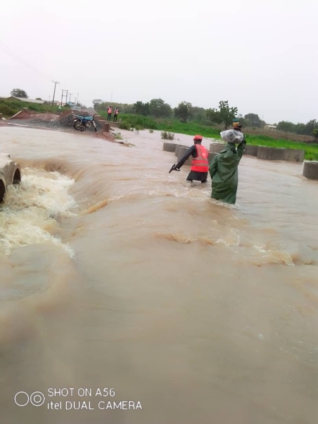
The Centre for Climate Change and Food Security (CCCFS) has sounded the alarm following the early spillage of the Bagre Dam in Burkina Faso, describing the situation as a “grave concern” and calling for urgent reforms to prevent another round of devastating floods in the Northern regions.
In a statement issued by CCCFS on August 26, the Burkinabè utility company SONABEL began releasing water from the Bagre Dam on 25 August 2025 two days ahead of schedule as the reservoir approached critical levels.
The dam currently stands at 234.27 metres, or 90.24% of its capacity, just 0.73 metres shy of its maximum retention limit. The nearby Kompienga Dam is also nearing its threshold, raising fears of compounded flooding in the coming days.
Ghana’s Water Resources Commission and the National Disaster Management Organisation (NADMO) have since advised communities along the White and Black Volta rivers to evacuate immediately to higher ground, as downstream flooding now appears imminent.
A Country Still Reeling
The CCCFS warns that the early release of Bagre comes at a time when Ghana has yet to fully recover from the catastrophic controlled spills from the Akosombo and Kpong dams in 2023.
That disaster displaced over 35,000 people across the Volta Region, crippling infrastructure and leaving many communities, such as Mepe, Battor, and Sogakope, submerged and dependent on relief aid.
Two years on, many survivors remain in temporary shelters and have yet to rebuild their lives.
“To face another flood before the wounds of Akosombo and Kpong have healed is unconscionable,” said a spokesperson for CCCFS. “Ghana is being forced into an annual cycle of destruction that is neither sustainable nor acceptable.”
A Recurring Nightmare
Spillage from the Bagre Dam has become a near-annual catastrophe for northern Ghana. The consequences are far-reaching: homes destroyed, roads washed away, farmlands submerged, and thousands displaced.
Outbreaks of communicable diseases such as cholera, malaria, bilharzia, and even polio have historically followed the floods, with limited healthcare access compounding the crisis. In 2019, a polio outbreak was traced to flood-hit areas.
According to the statement, in the past years, the statistics have been sobering. The 2007 spillage affected over 307,000 people and destroyed more than 12,000 hectares of farmland, prompting a national emergency and costing the government upwards of US$25 million.
In 2018, 17 lives were lost, and nearly 76,000 farms were wiped out. The CCCFS contends that these disasters are not isolated but symptomatic of systemic failures in dam management, risk governance, and regional cooperation.
Food Security on the Brink
One of the most enduring impacts is on food security. The CCCFS notes that floods routinely destroy crops just before harvest, obliterating household incomes and exacerbating malnutrition.
In 2007 alone, the Upper East Region lost an estimated 144,000 metric tonnes of food crops. In 2018, Ghana lost over 127 metric tonnes of maize, while Burkina Faso lost a comparable quantity of rice.
Flood-hit households have reported income losses averaging GH¢4,000, with some losing more than GH¢40,000. For subsistence farmers already living on the margins, such losses are devastating.
Governance Failures and the Call for Reform
At the heart of CCCFS’s statement is a sharp critique of what it describes as a failure of governance and regional cooperation. The Bagre Dam, built in 1993, was constructed without Ghana’s input, despite its downstream location on a shared river.
Although SONABEL provides advance notice of spills, the CCCFS claims that warnings often come too late and are not accompanied by meaningful support for evacuation or preparation.
Surveys reveal that more than 90% of residents along the Volta Basin both in Ghana and Burkina Faso have never heard of the Volta Basin Authority (VBA), the regional body meant to coordinate water governance.
The Water Charter it established remains unratified, and institutions like NADMO are perceived as reactive rather than proactive, distributing relief instead of building resilience.
“Too many households remain in the path of danger not by choice, but because they lack alternatives,” said CCCFS. “They are bound by poverty, ancestral ties, religious beliefs, and institutional mistrust. Warnings alone are not enough.”
Concrete Recommendations
The CCCFS is calling for the urgent creation of a binding Bagre-Kompienga Release Protocol, under the aegis of the VBA. This protocol must include real-time data sharing, predefined spill thresholds, and a joint operations centre active during the spillage season (August–October).
Ghana, the organisation says, must also adopt forecast-based financing releasing resources when climate forecasts predict danger thresholds to enable timely evacuation and safeguard food stocks and livestock.
The CCCFS also recommends a shift in flood communication strategy: using trusted local channels such as radio, chiefs, mosques, churches, and social media, with clear instructions tailored to affected communities.
In the long term, structural solutions such as “Room for the River” flood buffers, retention basins like the delayed Pwalugu project, and strict zoning enforcement are needed.
Social interventions including trauma counselling, farm input support, and agricultural insurance schemes must be part of a holistic recovery package.
A Tipping Point
The CCCFS concludes that the latest Bagre spillage must be a turning point. “This is not just a hydrological issue it is a governance crisis,” the statement reads. “Each year of delay leaves the country poorer, hungrier, and less safe.”
The Centre urged both government of Ghana and Burkina Faso, the Volta Basin Authority, NADMO, and all relevant agencies to act with urgency not just to warn, but to prepare; not just to respond, but to prevent.
Latest Stories
-
‘Influence should go beyond visibility’ – Taadi Banyinba GH launches The TB Impact
4 minutes -
Videos: Government announces emergency LEAP package for Hohoe flood victims
9 minutes -
Salomey Baffoe’s children are crying for their mother – Family appeals for her release
11 minutes -
Shortage of trained investigators and prosecutors hampers Ghana’s fight against money laundering – Report
11 minutes -
GoldBod generates US$1.87bn in September FX operations, exceeding monthly target
11 minutes -
Roads Minister says it is time to change one-year defect liability period for contractors, consultants
12 minutes -
Nana Asamoah takes Highlife across five West African languages
19 minutes -
UNICEF Ghana launches first Children’s Film Festival to amplify children’s voices
23 minutes -
Ghana must close gaps that allow drug trafficking – Dr Pelpuo
31 minutes -
Emmanuel Osei: President Mahama, dissolve GFA and save our soul
45 minutes -
Uganda Airlines to launch direct Accra-Entebbe flights from October 27
46 minutes -
Ghana records surge in 2025 tourism receipts as Ahafo Region honors top industry players
48 minutes -
I don’t have an official car, I use my own – Pelpuo
59 minutes -
Maiden Black Star Fashion Week to highlight Ghana’s national fashion platform
59 minutes -
GPRTU has entrusted vehicle inspection responsibility to station masters – GPRTU member
60 minutes