

Audio By Carbonatix
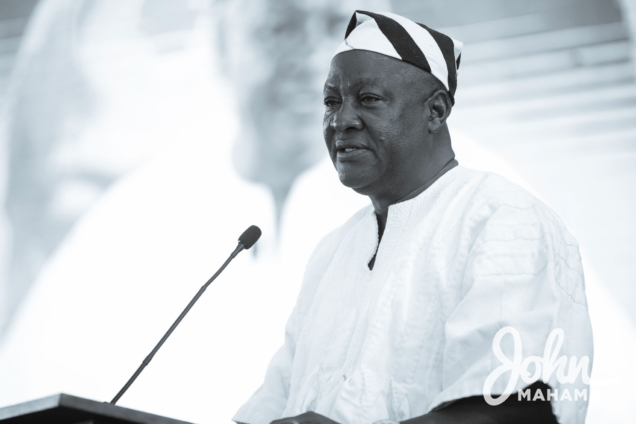
Former President John Mahama has reiterated his promise to restore the licences of some financial institutions that collapsed as part of a banking sector clean-up by the New Patriotic Party (NPP) administration.
According to Mr Mahama, this move will revive the banking industry and boost financial confidence.
Speaking at the 7th Ghana CEOs Summit and Expo held at the Kempinski Hotel in Accra, the newly elected flagbearer of the opposition NDC said, the gesture will also offer opportunities for experienced banking professionals who were laid off during the reforms to “move from the menial jobs that they were forced into with the closure of the indigenous banks.”
He argued that the Akufo-Addo-Bawumia government spent more money after closing down financial institutions that could have been allowed to operate with less financial support.
“I cannot to this day understand why a GH¢4 billion problem was made to cost the taxpayers GHS25 billion. These banks were asked to capitalize to GHS400 million, and if there were even 10 of them, that would be GHS4 billion and yet with the closure of banks, we incurred a public debt of GHS25 billion guaranteeing depositors' accounts.”
In view of this, the former President said he was convinced that the decision by the NPP government to shut down these financial institutions was mainly political.
“Indeed, for some of these banks, there was no problem. It was purely politics or personal vendetta. One bank was shutdown solely because its principal shareholder was being investigated for corruption in a case involving a state enterprise.”
Mr. Mahama further added that for businesses in the country to thrive, government must be apolitical in how it deals with the private sector.
“We must create an environment where businesses are allowed to grow no matter their political, ethnic or other colorization," he said
About the banking sector cleanup
The government in 2017 undertook the banking sector clean-up under the supervision of the Finance Minister, Ken Ofori-Atta.
The exercise saw a reduction in the number of banks from 34 to 23, whilst 347 microfinance institutions, 15 savings and loans and eight finance houses had their licences revoked.
A number of the institutions that had the licences revoked were found to have varying degrees of corporate governance lapses.
The total estimated cost of the state’s fiscal intervention, excluding interest payments, from 2017 to 2019 was pegged at GH¢16.4 billion.
The government in 2020 claimed that it spent about GH¢21 billion on the banking sector clean-up exercise.
Some of the financial institutions that disagreed with the revocation sued the government and the cases are still pending in court.
Latest Stories
-
Court hands Adjetey Sowah, two others lifetime bans after Amputee Football legal dispute
4 minutes -
NDC appoints Julius Kwame Anthony as a Deputy Communications Director
4 minutes -
Ghana repatriates 120 Nigerians rescued from suspected cybercrime centres
9 minutes -
NPP rejects Emelia Agbenyo’s appointment as Deputy EC Chair, demands withdrawal
13 minutes -
EOCO grants Suame MP John Darko enquiry bail in GH¢27m SIC investigation
17 minutes -
NPP cannot question EC appointment after appointing own people to Commission – Kwakye Ofosu
22 minutes -
BoG deepens public trust with regional stakeholder forum in Techiman
32 minutes -
‘We have turned the tide’ – Ato Forson says Ghana is ready to take off
37 minutes -
Police arrest man captured in viral video assaulting wife in Agona Nkwanta
39 minutes -
KATH Mother and Baby Unit construction stalled for 14 months over unpaid contractor arrears
53 minutes -
Government wanted to ‘tilt the balance’ with new EC appointments – Kwakye Ofosu
59 minutes -
Angry Tema Community 25 residents threaten to sleep at GWL over water shortage
1 hour -
BoG takes financial literacy drive to Techiman, vows to protect depositors
1 hour -
‘Stop the distractions’ – Akosua Manu demands answers over GH¢49.7m South Africa evacuation cost
1 hour -
Formula 1 to return to Africa with Rwanda Grand Prix in early 2030s
1 hour