

Audio By Carbonatix
BBC News and three leading news agencies have expressed desperate concern for journalists in Gaza, who they say are increasingly unable to feed themselves and their families.
Those reporting the conflict from Gaza now face starvation and "the same dire circumstances as those they are covering," a joint statement from BBC News, Agence France-Presse (AFP), Associated Press (AP) and Reuters said.
"For many months, these independent journalists have been the world's eyes and ears on the ground in Gaza", it reads.
International news outlets rely on local reporters within Gaza, as Israel does not allow foreign media, including BBC News, to send journalists into the territory.
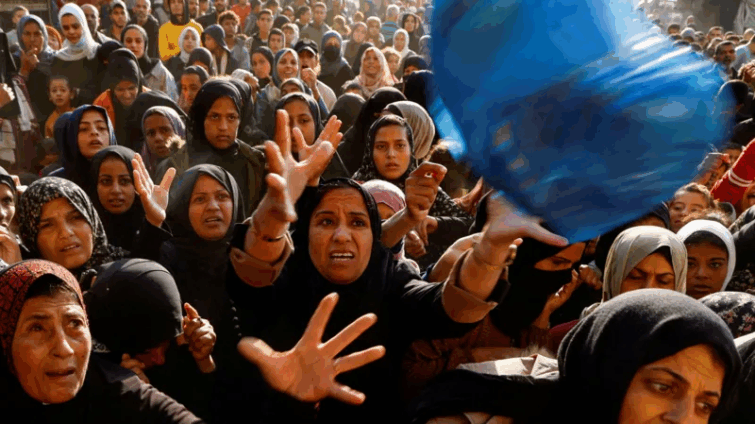
It comes as more than 100 international aid organisations and human rights groups have warned of mass starvation in Gaza.
The full statement reads: "We are desperately concerned for our journalists in Gaza, who are increasingly unable to feed themselves and their families.
"For many months, these independent journalists have been the world's eyes and ears on the ground in Gaza. They are now facing the same dire circumstances as those they are covering.
"Journalists endure many deprivations and hardships in warzones. We are deeply alarmed that the threat of starvation is now one of them.
"We once again urge the Israeli authorities to allow journalists in and out of Gaza. It is essential that adequate food supplies reach the people there."
In a separate joint statement, Médecins Sans Frontières (MSF), Save the Children and Oxfam, said their colleagues and the people they serve were "wasting away".
But Israel, which controls the entry of supplies into Gaza, has accused the charities of "serving the propaganda of Hamas".
Since Sunday, 45 Palestinians have died as a result of malnutrition, according to Gaza's Hamas-run health ministry.
Israel prevented aid deliveries to Gaza in early March following a two-month ceasefire.
The blockade was partially lifted after nearly two months, but food and medicine shortages have worsened.
Israel, along with the US, helped to establish a controversial new aid system run by the Gaza Humanitarian Foundation (GHF).
Hundreds of killings have been recorded in the vicinity of GHF's aid sites since they began operating eight weeks ago.
The World Health Organization has said that a quarter of Gaza's population is facing famine-like conditions, according to its assessments.
On Wednesday, its director Tedros Adhanom Ghebreyesus said: "I don't know what you would call it other than mass starvation, and it's man-made.
"And that's very clear, this is because of the blockade."
Latest Stories
-
Ghana Medical Trust Fund has exceeded expectations in first year – Health Minister
4 minutes -
One-Week Observation for Mrs Janet Gyasi Boakye
17 minutes -
Before the bulldozers arrive: What the state owes workers in the informal economy
17 minutes -
NIA extends Ghana Card registration for children in North East and Upper East
21 minutes -
Volta Team wins NPA 2026 Welfare Week Quiz championship
23 minutes -
Maxwell Klu turns birthday into relief mission for Hohoe flood victims
25 minutes -
NDC congratulates NPP, calls for national interest to rise above party politics
27 minutes -
NPP’s new executives will not alter our 2028 preparations – Tanko-Computer
1 hour -
Tema East MP urges men to take active role in breast cancer awareness
1 hour -
Hawa Koomson vows to bring experience and maturity to NPP women’s wing
1 hour -
Opare Addo cautions NDC against adopting NPP’s aggressive politics
2 hours -
NPP has 35 months to prepare for 2028 after early reorganisation – Political strategist
2 hours -
All six passengers presumed dead after plane went missing off US coast
2 hours -
Teachers’ promotion arrears to be paid by Oct. 30 – Education Minister
2 hours -
Stop talking too much on stage – Kafui Dey warns MCs
2 hours