

Audio By Carbonatix
Former Nigerian President Olusegun Obasanjo has urged African governments to build teachers’ capacity and competencies to address children’s learning challenges on the continent.
He said teachers were at the forefront of education delivery, hence their capacities and competences needed to be enhanced to enable them teach learners effectively.
“Due to my own background, I attach importance to, not only to education, to all essential aspects of learning and teaching. Because if you want to learn and you do not have a good teacher that can make you learn and inspire you to learn, it’s a problem.”
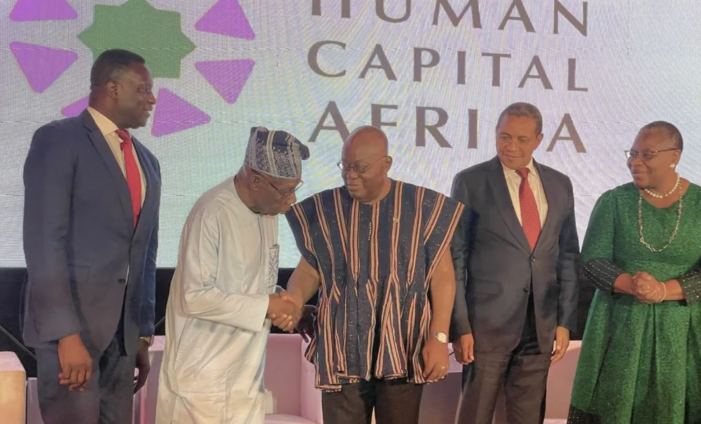
Mr Obasanjo was speaking at the Human Capital Africa’s Presidential Media Briefing in Accra.
The meeting was graced by President Nana Addo Dankwa Akufo-Addo, former Tanzania President Jakaya Mrisho Kikwete, Dr Yaw Osei Adutwum, Ghana's Minister of Education, among other educational sector leaders on the continent.
The meeting discussed the issue of foundational learning in Sub-Saharan Africa, where nine out of 10 children could not read by the age of 10.
Mr Obasanjo said often governments implement educational policies without considering the roles of teachers in those policies, which in turn inhibited their smooth running and overall intended effects on learners.
He also called for improved learning conditions for learners, especially in the area of nutrition, where learners were provided one mid-day meal to enable them stay attentive in class.
“When I was in secondary school, my school started what they called mid-day meal. And for some of us who came from poor homes, that one mid-day meal in the school was our main food. An empty stomach cannot learn much, if anything at all.”
“The idea of one meal in the school can also help a lot in learning. It helps the health of the children and also provides an incentive for them to come to school and to want to learn,” he added.
Dr Obiageli Katryn Ezekwesili, Founder and President of Human Capital Africa, said without investing in foundational learning, Africa could not meet its continental developmental goals.
She said investment in primary literacy and numeracy was needed to improve outcomes at all levels of education, saying, poor foundational learning outcomes translated into human capital deficit and weak labour markets.
“Foundational Learning Skills did not only predict a child’s future academic success but also support a country’s broader economic development goals.”
“The World Bank estimates that by 2030, the learning crisis in Africa will cost the continent over $300 billion annually, highlighting the immense economic implications of this issue.”
Dr Ezekwesili urged African leaders to make actionable commitments to address the deficiency in learning to safeguard the future of children on the continent.
Latest Stories
-
President Mahama ends Resetting Ghana tour of Ahafo Region
49 minutes -
African negotiators seek delivery of climate commitments at COP31
50 minutes -
BoG develops AI rules for financial sector
52 minutes -
‘Big Push’: Government assures contractors of prompt payments
56 minutes -
Court fines miner for breaking into gold buying shop
1 hour -
Tarkwa court jails labourer for three years over GH¢123,000 theft
2 hours -
GAEC must retain nuclear scientists for Ghana’s nuclear ambitions – Minister
3 hours -
Man reportedly mistaken for game and shot by hunter dead in forest
3 hours -
19-year-old mason jailed 15 years for defiling seven-year-old pupil
3 hours -
Ghana’s banking sector assets rise 20.47% to GH¢500.2bn – BoG Governor
3 hours -
22 injured as Sprinter bus overturns at Sege after tyre burst
3 hours -
UN housing expert urges Ghana to strengthen Rent Control Department amid housing affordability concerns
3 hours -
Delta-BCI partnership reaches 166,000 people with breast cancer education
3 hours -
Power restoration fault suspected in Kumasi Central Market fire
8 hours -
The 7-foot giant of Ngleshie Amanfro: Seven-foot Ghanaian Ephraim Saawa dreams of joining the national basketball team
9 hours