

Audio By Carbonatix
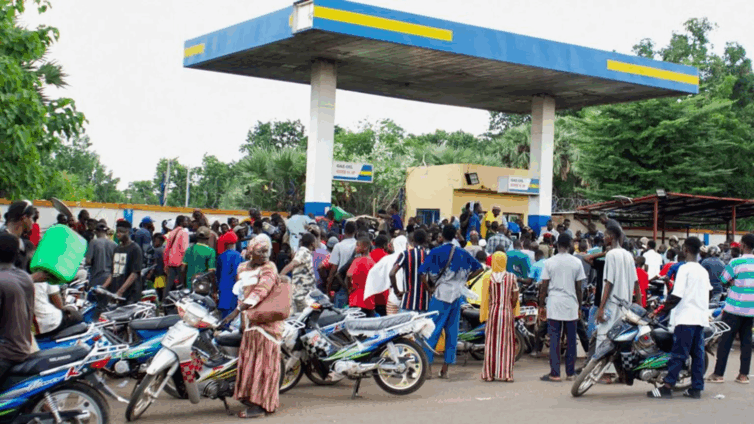
Long queues have been snaking around petrol stations in Mali's capital, a month after militants from an al-Qaeda affiliate imposed a fuel blockade by attacking tankers on major highways.
"Our business is at a standstill," one motorbike taxi driver told the BBC, as many others pushed their vehicles to join the petrol lines amidst chaotic scenes in Bamako.
Some of the garages forced to shut last week, paralysing the city, have now reopened after more than 300 petrol tankers arrived under army escort from the Ivory Coast on Tuesday.
The military government has assured residents it is only a temporary issue, but there are fears the new stock will quickly run out, as others complain about price hikes.
Other cities and areas have also been suffering from such shortages, power cuts and fuel inflation for several weeks.
"My business is dying," a vendor in the central town of Mopti told the AFP news agency about her problems keeping fish refrigerated.
Mali is landlocked, so all fuel supplies are brought into the country by road from neighbours such as Senegal and the Ivory Coast.
The junta had popular support when it seized power five years ago, promising to deal with the long-running security crisis prompted by a separatist rebellion in the north by ethnic Tuaregs, which was then hijacked by Islamist militants.
The UN peacekeeping force and French counter-terror forces deployed in 2013 in the wake of the uprising have left, and the military government has hired Russian mercenaries instead.
But the jihadist insurgency has continued, and has made much of the north and east of the country ungovernable.
The latest blockade by al-Qaeda linked Jama'at Nusrat al-Islam wal-Muslimin (JNIM) - which has seen lorries ambushed, some set aligh,t and drivers kidnapped - points to the geographic expansion of its insurgency as its fighters are targeting highways linking Mali to its neighbours to the west and south.
Images widely shared on social media highlight the rowdy lines at petrol stations in Bamako, with people waiting for hours.
Those caught up in the queues spoke to the BBC on condition of anonymity.
"I had to push my motorcycle from Djikoroni to Badalabougou, about 9km (nearly six miles) away, without fuel," said one rider.
"I had all the difficulties in the world [over the past two days]."
Another person told the BBC: "We are asking fuel traders to make things easier for the population. They have no reason to increase fuel prices because it does not help the country."
Community radio station Nostalgie reported that fuel prices in parts of Bamako have increased by more than 200%.
Following a crisis meeting chaired by Prime Minister Abdoulaye Maïga on Tuesday, the deputy director general of commerce said that an action plan had been adopted and, amongst other things, teams were being sent out to ensure state-capped prices were adhered to at garages.
"The situation will improve in the coming days," said Soumaïla Djitteye, thanking those involved in transporting the fuel for their "sacrifice and patriotism" and paying tribute to the security forces.
The situation is also reportedly exacerbating power cuts in Bamako. AFP quoted an official from the state-owned electricity firm as saying the supply had been reduced to just six hours a day in some areas, down from the usual 19 hours.
According to French public broadcaster Radio France Internationale (RFI), Malian officials are in "discreet" talks with the militants to lift the blockade.
It quoted a security source close to the negotiations as saying demands include the release of captured fighters and a relaxation of fuel restrictions.
There have been reports that JNIM began the blockade because of a ban on the sale of fuel at locations other than service stations in rural areas - a move intended to cut the jihadists' supplies.
RFI said another demand by the Islamist militants was that women wear veils on buses.
Latest Stories
-
Friends of Bridget Bonnie Marks her 35th birthday with donation to Kasseh Model Health Centre
28 minutes -
Landfilling waste management creates no value, it’s an economic waste
55 minutes -
Photos: Speaker Bagbin Commissions MPs constituency office under parliamentary decentralisation programme
1 hour -
Black Stars technical advisor Winfried Schäfer sacked as GFA shakes up backroom staff
1 hour -
Wenchi water project almost complete, critical to gov’t agenda – GWL MD
2 hours -
Anti-LGBTQ+ bill not part of government’s legislative agenda – Inusah Fuseini
2 hours -
Anti-LGBTQ Bill: Forget the rumour mongers, I’m a man of action, and will pass the bill – Speaker
2 hours -
Women and children among those killed in Sudanese army shelling of wedding celebration
2 hours -
President Mahama is not sincere with Ghanaians on LGBTQ bill matter – Hassan Tampuli
3 hours -
Gov’t to establish Prison Industrial Hub to equip inmates with income-generating skills – Prison Service boss
3 hours -
Alhassan Tampuli donates cement, roofing sheets to support storm victims in Gushegu
3 hours -
Alhassan Tampuli appeals for urgent support for storm victims in Gushegu
3 hours -
The hypocrisy must stop; pass Anti-LGBTQ+ Bill now – Alhassan Tampuli to Mahama
3 hours -
Imprisonment should be rehabilitative, not punitive – Ghana Prisons boss at UNGA
3 hours -
Ga Adangbe traditional priests petition Mahama over McDan aviation licence revocation
4 hours