

Audio By Carbonatix
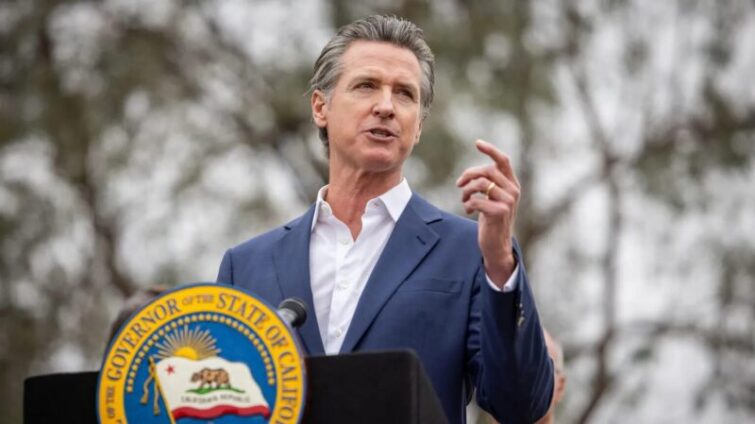
The governor of California Gavin Newsom has blocked a landmark artificial intelligence (AI) safety bill, which had faced strong opposition from major technology companies.
The proposed legislation would have imposed some of the first regulations on AI in the US.
Mr Newsom said the bill could stifle innovation and prompt AI developers to move out of the state.
Senator Scott Wiener, who authored the bill, said the veto allows companies to continue developing an "extremely powerful technology" without any government oversight.
The bill would have required the most advanced AI models to undergo safety testing.
It would have forced developers to ensure their technology included a so-called "kill switch". A kill switch would allow organisations to isolate and effectively switch off AI systems if they were they became a threat.
It would also have made official oversight compulsory for the development of so-called "Frontier Models" - or the most powerful AI systems.
In his statement, Mr Newsom said the bill "does not take into account whether an Al system is deployed in high-risk environments, involves critical decision-making or the use of sensitive data."
"Instead, the bill applies stringent standards to even the most basic functions - so long as a large system deploys it," he added.
At the same time, Mr Newsom announced plans to protect the public from the risks of AI and asked leading experts to help develop safeguards for the technology.
Over the last few weeks, Mr Newsom has also signed 17 bills, including legislation aimed at cracking down on misinformation and so-called deep fakes, which include images, video, or audio content created using generative AI.
California is home to many of the world's largest and most advanced AI companies, including the ChatGPT maker, OpenAI.
The state's role as a hub for many of the world's largest tech firms means that any bill regulating the sector would have a major national and global impact on the industry.
Mr Wiener said the decision to veto the bill leaves AI companies with "no binding restrictions from US policy makers, particularly given Congress’s continuing paralysis around regulating the tech industry in any meaningful way."
Efforts by Congress to impose safeguards on AI have stalled.
OpenAI, Google and Meta were among several major tech firms that voiced opposition to the the bill and warned it would hinder the development of a crucial technology.
Latest Stories
-
GAF sets Sept. 28–30 for Documentation, Body Selection Exercise
10 minutes -
I resigned five months ago – BoG Governor Asiama explains GoldBod Board exit
26 minutes -
Trump says men arrested at UK air base used by US were looking to do ‘big damage’
42 minutes -
Trump confirms meeting with Anthropic’s Amodei, repeats dismissal of AI fears
52 minutes -
China pushes back against US on Iran and Cuba in UN speech
1 hour -
OpenAI, Anthropic CEOs called to appear at Australian AI probe
1 hour -
T-bills auction: Government exceeds target marginally; yield on 91-day bill remains unchanged
4 hours -
GPL 2026/27: 10-man Aduana hand Kotoko defeat in Kumasi
4 hours -
News media must stay relevant or ‘society will struggle’, says World News Day boss
5 hours -
Kenyan High Commissioner hosts Heads of Mission from 25 countries
5 hours -
Embattled Serbian president resigns, paving way for early elections
5 hours -
GPL 2026/27: Medeama ease past Basake Holy Stars
5 hours -
Five arrested as counter-terror police investigate major incident near RAF Fairford
5 hours -
Appiah Adomako writes: Why DVLA must stop treating every expired licence holder as delinquent
5 hours -
Tuchel rues ‘big mistakes’ – did Manchester City charges have impact?
5 hours