

Audio By Carbonatix
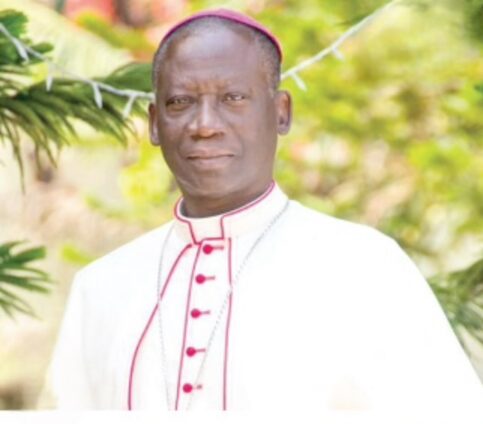
Catholic Bishop Kwasi Gyamfi has defended the Catholic Church’s involvement in national issues, saying its interventions are driven by a responsibility to protect human dignity.
According to him, the Church’s mandate extends beyond spiritual matters to include moral issues and matters affecting the well-being of the human person.
“The Catholic Church deals not only with spiritual issues, it deals also with moral issues and anything that enhances human dignity,” he said.
Bishop Gyamfi explained that the Church considers the human person sacred and therefore has a responsibility to speak against issues it believes dehumanise people or undermine their dignity.
Speaking to Joy News' Gemma Appiah, He rejected suggestions that such interventions amount to the Church entering the political arena.
“We do not do politics. We call it the enhancement of the human person,” he said.
He acknowledged that some of the issues raised by the Church may be viewed as political by others, but said the Church considers them matters of human development and community welfare.
On the Church’s call for qualified Catholic students to have access to Catholic schools, Bishop Gyamfi said the demand should not be interpreted as a quota system.
He explained that Catholic schools were established to provide academic and skills training alongside moral and spiritual formation.
“We believe skills training alone, academic excellence alone, is not enough for the human person,” he said.
Bishop Gyamfi said Catholic schools remain open to people of other faiths who share their values, but stressed that this should not result in the dilution of the Catholic character and purpose of the institutions.
He maintained that qualified Catholic students who choose Catholic schools should have the opportunity to attend them because of the specific formation the Church seeks to provide.
According to him, preventing such students from accessing the schools could undermine the purpose for which the Catholic Church established them.
He also pointed to the Church’s investment in establishing many of the schools before the state assumed responsibility for paying teachers’ salaries.
“The fact that the state pays salaries of teachers does not make the schools state schools,” Bishop Gyamfi said.
He stressed that the schools were established with a distinct educational philosophy that combines academic excellence with human, moral and spiritual formation.
Bishop Gyamfi further cited the history of formal education in Ghana, noting that missionary groups, including the Presbyterians, Methodists and Catholics, played a major role in establishing formal education before government became involved.
Latest Stories
-
Photos: Antoine Semenyo says ‘I do’ to longtime partner Jordeen Buckley
6 minutes -
Gender Minister visits Nana Akua Addo, assures family of support
7 minutes -
You need to fake it sometimes to make it fun – Stephanie Benson tells couples
26 minutes -
Mahama Cares says political affiliation will not determine access to medical support
28 minutes -
Government inherited GH¢111bn debt burden but continues infrastructure projects – Lands Minister
34 minutes -
Mallam Atta traders urge government to speed up 24-hour market redevelopment
43 minutes -
Catholic Church has a duty to speak on issues affecting human dignity – Bishop Gyamfi
53 minutes -
KATH sickle cell, blood bank project stalled over $1.6m legal dispute – CEO
1 hour -
Restricting preaching in moving vehicles is an attempt to gag the church – Rev. Kwadwo Bempah
1 hour -
Central Charismatic Baptist Church marks 30 years, urges review of law restricting preaching on buses
1 hour -
Mafi Kope residents appeal for urgent medical intervention over illnesses affecting children, adults
1 hour -
ECG to limit planned power outages in Ashanti to two days a week
1 hour -
NYA CEO, management doing ‘yeoman’s job’with meagre budget — Parliament’s Youth Committee Chairman
1 hour -
Mahama commends Trade Minister for championing Ghana’s industrial growth
2 hours -
Public cautioned against transactions over Borteyman land as Supreme Court rules in favour of Sino Africa
2 hours