

Audio By Carbonatix
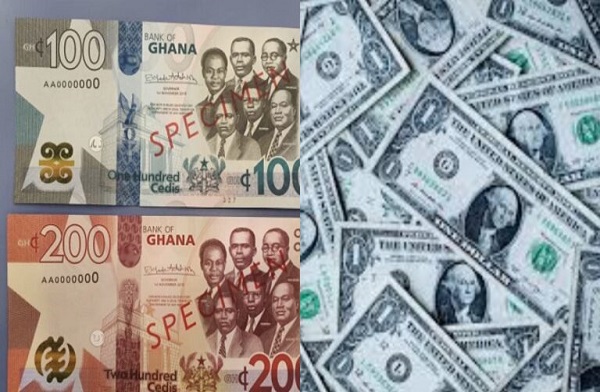
The Ghana cedi continued to gain more grounds against the US dollar today following an expected approval of a $3 billion Extended Credit Facility Arrangement for Ghana by the International Monetary Fund (IMF).
According to Bloomberg, the cedi has become the world’s best performer against the dollar over the past six months.
It has advanced 33% since November 2022, the biggest gain among about 150 currencies, reversing some significant losses.
Ghana’s dollar bonds have also delivered a strong performance too, providing investors with a return of almost 12%, more than the 3.6% average for emerging and frontier peers in a Bloomberg index.
The local currency has lost about 8.7 percent in value to the US dollar since the beginning of the year. This is far better than the interbank market.
Checks by Joy Business at the forex bureaus on May 17, 2023, indicate that the local currency is going ¢11.30 to the American greenback.
Cedi records relative stability since March 2023
Prior to Friday, May 12, 2023, the cedi recorded relative stability, trading around ¢11.7 and ¢11.9 to a dollar since late March 2023.
Investors were cautiously optimistic that Ghana would get the IMF deal approval during the second quarter, without ruling out a May 2023 approval per government's indications.
When Ghana obtained financing assurance from members of the G20 Common Framework, the market become buoyant with some investors willing to buy the dollars cheaply.
“Immediately on Friday [May 12, 2023], we saw that reflected in the Ghana cedi performance as the local currency gained 1.0% on Friday alone. The gains have continued into this week as the market expect the approval this week, roundly today, as communicated by government officials”, Economist Courage Martey, , told Joy Business.
“So, in sum, yes. The recent run appreciation of the Ghanaian cedi is due to the latest positive news effect from anticipated IMF programme approval”, he added.
Analysts worried about spread between buy-side and sell-side
Meanwhile, many analysts are worried about the spread between the buy-side and the sell-side.
“It appears the buy-side is falling faster than the sell-side and this is widening the spread. Essentially, traders want to buy the US dollar very cheap but are not willing to sell too cheap”, Mr. Martey pointed out.
“This means that the appreciation of the cedi is not yet supported by any strong improvement in economic fundamentals, but rather on sentiments and news effects”, he added.
Latest Stories
-
Burnham had formal meeting with Man City chair while mayor
5 minutes -
Is Ghana producing too many lawyers? What is the best lawyer-to-citizen ratio?
8 minutes -
NDC sinking Ghana’s democracy with Emelia Agbenyo’s appointment – Miracles Aboagye
17 minutes -
Seedorf back in football as Corinthians head coach
30 minutes -
Hincapié and Zubimendi injured in post-match training session
39 minutes -
Fridges in French supermarkets hit by cyberattack
50 minutes -
Qantas flight grounded after bedbug outbreak
59 minutes -
Reality Zone with Vicky Wireko: International Day of the Girl, shaping today’s girl for tomorrow’s future – ZONTA Clubs lead the way
1 hour -
Global health must be led by countries, not designed for them – Mintah Akandoh
2 hours -
Mahama honoured at 2026 World Health Summit in Berlin for global health leadership
2 hours -
Breast cancer is not a death sentence – Besease Kontire Obaapanin, Magmina Foundation lead awareness campaign
2 hours -
EcoBank invests in digital education of 4 Garisson School to mark 40 years in Africa
3 hours -
AGI urges investment in skills and raw materials to strengthen local manufacturing
3 hours -
GPL 2026/27: ‘We have to rectify our mistakes’ – Boadu reacts to Aduana FC defeat
3 hours -
No disability access, no building permit – KMA declares
3 hours