

Audio By Carbonatix
The Ghana cedi and three other currencies are the worst-performing currencies in Sub-Saharan Africa (SSA) in 2024, the World Bank’s October 2024 Africa Pulse Report has revealed.
According to the report, the cedi has lost about 24% value to the US dollar, placing it as the 4th weakest in SSA.
South Sudan’s pound (over 60%), Ethiopia's birr (51%) and Nigeria’s naira (over 40%) are the worst-performing currencies in Sub-Saharan Africa in 2024.
Interestingly, the Kenya shilling is the best-performing currency in Africa this year with a year-to-date gain of about 21% as of August 2024.
“Ethiopia, Ghana, and Nigeria are among the worst performing in Africa this year, and their currencies continue weakening while demand for foreign exchange remains pressing”, the report said.
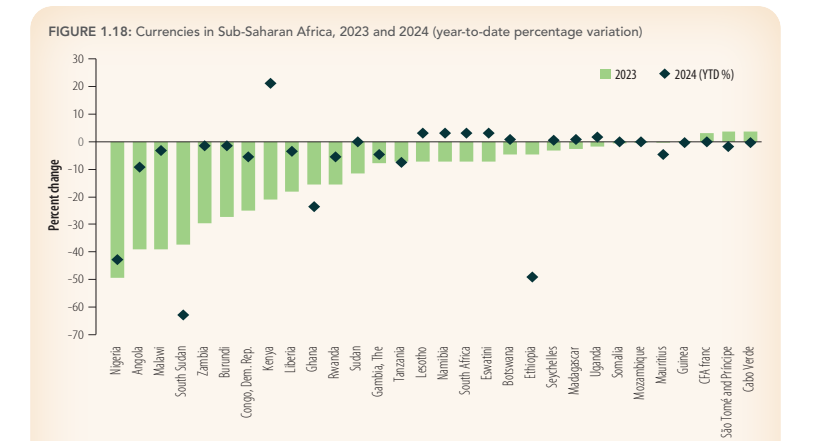
It added “By end-August 2024, the Ethiopian birr, Nigerian naira, and South Sudanese pound were among the worst performers in the region. The Nigerian naira continued losing value, with a year-to-date depreciation of about 43% as of the end of August. Surges in demand for US dollars in the parallel market, driven by financial institutions, money managers, and non-financial end-users, combined with limited dollar inflows and slow foreign exchange disbursements to currency exchange bureaus by the central bank explain the weakening of the naira”.
In contrast, the report said some currencies that weakened in 2023 have stabilised or strengthened this year.
“The Kenyan shilling is the best-performing currency in Sub-Saharan Africa this year: it appreciated by 21 per cent year-to-date by end-August 2024. The South African rand and currencies pegged to it have strengthened by 3.1% so far this year, after losing value in the past year”.
Although most currencies are stabilising, the October 2024 Africa Pulse Report pointed out that the exchange rate pressures and shortages of foreign exchange remain a concern for African policymakers.
“From a sample of 30 countries and two currency unions (the Economic and Monetary Community of Central Africa and WAEMU), more than one-third of the countries in the region are set to have less than three months of imports in international reserves by end-2024”.
Latest Stories
-
President Mahama ends Resetting Ghana tour of Ahafo Region
50 minutes -
African negotiators seek delivery of climate commitments at COP31
52 minutes -
BoG develops AI rules for financial sector
54 minutes -
‘Big Push’: Government assures contractors of prompt payments
58 minutes -
Court fines miner for breaking into gold buying shop
1 hour -
Tarkwa court jails labourer for three years over GH¢123,000 theft
2 hours -
GAEC must retain nuclear scientists for Ghana’s nuclear ambitions – Minister
3 hours -
Man reportedly mistaken for game and shot by hunter dead in forest
3 hours -
19-year-old mason jailed 15 years for defiling seven-year-old pupil
3 hours -
Ghana’s banking sector assets rise 20.47% to GH¢500.2bn – BoG Governor
3 hours -
22 injured as Sprinter bus overturns at Sege after tyre burst
3 hours -
UN housing expert urges Ghana to strengthen Rent Control Department amid housing affordability concerns
3 hours -
Delta-BCI partnership reaches 166,000 people with breast cancer education
3 hours -
Power restoration fault suspected in Kumasi Central Market fire
8 hours -
The 7-foot giant of Ngleshie Amanfro: Seven-foot Ghanaian Ephraim Saawa dreams of joining the national basketball team
9 hours