


Audio By Carbonatix
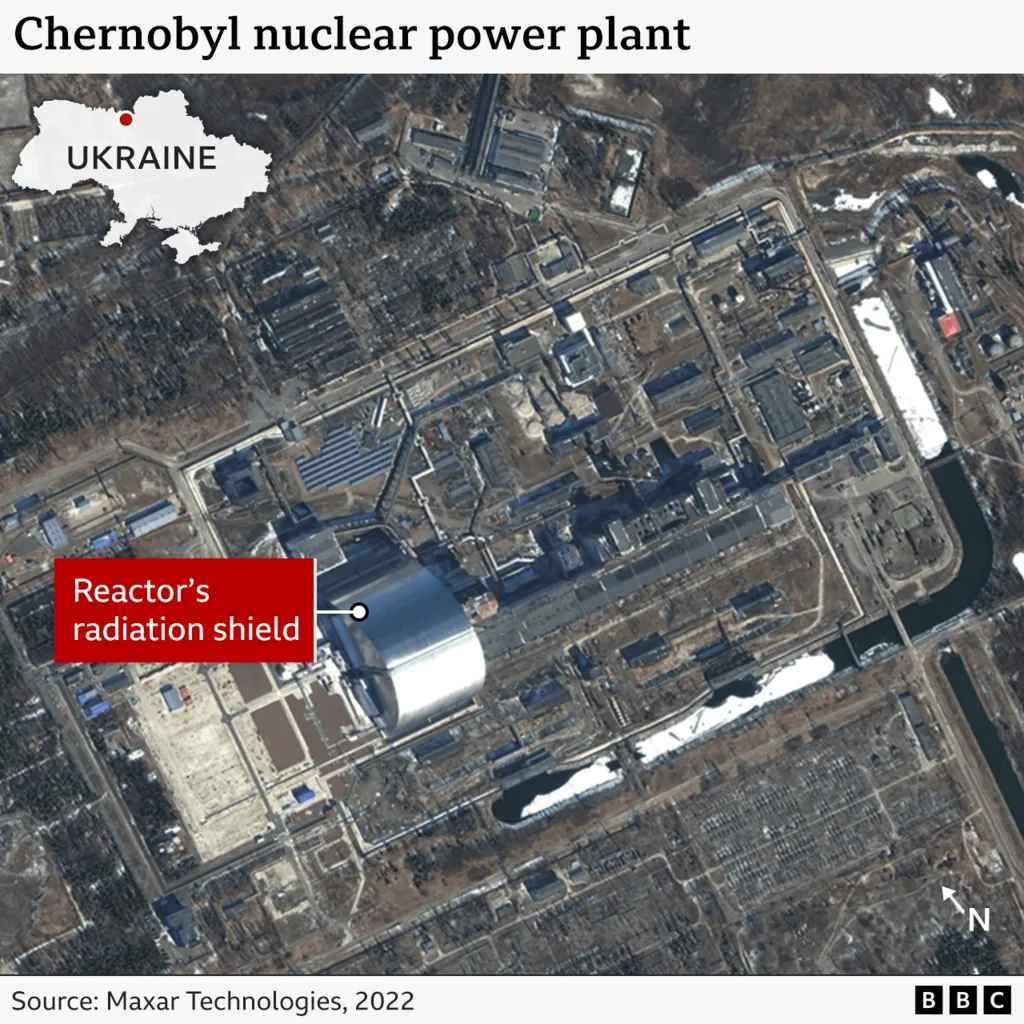
A protective shield covering the Chernobyl nuclear reactor in Ukraine can no longer provide its main containment function following a drone strike earlier this year, according to a UN watchdog.
International Atomic Energy Agency (IAEA) inspectors found that the massive structure, built over the site of the 1986 nuclear disaster, had lost its "primary safety functions, including the confinement capability".
In February, Ukraine accused Russia of targeting the power plant - a claim the Kremlin denied.
The IAEA said repairs were "essential" to "prevent further degradation" of the nuclear shelter. However, environmental expert Jim Smith told the BBC: "It is not something to panic about."
Prof Smith from the University of Portsmouth in the UK, who has studied the aftermath of the Chernobyl disaster, said the biggest danger linked to the site was disturbing radioactive dust.
But he said that "the risk is low" because contaminated dust is contained within a thick concrete "sarcophagus" which is covered by the protective shield.
The 1986 explosion at Chernobyl blasted radioactive material into the air, triggering a public health emergency across Europe.
In response, the former Soviet Union constructed the sarcophagus over the nuclear reactor.
The sarcophagus only had a 30-year lifespan, prompting the need for the protective shell to prevent radioactive material from leaking out over the next 100 years.
The IAEA said a team had completed a safety assessment of the site last week after it was "severely damaged" by the drone strike. The attack caused a fire in the outer cladding of the steel structure.
Inspectors said there was no permanent damage to the shell's load-bearing structures or monitoring systems and some repairs had been carried out on the roof.
But IAEA director general Rafael Grossi said: "Timely and comprehensive restoration remains essential to prevent further degradation and ensure long-term nuclear safety."
Since the beginning of December, the UN's nuclear watchdog has been assessing Ukraine's energy infrastructure as the country continues to defend itself against Russia.
Overnight, Russia launched airstrikes on the city of Kremenchuk, a major industrial hub in the centre of Ukraine.
As well as assessing Chernobyl, the IAEA has been inspecting electrical substations linked to nuclear safety and security.
Mr Grossi said: "They are absolutely indispensable for providing the electricity all nuclear power plants need for reactor cooling and other safety systems.
"They are also needed to distribute the electricity that they produce to households and industry."
Latest Stories
-
He entered at eight. He is now 16: Ghana’s children growing up in prayer camps
2 hours -
‘Development must not always begin from Accra’ — Anwelle Foundation launched in Jirapa
2 hours -
PKO trio eye victories at Odwira Festival
4 hours -
346 Ghana Navy recruits pass out after 26 weeks of intensive training
4 hours -
Newsfile to discuss EOCO-MP arrest, drug trafficking, speech arrests and $235m water debt
5 hours -
JoyNews gets results as listeners raise GH¢40,000 to help 17-year-old student with cerebral palsy attend SHS
5 hours -
Vice President calls for stronger local pharmaceutical production to reduce medicine imports
6 hours -
The brewing tension at KNUST; Beware the Ides of October….
6 hours -
Health Ministry moves to integrate traditional medicine into mainstream healthcare
6 hours -
550 pupils in Kintampo South get educational lifeline as ‘Seeds of Hope’ reaches farming communities
7 hours -
Opoku Mensah urges Christian Council, House of Chiefs to speak up on democratic freedoms
7 hours -
Teacher unions’ strike: Minority demands immediate payment of teacher arrears, 20% deprived area allowance
7 hours -
The Accra-Kumasi Expressway: Building it right
7 hours -
Beyond gold exports: Building value and economic resilience from Ghana’s gold
7 hours -
2027 AFCONQ: Ghana under pressure as Gambia beat Somalia 2-1
7 hours