

Audio By Carbonatix
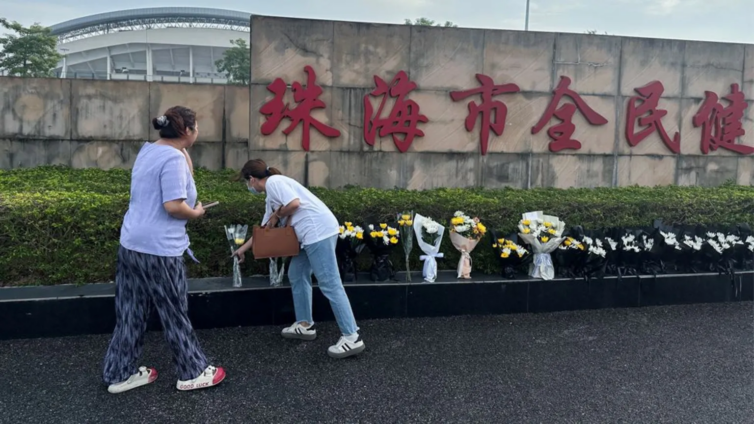
China has executed a man found guilty of killing at least 35 people in a car attack in November, in what is thought to be the deadliest attack in the country for a decade.
Fan Weiqiu, 62, injured dozens more when he drove his car into people exercising outside a stadium in the southern city of Zhuhai.
State media said a second man was executed for a separate attack that came days later. Xu Jiajin, 21, killed eight people in a stabbing spree at his university in the eastern city of Wuxi.
Authorities said Fan was driven by "dissatisfaction" over how his property had been divided following his divorce, while Xu carried out his attack after "failing to obtain his diploma due to poor exam results".
Fan was detained at the scene on 11 November, where police said he was found with self-inflicted wounds.
In December, he was found guilty of "endangering public safety", with the Zhuhai Intermediate People's Court describing his motive as "extremely vile" and the methods used "particularly cruel".
His execution on Monday comes less than a month after the court sentenced him to death.
In the case of Xu, police said he confessed to his crime "without hesitation" on 16 November. He was sentenced to death on 17 December, with the court hearing that the circumstances of his crime were "particularly bad" and "extremely serious".
Human rights groups believe China is the world's leading executioner, killing thousands of people every year. The country does not release details about its use of the death penalty, so reliable numbers are unavailable.
China has been grappling with a spate of public violence, with many attackers believed to have been spurred by a desire to "take revenge on society" - where perpetrators target strangers over their personal grievances.
The number of such attacks across China reached 19 in 2024.
Within days of the Zhuhai and Wuxi attacks, a man drove into a crowd of children and parents outside a primary school in Changde city, injuring 30.
Authorities said the man, Huang Wen, wanted to vent his anger after dealing with investment losses and family conflict.
Huang was handed a suspended death sentence last month, which could be commuted to life imprisonment if he does not commit another crime in the next two years.
Analysts earlier told the BBC that the string of mass killings raised questions about how people in China have been dealing with various sources of stress, such as the country's sluggish economy.
"The tensions do seem to be building, and it doesn't look like there is any way it is going to ease up in the near future," says George Magnus, an economist at Oxford University's China Centre.
Latest Stories
-
Ghana, Germany deepen cooperation on railways, labour mobility
13 seconds -
Huge crowds greet Pope in Paris for open-air Mass
11 minutes -
‘I never said I’ll declare a state of emergency’ – President Mahama on galamsey
51 minutes -
Bobby Banson condemns EOCO’s attempted arrest of Nana Agyei Baffour Awuah
1 hour -
When Kumasi begins to look like somebody is in charge
1 hour -
Parliamentary probe into cocaine seizure would be a waste of time – Inusah Fuseini
1 hour -
Cocaine seizure: Focus on Ghana’s reputation, not partisan blame – Osae-Kwapong
1 hour -
Two Invitations, Three Interrogations: Did Baffour Awuah tell the whole story?
2 hours -
Drug cartels may be seeing Ghana as easy route – Lenin Anane Agyei
3 hours -
Ghana risks gaining notoriety as drug-trafficking hub – Bobby Banson
3 hours -
Government dismissed my drug trafficking warning, then tried to arrest me – Ntim Fordjour
3 hours -
Day Two: 3rd Republic Bank-JoyNews Habitat Fair Clinic underway at Junction Mall
3 hours -
NACOC addressing inherited gaps in fight against drug trafficking – Deputy Director-General
3 hours -
Taekwondo goes to school as GTF launches five-region youth campaign
3 hours -
The issues Mourinho is struggling to fix at Real Madrid
3 hours