

Audio By Carbonatix
A virologist with the Kumasi Centre for Collaborative Research (KCCR) has said Ghana’s number of the novel coronavirus cases has not yet reached its peak.
Dr Augustina Angelina Sylverken believes the idea in relation to Ghana’s situation is a myth which must be shelved at this point.
This revelation goes contrary to information presented to the Ghanaian populace by the Ghana Health Service.
At a press briefing on May 5, Director of Public Health for GHS, Dr Badu Sakordie sought to suggest that the infection curve, at the time when the case count stood at 2,719, had peaked.
Following that announcement, some public health experts challenged the Service’s position.
GHS subsequently released two graphs as data based on which their conclusions were made in order to drum home their point.
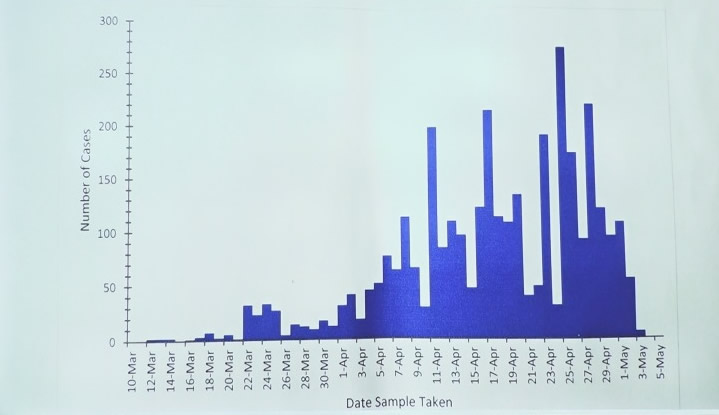
Director-General of GHS Dr Patrick Aboagye said, “we peaked around the 25 of April and since then the numbers have continued to come down until May 6.
“So that is showing that of the positivity, since peaking on April 2, we have consistently recorded a decline until today, May 7."
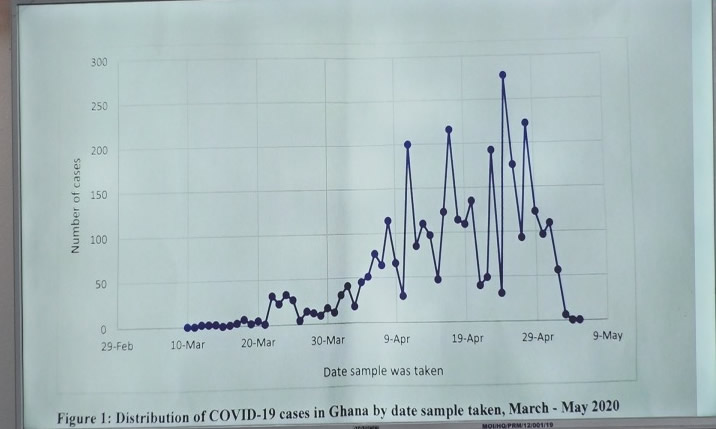
Since this announcement, Ghana’s number of Covid-19 infections has shot up to 4,700 with 22 deaths and 474 recoveries as of May 11.
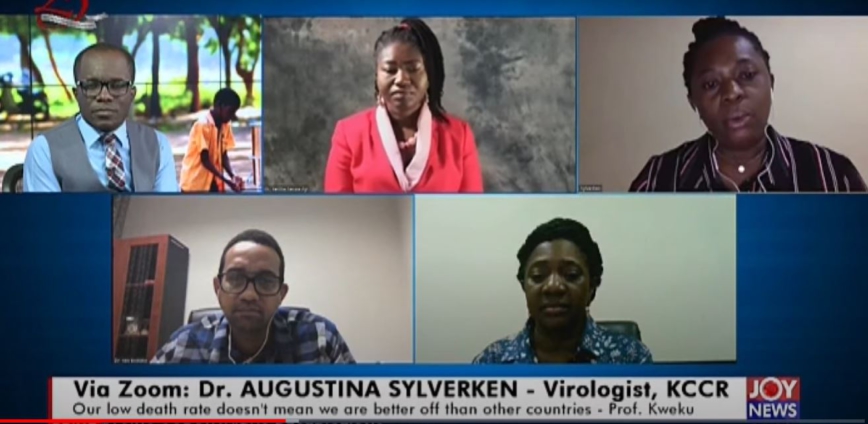
Speaking on JoyNews' PM Express, the virologist and Theoretical and Applied Biology lecturer at the Kwame Nkrumah University of Science and Technology (KNUST) described the idea of Ghana reaching the peak of its Covid-19 infections as a myth.
“Once you peak you know that your health system will be overwhelmed and people will be rushing all over. They will require ICU management and we know that even when people have been put on ventilators,” Dr Sylverken explained.
She emphasised that: “We may want to gradually move from this - I don’t know whether to call it a myth - that we have peaked because even after we claimed to have peaked, look at the numbers we are recording. The interesting thing is that when we test, we find.”
The virologist also posited that this was not the time to be rest on our oars as she stressed the need for “heavy preventive measures as always recommended i.e the washing of hands and change in attitudes.”
Her position was seconded by Dr Bertha Serwa Ayi, a specialist in Clinical Infectious Diseases who posited that a declaration of a peak in any outbreak comes with its attendant implications in terms of policy and must not be taken for granted.
“A peak means that we are getting fewer cases so we are about to ease our non-pharmacological interventions like people can go back to school and church,” she said.
According to Dr Ayi, “for you to peak it means you have reached your maximum number of cases and the rate at which your number is decreasing is increasing. But if we report 533 within one day – we understand that it’s from April - then clearly we have not peaked.

The Adjunct Assistant Professor of Medicine at the Kansas Health Science Centre also highlighted a criterion necessary to effectively say that a country has peaked and is on the road to recovery.
She enumerated the evidence of low transmission, ability to detect ever case as soon as possible, a good case management regime, individual behavioural change and effective community engagement as being crucial to such a declaration.
Latest Stories
-
Afenyo-Markin’s influence is limited by minority numbers in Parliament – Haruna Iddrisu
1 minute -
Police administration is doing a yeoman’s job – President Mahama
4 minutes -
GoldBod tells PAC Bank of Ghana authorised its foreign exchange transactions
4 minutes -
GCB customers call for more frequent engagement with bank leadership
9 minutes -
Dark Signals: The death trap of non-functioning traffic lights along Asokwa-Aputuogya Road
11 minutes -
80–90% of gold purchased and exported is now refined in Ghana– Sammy Gyamfi
28 minutes -
Dichemso M/A teachers go house-to-house to get absent pupils back to class after strike suspension
32 minutes -
Meet Dr Hazel and Nhyira: Mother and daughter called to the Ghana Bar
34 minutes -
Black Star Fashion Week: Can Ghana turn the runway into a tourism attraction?
35 minutes -
Ghana sends 61 health workers to Grenada under Labour Export Programme
47 minutes -
Central banks should avoid reacting too strongly to headline inflation – IMF
54 minutes -
Kumasi: One injured, shops destroyed in Atasemanso fire in Kumasi
1 hour -
Global economy proving resilient, growth projected at 3.1% in 2026 – IMF
1 hour -
NDC targets all 6 parliamentary seats in Ahafo Region for 2028
1 hour -
Ghana targets thousands of overseas nursing jobs under Labour Export Programme
1 hour