

Audio By Carbonatix
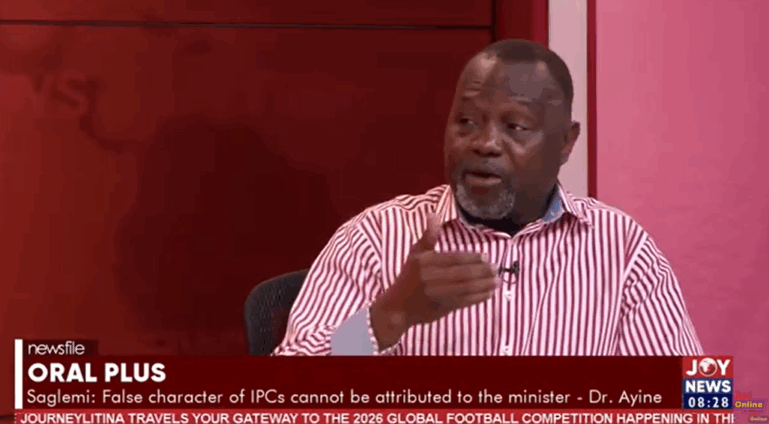
The Attorney-General and Minister of Justice, Dr Dominic Akuritinga Ayine, says that prosecution of criminal trials is largely controlled by the judiciary and not solely by the prosecuting authorities.
Speaking on JoyNews’ Newsfile on Saturday, January 10, Dr Ayine said he remains unable to proceed to court over matters relating to the National Cathedral project until he receives a forensic audit report, which he described as critical to any potential prosecution.
“And even the National Cathedral, for instance, I am still waiting for the forensic report. I cannot proceed to court on the National Cathedral unless the forensic report is given to me,” he stated.
His comments come after former Auditor-General Daniel Domelevo stated that the credibility of the anti-corruption fight now rests largely on how the Attorney-General handles high-profile cases submitted under the Operation Recover All Loot (ORAL) initiative.
Dr Ayine expressed surprise at criticisms from some individuals, including the former Auditor-General, who has called for quicker action on high-profile cases.
He argued that such criticisms often overlook the realities of criminal litigation.
“For people like Domelevo, I am a bit surprised that they know that even when I have filed a case in court, the speed of the case does not depend exclusively on me,” he said.
The Attorney-General explained that once a matter enters the courts, the conduct and pace of proceedings fall under the authority of the judiciary.
“What we have to understand is that, first of all, a criminal trial is a judiciary-controlled process,” he noted.
To illustrate his point, Dr Ayine cited the issue of adjournments, which are at the discretion of the presiding judge.
“If a judge says, ‘I am giving an adjournment of one month or two months’, and I plead with the judge or my lawyers plead with the judge to give a shorter adjournment and the judge refuses, what do I do in that case?” he asked. “I cannot compel the judge to give a shorter adjournment.”
While acknowledging public demands for swift justice, Dr Ayine said he is committed to expediting cases where possible, but cautioned against rushing prosecutions at the expense of thoroughness and legal soundness.
“And so if people like him say I should speed up, yes, I will speed up,” he said.
“But I don’t want to speed up and then trip along the line, and the same people will say, ‘well, Ayine didn’t do his work well; that is why he is tripping.’”
The Attorney-General stressed that his approach is guided by the need to build strong, defensible cases that can withstand judicial scrutiny, particularly in complex and high-profile matters such as the National Cathedral project.
Latest Stories
-
Power restoration fault suspected in Kumasi Central Market fire
5 hours -
The 7-foot giant of Ngleshie Amanfro: Seven-foot Ghanaian Ephraim Saawa dreams of joining the national basketball team
6 hours -
Government promises support for Kumasi Central Market fire victims
6 hours -
Vibes The Movie: Big Ghun’s Ghanaian film earns five nominations at 2026 REFFA
6 hours -
MamaCare CEO warns unresolved conflicts among health workers could undermine maternal and neonatal care
7 hours -
Health professionals urged to translate medical knowledge into practice to save mothers
7 hours -
Retired judge Justice Francis Korbieh charges 1,568 new lawyers to uphold integrity
8 hours -
Conflicts among care providers linked to maternal, neonatal deaths – Expert
8 hours -
GIS marks 10th TIME conference, champions improved teaching practices
8 hours -
BRICS Or Balance? What Ghana’s bid really means
9 hours -
GPRTU wants full TRAFFITECH-GH implementation to start in 2027
9 hours -
How 10-mile walks for basic education birthed a 50-year legal career for Justice Korbieh
9 hours -
Mahama announces plans to import electric wheelchairs for PWDs
9 hours -
KGL U17 Colts 2026: Western beat Prempeh Elite Academy to set up final final with Greater Accra Region
9 hours -
Late Solanke strike salvages 10-man Spurs draw at Man United
10 hours