

Audio By Carbonatix
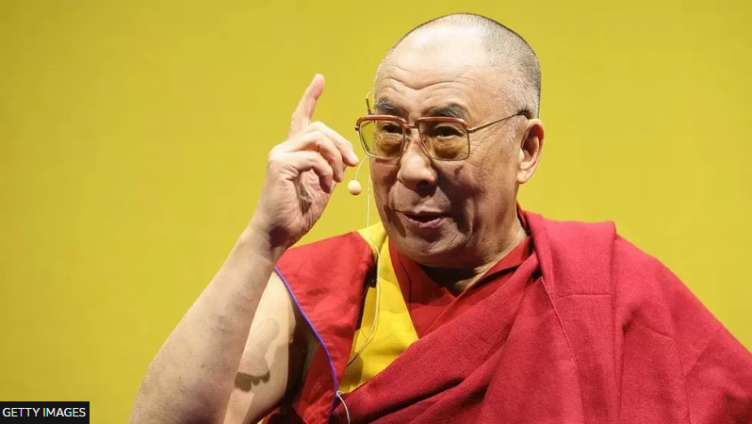
The Dalai Lama's successor will be born outside China, the spiritual leader of Tibetan Buddhism says in a new book, raising the stakes in a dispute with Beijing over control of the Himalayan region he fled more than six decades ago.
Tibetans worldwide want the institution of the Dalai Lama to continue after the 89-year-old's death, he writes in "Voice for the Voiceless", which was reviewed by Reuters and is being released on Tuesday.
He had previously said the line of spiritual leaders might end with him.
His book marks the first time the Dalai Lama has specified that his successor would be born in the "free world", which he describes as outside China. He has previously said only that he could reincarnate outside Tibet, possibly in India where he lives in exile.
"Since the purpose of a reincarnation is to carry on the work of the predecessor, the new Dalai Lama will be born in the free world so that the traditional mission of the Dalai Lama - that is, to be the voice for universal compassion, the spiritual leader of Tibetan Buddhism, and the symbol of Tibet embodying the aspirations of the Tibetan people - will continue," the Dalai Lama writes.
Tenzin Gyatso, the 14th Dalai Lama, fled at the age of 23 to India with thousands of other Tibetans in 1959 after a failed uprising against the rule of Mao Zedong's Communists.
Beijing insists it will choose his successor, but the Dalai Lama has said any successor named by China would not be respected.
China brands the Dalai Lama, who won the Nobel Peace Prize in 1989 for keeping alive the Tibetan cause, as a "separatist".
When asked about the book at a press briefing on Monday, a spokesperson for China's foreign ministry said the Dalai Lama "is a political exile who is engaged in anti-China separatist activities under the cloak of religion.
"On the Tibet issue, China's position is consistent and clear. What the Dalai Lama says and does cannot change the objective fact of Tibet's prosperity and development."
'REPRESSIVE COMMUNIST CHINESE RULE'
Beijing said last month it hoped the Dalai Lama would "return to the right path" and that it was open to discussing his future if he met such conditions as recognising that Tibet and Taiwan are inalienable parts of China, whose sole legal government is that of the People's Republic of China. That proposal has been rejected by the Tibetan parliament-in-exile in India.
Supporters of the Dalai Lama and the Tibetan cause include Richard Gere, a follower of Tibetan Buddhism, and Nancy Pelosi, the former speaker of the U.S. House of Representatives.
His followers have been worried about his health, especially after knee surgery last year. He told Reuters in December that he might live to be 110.
In his book, the Dalai Lama says he has received numerous petitions for more than a decade from a wide spectrum of Tibetan people, including senior monks and Tibetans living in Tibet and outside, "uniformly asking me to ensure that the Dalai Lama lineage be continued".
Tibetan tradition holds that the soul of a senior Buddhist monk is reincarnated in the body of a child on his death. The current Dalai Lama was identified as the reincarnation of his predecessor when he was two.
The book, which the Dalai Lama calls an account of his dealings with Chinese leaders over seven decades, is being published on Tuesday in the U.S. by William Morrow and in Britain by HarperNonFiction, with HarperCollins publications to follow in India and other countries.
The Dalai Lama, who has said he will release details about his succession around his 90th birthday in July, writes that his homeland remains "in the grip of repressive Communist Chinese rule" and that the campaign for the freedom of the Tibetan people will continue "no matter what", even after his death.
He expressed faith in the Tibetan government and parliament-in-exile, based with him in India's Himalayan city of Dharamshala, to carry on the political work for the Tibetan cause.
"The right of the Tibetan people to be the custodians of their own homeland cannot be indefinitely denied, nor can their aspiration for freedom be crushed forever through oppression," he writes. "One clear lesson we know from history is this: if you keep people permanently unhappy, you cannot have a stable society."
Given his advanced age, he writes, his hopes of going back to Tibet look "increasingly unlikely".
Latest Stories
-
Ghana, Germany deepen cooperation on railways, labour mobility
45 seconds -
Huge crowds greet Pope in Paris for open-air Mass
12 minutes -
‘I never said I’ll declare a state of emergency’ – President Mahama on galamsey
52 minutes -
Bobby Banson condemns EOCO’s attempted arrest of Nana Agyei Baffour Awuah
1 hour -
When Kumasi begins to look like somebody is in charge
1 hour -
Parliamentary probe into cocaine seizure would be a waste of time – Inusah Fuseini
1 hour -
Cocaine seizure: Focus on Ghana’s reputation, not partisan blame – Osae-Kwapong
2 hours -
Two Invitations, Three Interrogations: Did Baffour Awuah tell the whole story?
2 hours -
Drug cartels may be seeing Ghana as easy route – Lenin Anane Agyei
3 hours -
Ghana risks gaining notoriety as drug-trafficking hub – Bobby Banson
3 hours -
Government dismissed my drug trafficking warning, then tried to arrest me – Ntim Fordjour
3 hours -
Day Two: 3rd Republic Bank-JoyNews Habitat Fair Clinic underway at Junction Mall
3 hours -
NACOC addressing inherited gaps in fight against drug trafficking – Deputy Director-General
3 hours -
Taekwondo goes to school as GTF launches five-region youth campaign
3 hours -
The issues Mourinho is struggling to fix at Real Madrid
3 hours