


Audio By Carbonatix
Denmark's Prime Minister Mette Frederiksen has issued a long-awaited apology to the Greenlandic women and their families affected by what she called "systematic discrimination" during a contraceptive campaign.
During the 1960s and 70s, thousands of Inuit women and girls as young as 12 were fitted with contraceptive devices, as part of a birth-control programme administered by Danish doctors.
"We cannot change what has happened. But we can take responsibility," Frederiksen said of the scandal.
"On behalf of Denmark, I would like to say sorry," she said, acknowledging that victims had "experienced both physical and psychological harm".
The scale of the birth-control programme was first brought to light in 2022, by an investigative podcast called Spiralkampagnen - the coil campaign.
The device used is commonly known as a coil and is placed inside the womb, or uterus, to prevent pregnancy.
In the past few years, many women have come forward to say they were fitted with an intra-uterine device (IUD) without their knowledge or consent.
Few had previously been aware of the contraceptive campaign, and the reports prompted shock and anger.
Records from the national archives showed that, between 1966 and 1970, 4,500 women and girls, some as young as 13, had an IUD implanted.
Of these, it is unclear how many cases lacked consent. However, dozens of women have come forward sharing traumatic personal accounts and some were left sterile.
A group of 143 women have since filed a lawsuit against the Danish state demanding compensation:138 of them were under 18 at the time.
Use of the birth control was so widespread that Greenland's population growth severely slowed.
Speaking on Danish television last December, the former Prime Minister of Greenland, Mute B Egede, said it was "genocide".
A formal inquiry was launched, and the findings will be released next month, following two years of investigation.
"Even though we do not have the full picture," Frederiksen said, "it makes a serious impression on the government, that so many Greenlandic women unanimously report that they have been subjected to abuse by the Danish healthcare system."
One of the victims, Henriette Berthelsen, said she was happy with the apology, even if it had come quite belatedly.
Naja Lyberth, who is a psychologist, told the BBC in an earlier interview that it was 100% clear the government had broken the law by "violating our human rights and causing us serious harm".
"An apology, that's nice of course, and makes my clients happy. That's part of what they need," said Mads Pramming, the lawyer representing the women told the BBC.
"[What] we've not heard anything about," he added, "is whether they also admit or agree that they that this was a human rights violation."
Greenland was a Danish colony until 1953, and did not gain home rule until 1979, however Copenhagen continued to oversee the healthcare system, before Greenland took responsibility in 1992.
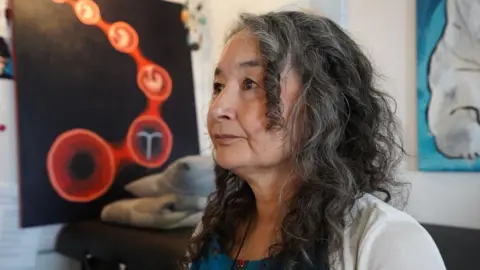
A few cases of forced contraception also took place after this time, and as late as 2018, as the BBC has previously reported.
Greenland's Prime Minister Jens-Frederik Nielsen said his government also recognised its own responsibility but said on Facebook it was about time that Denmark had officially apologised.
"For too long, the victims... have been silenced to death. It's sad that an apology only comes now - it's too late and too bad," he said.
"We cannot change what has happened. But we can take responsibility for the fact that the truth comes out, and that responsibility is placed where it belongs. The upcoming investigation will show the full extent of the assaults and help ensure nothing like this ever happens again."
Mette Frederiksen acknowledged that the case had caused "anger and sadness for many Greenlanders and many families" and had damaged perceptions of Denmark.
This case is one of several controversies involving the Danish treatment of Greenlanders, including forced adoptions, the removal of Inuit children from their families, and the legally fatherless, that have rocked relations between the Arctic territory and Copenhagen, and contributed to calls for independence.
Greenland and Denmark agreed to investigate the coil scandal in 2022. At the time Danish historian Soeren Rud told the BBC that the rationale for the policy was partly financial, but also the result of colonial attitudes.
After the World War Two Greenland's tiny population rocketed and by 1970 it had almost doubled. Mr Rud said Denmark wanted to limit the growth of the population, adding that this reduced "the challenges of providing housing and welfare services".
Aaja Chemnitz, a Greenlandic MP in the Danish parliament, welcomed the apology and told the BBC it was important for both Greenlandic and Danish society to achieve closure.
"These different cases that are not historic, but actually present. These are people living today, that have been affected by this."
"We also need to focus on compensation for the women," she continued. "Of course, we're going to look into the report. We're going to follow up politically."
Latest Stories
-
Insults generally are not crimes, but some may be criminal under the law – Samson Lardy Anyenini
3 minutes -
IGP deploys specialised police team, armoured vehicle to strengthen security in Nkwanta
3 minutes -
Dr Bawumia advocates solar power, access to credit, training and certification for artisans
6 minutes -
Trade Minister engages Russia, UAE and UNDP to boost trade, investment
7 minutes -
7 best foods to help keep blood sugar levels steady
10 minutes -
Ghana to host signing of UN trade convention to modernise global cargo documentation on October 26
26 minutes -
Family announces memorial mass for Nana Konadu Agyeman-Rawlings
29 minutes -
Mahama, Trade Minister, tours Afienya and Tema factories, schedules meeting on Free Zones incentives
34 minutes -
Gyakie and FlipTheMusic unveil ‘Your Body’ following a new distribution deal with Warner Music Africa
35 minutes -
Stop looking down on new media practitioners as if they don’t matter – New Media President
36 minutes -
Ghana’s BRICS partnership bid aimed at broadening development opportunities – Mahama
42 minutes -
Fiabci-Ghana inaugurated to promote professionalism and global collaboration in real estate sector
1 hour -
‘No flying in just for matches’ – Kofi Adams sets conditions for next Black Stars coach
1 hour -
Ghana and BRICS: Strategic opportunity, economic imperative or geopolitical gamble?
1 hour -
SML vs GRA: Court grants preservation order in dispute over US$500 million investment
1 hour