

Audio By Carbonatix
The Deputy Chairman in charge of Operations at the National Commission for Civic Education (NCCE), Mr Samuel Asare Akuamoah says domestic violence is synonymous with violent extremism, and deserves equal attention.
He said perpetrators of both acts have the same intention of inflicting harm on victims, so there should be a conscious effort to prevent their happenings.
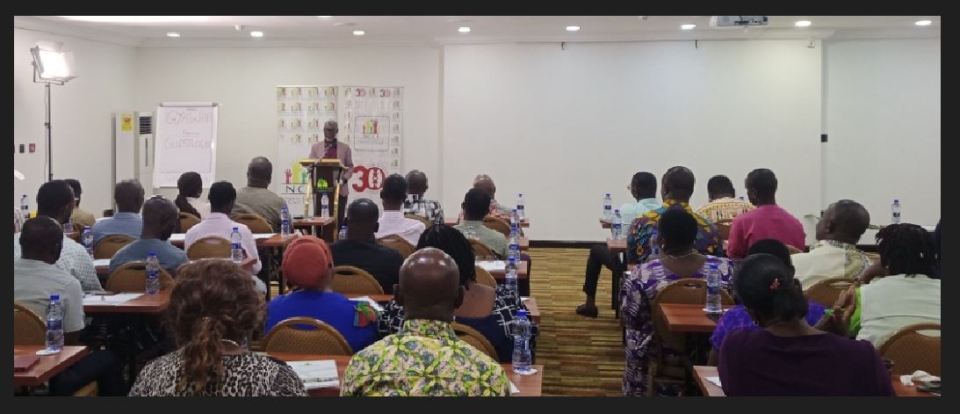
Mr Akuamoah said this at the opening of a 2-day training workshop on Gender-Based Violence (GBV) for 70 selected NCCE staff and 26 Domestic Violence and Victim Support Unit (DOVVSU) Officers of the Ghana Police Service from 8 Regions at Tesano, Accra in the Greater Accra Region.
The training seeks to equip and strengthen the capacity of staff with adequate knowledge on the subject for public education.
The Deputy Chairman said there was a need to update knowledge through capacity building to deliver effectively.
Mr. Akuamoah also asked the participants to continue their education on terrorism and its effects since Ghana is not immune to terrorist attacks.
Assistant Commissioner of Police (ACP) Owusuwaa Kyeremeh, Director, DOVVSU, said GBV was an economic issue as it affects productivity and impacts negatively on the nation's economy.
She said the act also had social and health consequences on the victim and needed a concerted effort to curtail it.
ACP Owusuwaa Kyeremeh said that was why they thought it wise to partner with NCCE to help disseminate information on the menace as punishment alone is not enough, but education to reduce it.
“We need to network, build capacity and share information to stop GBV, so let's maintain this relationship", she said.
The NCCE Director of Research, Gender, and Equality, Dr Henrietta Asante-Sarpong said cases of gender-based violence are on the rise with several cases of physical and sexual violence and that globally, one out of three women experience sexual or physical violence.
She said in Ghana, one out of four women have suffered physical or sexual violence by intimate partners and that over 48 per cent of Ghanaian girls have been sexually abused.
"Approximately, 94 per cent of children between the ages of one to 14 have experienced one form of gender-based violence," she added.
Dr Asante-Sarpong said GBV is usually caused by the low socio-economic status of women, men associated with peers who condoned violence, witnessing marital violence as a child, or being a victim of abuse.
She said to address these root causes, there is the need to carry out a targeted education with different segments of the population, hence the capacity-building training on the subject matter for proper sensitisation.
Latest Stories
-
Libya’s military seizes narcotics after firefight with smugglers
2 hours -
At least 139 migrants dead, including some children, after boat from Djibouti to Yemen capsizes, UN agency says
2 hours -
“US Embassy introduced TRIBE Culture Fest to NSA, GTA” – Kofi Adams
2 hours -
“NSA did not tell us of any embassy arrangement” – Kofi Adams
3 hours -
Kumasi records third commercial fire in three days
4 hours -
Trump faces growing backlash over plans to import diesel from Russia
4 hours -
AI is less regulated than milk, says Microsoft president
4 hours -
Boots sold in £7bn deal to Canadian billionaire family
4 hours -
Glasner suffers loss on Selhurst return as Palace beat Forest
4 hours -
WAFU B U17: ‘We won but I expected more from my boys’ – Kassim Ocansey
4 hours -
Royal Mail plans to cut 2,500 jobs
4 hours -
Man City cruise to statement win over 10-man Liverpool
4 hours -
Citroen revives the 2CV for an electric age
4 hours -
Blind guide dog owner says quiet EVs put lives at risk
5 hours -
Hamilton apologises to Ferrari as Antonelli moves to brink of title
5 hours