


Audio By Carbonatix
Students in the country’s tertiary institutions have been urged to reject vote-buying, intimidation, insults, and misinformation during campus elections.
The Central Regional Director of the National Commission for Civic Education (NCCE), Mercy Essien, who made the call, cautioned aspiring leaders and students against allowing campus politics to be characterised by unhealthy rivalry, manipulation, and unethical conduct.
According to her, student elections at the university should serve as a practical training ground for democratic governance, accountability, and responsible leadership rather than becoming platforms for personal attacks and corruption.
Ms. Essien was speaking at a forum organised by the NCCE under the “Civic Engagements on the Rule of Law and the Fight Against Corruption” initiative, under the Participation, Accountability, and Integrity for a Resilient Democracy (PAIReD) programme implemented with support from the European Union, GIZ, and the Ministry of Finance.
Issue-based elections
Ms. Essien stressed that campaigns ahead of the upcoming Students’ Representative Council (SRC), Graduate Students’ Association of Ghana (GRASAG), National Union of Ghana Students (NUGS), and Junior Common Room Committee (JCRC) elections should be issue-based and driven by ideas that seek the welfare of students.
“Elections should not be characterised by insults, misinformation, intimidation, vote-buying, manipulation, or unhealthy rivalry,” she said, urging students to instead embrace maturity, tolerance, fairness, and discipline throughout the electoral period.
Ms. Essien noted that the campus elections remained a training ground for future national leaders, stressing that the values students embraced today would shape the country’s democratic future.
Guided leadership
She observed that societies flourished when leadership was guided by honesty, accountability, transparency, and respect for the rule of law but declined when corruption, abuse of office, and influence peddling became normalised.
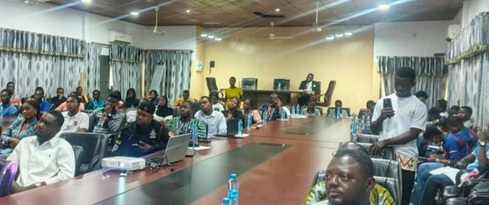
The students at the forum
She warned that one of the greatest threats to national development was not corruption alone, but silence and indifference that allowed wrongdoing to thrive.
Ms. Essien said true leadership was not about titles, popularity, or influence but rather responsibility, sacrifice, and service to others.
Honest campaign
For his part, the Legal Officer at the Central Regional office of the Commission on Human Rights and Administrative Justice, Kweku Simpson, raised concerns over corruption and influence peddling, describing corruption as a major obstacle to national development.
He cautioned student leaders against abusing political or social connections to influence decisions unfairly, especially as many student leaders eventually transitioned into national politics.
The Public Relations Officer of the Central Regional Command of the Ghana Police Service, Chief Inspector Isaac Evans Ettie, also advised students to avoid situations that could create conflicts of interest.
Civic Club
The event also witnessed the inauguration of executives for the UCC chapter of the NCCE Civic Education Club.
Sandra Awolousor was sworn in as president, with Mohammed Alhassan serving as Vice-President. Dugratey Quame Clara Korkor assumed the role of General Secretary, while Frimpong Samuel was named Projects and Programmes Coordinator.
Latest Stories
-
Mahama arrives in Egypt for AU summit and inaugural Alamein Africa Forum
5 minutes -
How the NPP and NDC undermine the GFA, then demand accountability
36 minutes -
Godfred Dame questions 2-night EOCO detention of Baffour Awuah over GH¢2.2m legal fees
43 minutes -
GH¢1.64bn NHIS claims paid in 2026 as Private Health Facilities welcome improved reimbursements
50 minutes -
Blue Medics champions healthy ageing at Akuapem North older persons commemoration
55 minutes -
NPP elects national executives today in Kumasi ahead of election 2028
1 hour -
Godfred Dame accuses EOCO, CID, AG of using state power to punish political opponents
1 hour -
Walter Mosley visits W.E.B. Du Bois Centre in Accra: A New York Secretary’s homecoming story on where Du Bois spent his final years.
3 hours -
MTN set to deploy 5G services after winning spectrum licenses worth US$202m
5 hours -
NPP national elections: 3,000–4,000 police to handle security, traffic in Kumasi – Karbo
7 hours -
Atta Akyea fumes as Manhyia MP is to spend another night in EOCO custody
8 hours -
SSNIT says La Beach clearance was to protect hotel investments, beaches to remain public
9 hours -
APSU congratulates St Augustine’s College after back-to-back National Investment Quiz wins
9 hours -
Renewed flood intervention at Mallam Junction raises hopes among residents, businesses
10 hours -
St Augustine’s College retain National Investment Quiz title after nail-biting grand finale
10 hours