

Audio By Carbonatix
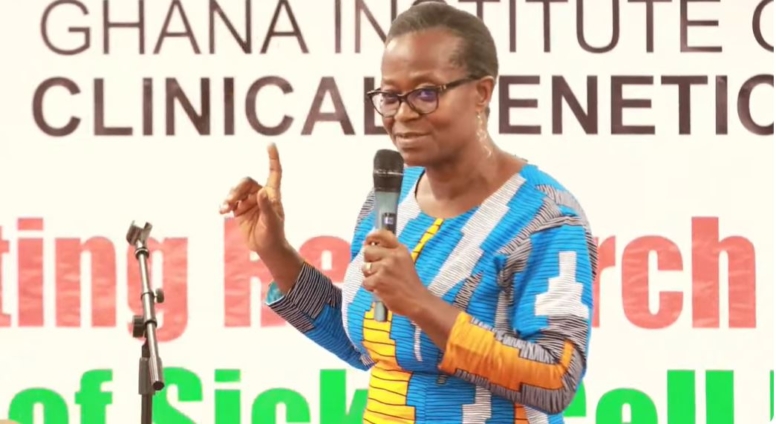
A professor of Haematology at the University of Cape Coast, Professor Ivy Ekem, has urged Ghanaians to stop blaming mothers for giving birth to children with sickle cell disease.
The past Vice President of the West African College of Physicians & Head of Department of Haematology at the University of Cape Coast emphasised that the condition is inherited from both parents, making it a shared genetic responsibility.
Delivering a public lecture on Friday, August 29, to commemorate the 50th anniversary of the Ghana Institute of Clinical Genetics, Prof. Ekem said, "If you have a mother or a father who is blaming the wife for a child who has been born with sickle cell disease, it's not right, because both parents contribute to the condition."
She clarified that a child can only be born with sickle cell disease if they inherit the gene from both their father and their mother.
She further noted that there are different types of the condition, with some individuals being SS while others are ST.
Prof. Ekem also sought to correct the common misconception that all people with sickle cell disease are constantly ill.
She explained that while the condition can be associated with illness, there are many individuals who live full and healthy lives with proper care and management.
She stressed the importance of moving away from the term "disease" to a more accurate understanding of the condition.
Professor Ekem's address comes at a crucial time for Ghana, which has one of the highest burdens of sickle cell disease in the world.
Approximately 2% of newborns in the country are born with the condition, which translates to about 15,000 babies each year.
The Sickle Cell Foundation of Ghana estimates that about 10,000 children born with the disease die before their fifth birthday.
The high number of carriers, which is around 20% of the population, further highlights the scale of the challenge.
The Ghana Institute of Clinical Genetics has been at the forefront of tackling this issue for the past 50 years, providing essential care, conducting research, and advocating for increased public awareness.
Prof. Ikem's message reinforces the need for a collaborative approach to sickle cell management, one that involves not only medical professionals but also community education and support to fight the stigma associated with the condition.
Latest Stories
-
GPL 2026/27: Darkwah Wiafe’s winner sees All Blacks beat Kotoko
5 minutes -
ITF World Tour : Patel Wins Boys’ Singles Final at J100 Accra
18 minutes -
Ghana must pursue BRICS partnership if it brings economic benefits – Kpebu
21 minutes -
Success and Wright Claims J100 Accra Girls’ Doubles Championship
21 minutes -
ITF J100: America’s Wright wins J100 Accra Girls’ Singles Title
28 minutes -
Expedition hopes to find aviator Amelia Earhart’s plane on remote island
28 minutes -
US seeks changes to rejected $109m health compact with Ghana – Mahama
59 minutes -
Nine dead in mass shooting at Pennsylvania home
1 hour -
‘Time for Ukraine to get new president,’ says Trump after Zelensky condemns diesel deal
1 hour -
Hincapie injury adds to Arsenal issues after Guimaraes rescue act
1 hour -
Henderson scores twice as Chelsea thumb Bournemouth
2 hours -
Photos: Mentapulse Africa convenes health and labour summit to address talent retention
2 hours -
Mahama inspects Nkokɔ Nketenkete plant, eyes Bechem as chicken capital
2 hours -
Ghana not seeking full BRICS membership, applying as Partner Country – Ablakwa
2 hours -
Woman injures three people in third Poland school knife attack in a week
2 hours