

Audio By Carbonatix
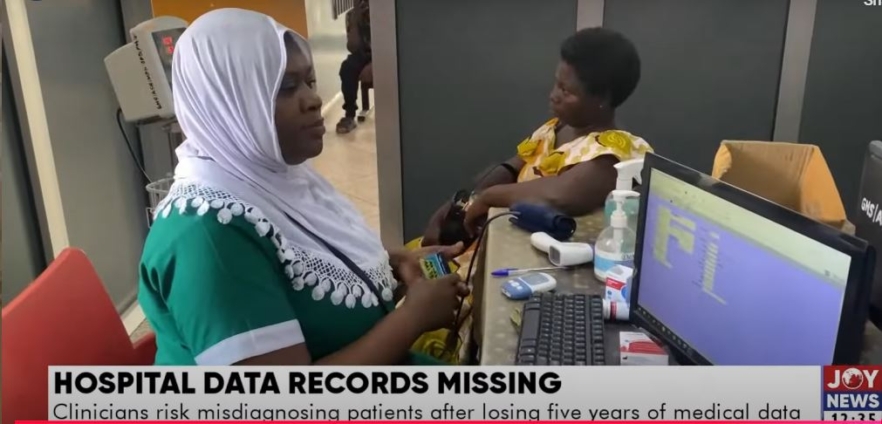
Healthcare delivery across Ghana's public facilities is facing a critical challenge, as medical records dating back to 2020 have been rendered inaccessible following the abrupt shutdown of the Lightwave Health Information Management System (LHIMS) for several weeks.
The disruption has forced doctors and health professionals to abandon electronic systems and rely on rudimentary tools like exercise books and patient folders to log new medical data, leading to long queues and threatening the quality of patient care.
The government, through the Health Minister, Kwabena Mintah Akandoh, lamented the shutdown and announced a new Ghana Health Information Management System (GHIMS) to replace the old system following disputes with the provider of LHIMS.
The move was justified by claims that the LHIMS contractors failed to deliver on their mandate, including connecting over 900 health facilities to the platform and other contractual breaches.
Dr. Elliot Koranteng, a nephrologist at the Komfo Anokye Teaching Hospital (KATH), highlighted the grave implications of the data loss in an interview with JoyNews’ Emmanuel Bright Quaicoe, who assessed the impact of the development in the Ashanti Region.
Dr Koranteng stressed that without historical records, doctors are effectively "tied" in their ability to diagnose and manage chronic illnesses.
Dr. Koranteng detailed the immediate difficulty faced by specialists managing conditions like kidney disease:
“...we had to virtually tell the patient that, listen, we are unable to assess [the system]. So those of you who have ever come, you may have to go [home], and those who remember your medications, then we may have to now write your own medications...
"...for me as a nephrologist, whatever has happened to your kidney function, whether it’s improving or getting worse, I will be able to tell if I’m able to see what your last lab result was. But now, even if you present [a result] today and your creatinine is, say, 200, the question is, I cannot be hard on you because I don’t know whether you have come from 300 to 200 or you have probably gone from 100 to 200..."
He emphasised that clinical decisions are impossible without the full patient history:
"...the difficulty is the fact that if you don't have the record, you would not even know what you are managing because you don't know the diagnosis; the diagnosis is not in our heads."
The specialist also raised serious concerns about the technical and ethical implications of replacing one Electronic Medical Records (EMR) system with another, noting the irony that once-abandoned physical folders now seem more reliable than the electronic infrastructure.
“So now the question is, we have LHIMS cards for these patients. Are we going to now get new cards for these ones? How do we link the new cards to the GHIMS card and be able to ensure there’s continuity of care...
"...it’s disappointing that gone are the days when we were using folders. I think now the folders are becoming more reliable because now we’re going back to the exercise book, which is like the folder, than when now we are using electronic medical records, which were supposed to be more reliable..."
Dr. Koranteng condemned the systemic risk created by such abrupt changes, which places patient safety at risk:
"...that one day a company says or maybe a government says okay now I don’t want this old one again,' and then a new one comes and says okay I also don’t want GHIMS because there was whatever...then what are we doing to ourselves as a country and this medical record or data of our patients is sacrosanct; it’s like so important without the data, we are useless. We cannot manage them [patients].”
Beyond clinical care, the lost data is also threatening vital academic and scientific work, as years of historical patient information—crucial for longitudinal studies—have vanished:
“To make matters even worse, there are a lot of studies that are going on that require this data... Now, where is the data? So a lot of grants or a lot of research that rely on this data are going to suffer.”
Health professionals are calling for the immediate restoration of the data system to mitigate the ongoing harm to patient management and research integrity.
Latest Stories
-
GRA submits preliminary report on drug shipment case to Mahama – Commissioner-General
8 minutes -
Sammy Gyamfi using ‘procedural roadblocks’ to dodge defamation case? – Afenyo-Markin’s lawyers
9 minutes -
The illusion of a good deal: Why some everyday money-saving habits may be costing you more
24 minutes -
Family seeks autopsy, police investigation into death of student 12 days after Abomosu SHS enrolment
33 minutes -
Trade Minister urges employers to leverage industrial opportunities to create jobs
40 minutes -
Asantehene plants trees to commence Jimi Watercourse Rehabilitation destroyed by galamsey
1 hour -
15 arrested, 6 trucks impounded over sandwinning activities on Kumasi-Accra Expressway
1 hour -
OFFICIAL: Vinicius will miss El Clásico, suspended four games
1 hour -
Prayer vigil held after four arson attack murders
1 hour -
GRA fully recovers $154k legacy debt owed by foreign entities between 2022 and 2024
1 hour -
Kwesi Pratt Jr warns bus preachers are adding to passengers’ stress with accident prophecies
1 hour -
MTN Ghana to spend $1.1bn in 3 years, build 500 new sites as MoMo hits 44% Growth
1 hour -
I have no regrets joining Assemblies of God – Mahama
1 hour -
Starlink restrictions in Ukraine war linked to political situation, Zelensky aide says
1 hour -
Furniture boost for Techiman North schools as MP donates to 20 institutions
1 hour