


Audio By Carbonatix
Ethiopia has detained 1,200 people over the deadly political violence that broke out a fortnight ago, police say.
These are the first mass arrests since reformist Prime Minister Abiy Ahmed came to power in April.
At least 28 people died in clashes near the capital, Addis Ababa, following the return of exiled leaders of a former rebel group, the Oromo Liberation Front (OLF) on 15 September.
Rights group Amnesty International has called for the prisoners' release.
In addition to those held in connection with the violence, a further 1,400 people were taken into custody following raids on places where people gamble, smoke shisha or chew the narcotic leaf khat
Most of those have been released, Addis Ababa police chief Maj Gen Degfie Bedi is quoted as saying by the state-linked Fana Broadcasting Corporate (FBC).
Those arrested for the violence have been sent to Tolay military camp, which is known for providing what is called "rehabilitation training", reports the BBC's Habtamu Tibebu from Addis Ababa.
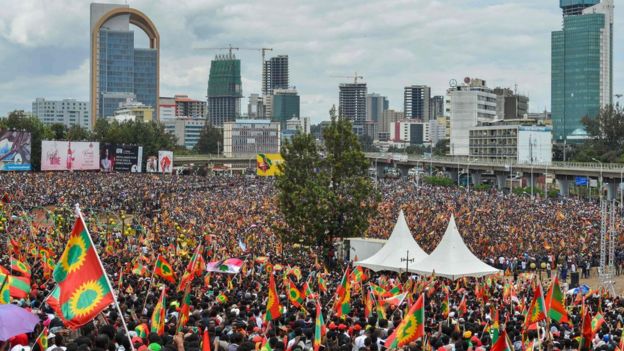
The rally to welcome back the exiled leaders of the OLF passed off peacefully
The trouble began on 13 September as OLF supporters placed their flag in parts of the capital. The move was interpreted by some residents as an attempt by the OLF to take control of Addis Ababa.
Rival supporters then clashed leading to the closure of parts of the commercial centre of Addis Ababa.
The violence escalated two days later, leaving 28 people dead, FBC quotes Maj Degfie as saying.
'Do not fill prisons again'
Most of them died through beating with sticks and stones as rival groups clashed and seven were killed by security officers, Maj Degfie said.
Amnesty International put the number of dead at 58.
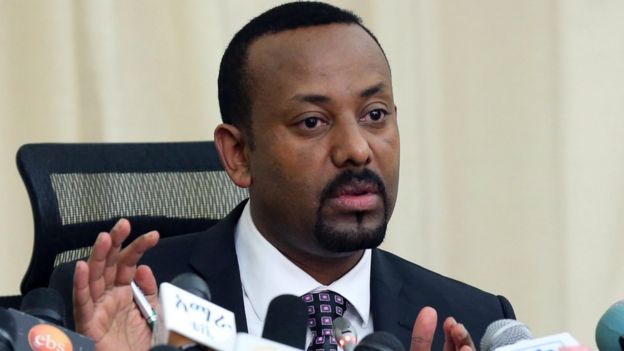
Prime Minister Abiy Ahmed has made changes that have transformed the country
It condemned the arrests, saying the government had made a "commendable attempt to empty" prisons and it should not "fill them up again" by detaining people without charge.
"The government must renew its commitment to a new era of respecting and upholding human rights," Amnesty added in a statement.
Since coming to power in April, Prime Minister Abiy has introduced a series of reforms that have been widely welcomed.
He has released thousands of political prisoners and unbanned groups, including the OLF, which had been labelled as terrorist organisations.
Mr Abiy who is from the Oromo ethnic group, has been seen as the person who could resolve political and ethnic divisions in the country.
In recent years, Ethiopia has been hit by a wave of protests led by Oromos, who have been complaining about political and economic marginalisation.
The Oromos are the largest ethnic group in Ethiopia.
Latest Stories
-
Labour Minister wants SOEs to help shape new public pay system
2 hours -
IPEC will ensure Equity and Sustainability in SOEs Compensation
2 hours -
White House bars CNN from travelling with Trump on Air Force One
3 hours -
Fennis wins second consecutive ITF J60 title in Accra
3 hours -
Spain beat England in thriller after Kane penalty miss
3 hours -
GPL 2026/27: Zaidan’s late goal ends Hearts of Oak unbeaten start
3 hours -
CEOs demand clarity on pay harmonisation, board autonomy as FWSC engages SOEs bosses over IPEC transition
3 hours -
2026 Women’s Super Cup: FC Savannah, Epiphany Warriors maintain top spots ahead of final group games
3 hours -
‘Is EOCO responsible for determining lawyers’ fees?’ – Baffour Awuah
3 hours -
David Beckles claims second J60 Accra title
4 hours -
No France cocaine suspect linked to Mahama, Vice President’s security details – NACOC
4 hours -
Anwelle Foundation launched in Jirapa to tackle poverty, youth unemployment
4 hours -
Joy Sports Editor Fentuo Tahiru Fentuo to moderate inaugural Music Meets Football Summit in Zambia
4 hours -
Court premises too volatile for Baffour Awuah’s attempted arrest by EOCO – Inusah Fuseini
5 hours -
Drug bust: Under no circumstances will NACOC leadership be compromised – Twum-Barimah
5 hours