

Audio By Carbonatix
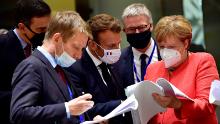
After almost five days of fraught discussions, European Union leaders have agreed on a 750 billion euro (almost $858 billion) stimulus plan to help fund Europe's recovery from the coronavirus crisis.
The deal would focus on providing funding across three pillars: creating reforms to help businesses rebound from the pandemic, rolling out new measures to reform economies over the long haul, and investing to help protect from "future crises." It would provide hundreds of billions of dollars in grants and loans to member states.
The agreement came after days of deadlock and fractious talks that were described as some of the most bitterly divided in years.
"We did it! Europe is strong. Europe is united," European Council President Charles Michel said at a press conference Tuesday. "This is a good deal, this is a strong deal, and most importantly, this is the right deal for Europe right now."
Michel described the occasion as the first time that members of the European Union were "jointly enforcing our economies against the crisis."
The commission also agreed to a core budget of 1.1 trillion euro (nearly $1.3 trillion) from 2021-2027.
Commenting on the deal, French President Emmanuel Macron hailed the agreement as a "historic day for Europe," while Belgian Prime Minister Sophie Wilmes said that "the European Union has never before decided to invest so ambitiously in the future."
There had been bitter rows over some of the terms of the deal during the last few days. The agreement came just hours after Michel had presented a new proposal to political leaders on Monday.
The European Union is battling a savage recession triggered by the pandemic, and the hardest-hit countries such as Italy and Spain urgently need fresh economic relief worth hundreds of billions of dollars.
Before Tuesday, any agreement had been thwarted by deep divisions over the overall size of the recovery fund, how much assistance should be given as grants or loans, and the conditions that should be attached.
The European Commission said earlier this month that it expects the EU economy to shrink 8.3% in 2020, considerably worse than the 7.4% slump predicted two months ago.The meeting of the EU top brass is the first major in-person gathering of world leaders since the pandemic started.
Latest Stories
-
Benedict Okyere Yeboah: Ghana’s football problem goes beyond sacking a coach
7 minutes -
GPL 2026/27: Darkwah Wiafe’s winner sees All Blacks beat Kotoko
13 minutes -
ITF World Tour : Patel Wins Boys’ Singles Final at J100 Accra
25 minutes -
Ghana must pursue BRICS partnership if it brings economic benefits – Kpebu
29 minutes -
Success and Wright Claims J100 Accra Girls’ Doubles Championship
29 minutes -
ITF J100: America’s Wright wins J100 Accra Girls’ Singles Title
36 minutes -
Expedition hopes to find aviator Amelia Earhart’s plane on remote island
36 minutes -
US seeks changes to rejected $109m health compact with Ghana – Mahama
1 hour -
Nine dead in mass shooting at Pennsylvania home
1 hour -
‘Time for Ukraine to get new president,’ says Trump after Zelensky condemns diesel deal
1 hour -
Hincapie injury adds to Arsenal issues after Guimaraes rescue act
2 hours -
Henderson scores twice as Chelsea thumb Bournemouth
2 hours -
Photos: Mentapulse Africa convenes health and labour summit to address talent retention
2 hours -
Mahama inspects Nkokɔ Nketenkete plant, eyes Bechem as chicken capital
2 hours -
Ghana not seeking full BRICS membership, applying as Partner Country – Ablakwa
2 hours