

Audio By Carbonatix
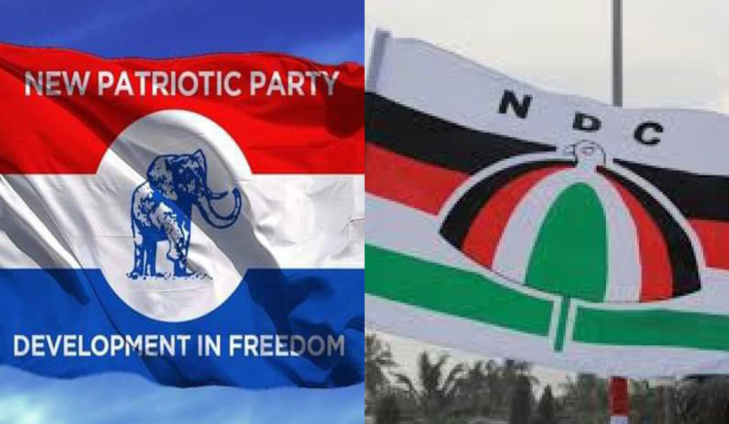
In the annals of Ghana's democratic dispensation, eight general presidential elections have shaped the political narrative since 1992. This has revealed a striking trend that has necessitated this data-driven article.
The New Patriotic Party (NPP) has consistently garnered more popular votes than its counterpart, the National Democratic Congress (NDC) in the last eight years.
As the Electoral Commission's data and data from other credible outlets disclose, the NPP's cumulative total of 34,228,070 votes, as against the NDC's 33,910,521, sparks a profound inquiry into the factors behind this electoral phenomenon.
The NDC's Electoral Contributions and Demarcations
Delving into the specifics of the NDC's performance across these eight elections, a nuanced breakdown emerges.
The man who led Ghana into its 4th Republic, Flt. Lt. Jerry John Rawlings, an iconic and enigmatic figure in Ghana's political history, played a pivotal role in the early years, contributing 6,424,809 votes during the 1992 and 1996 elections, representing 18.98% of the NDC's overall votes.
The subsequent eras were marked by distinct leadership figures. Prof Evans Atta-Mills of blessed memory, spanning the 2000, 2004, and 2008 elections, garnered 10,982,785 votes, constituting 32.39%. Former President John Dramani Mahama, leading the party in the 2012, 2016, and 2020 General elections, secured an impressive 16,502,927 votes, representing 48.68% of the NDC's cumulative total.
The NPP's Electoral Contributions and Demarcations
In contrast, the NPP's dominance is evident in its cumulative total of 34,228,070 votes. Notable figures have significantly influenced the party's electoral success.
Prof Adu Boahen, in the 1996 election, garnered 1,204,764 votes, constituting 3.52% of the party’s total vote.
John Agyekum Kufuor, a prominent leader covering the 1996, 2000, and 2004 elections, amassed 10,846,940 votes, representing 31.69%. The recent years, marked by Nana Addo Dankwa Akufo-Addo, saw an impressive 22,176,366 votes, contributing a substantial 64.79% to the NPP's overall total.
Possible Explanations based on the numbers
The NDC; Rural Appeal and Rawlings' Factor
One plausible explanation for the NDC's enduring popularity lies in its historical advantage in rural and peri-urban areas. President Rawlings' groundwork in these regions has created a sustained connection, making the NDC a formidable force in these locales. President Rawlings was a polarising figure. From his training days in the Air Force academy, leading the first coup in 1979 and head of the AFRC, handing over power to an elected president, working behind the scenes to ensure the success of democracy, and coming back to lead the 31 December revolution, Rawlings was able to marshal actions to create and sustain the vision of a better society for the Ghanaian people.
Many Ghanaians equally believed that Rawlings is a man of strong emotions, convictions and driven by a passion for moral justice, intellect and integrity. On the intellectual front, they maintain that he is the first leader of charisma and stature since Nkrumah (in his early days). Many in Ghana believe that Rawlings’ achievements in the political and economic realm were possible only because of his tenacity, honesty, clear objectives and sense of direction. He was a hands on leader who toured many hinterlands and hamlets to connect with people and work with them on the fields. That certainly counted in the scheme of things. The NDC has over the years failed to continue this trajectory.
The NPP; President Kufuor's legacy as the behemoth of social intervention programs has significantly shaped the NPP's popularity.
Under the second president of the 4th republic dispensation, substantial reform of contributory social security was undertaken, with the introduction of a national health insurance scheme, introduction of free primary education (school fee exemption via the 'capitation grant') in 2004, and social assistance schemes such as a school feeding programme (the Ghana School Feeding Programme or GSFP) in 2005, and a cash transfer scheme known as the Livelihood Empowerment Against Poverty (LEAP) scheme, announced in 2007 and implemented from.
He further instituted a National Youth Employment Programme, an active labour market policy intended to contribute to skills and job creation among the youth in 2006. The period of NPP rule (2000-2008) can therefore be characterised as one of intense reform of contributory social insurance, a degree of pro-poor social policy reform and modest expansion of social assistance which greatly endeared many people to the NPP.
Political Consequences for Ghana's Future The consistent lead of the NPP over the NDC in popular votes carries profound political ramifications for the future of Ghana's governance. The NPP's dominance, especially propelled by social intervention programs, suggests that pro-poor policies resonate with the electorate. This trend might encourage a continued focus on such policies to maintain voter support. This is evident in how the government is running the free SHS which has in the last 7 years directly impacted 1.4 million SHS students.
Understanding the geographical strengths of each party, particularly the NDC's appeal in rural areas, becomes crucial for shaping future electoral strategies of the party. The NDC may need to adapt its campaign to effectively address the varied needs of both urban and rural constituencies while giving true meaning to their social democratic roots.
Latest Stories
-
Government pledges to pay striking teachers as payment dispute is resolved
55 seconds -
GTEC flags over 100 tertiary institutions as unrecognised
12 minutes -
Agric Committee chair commends NAFCO for turnaround from GH¢20m debt to GH¢96m profit
17 minutes -
NPP: Judicial office requires judges to surrender some personal freedoms
22 minutes -
Senyo Hosi: Ghana missed its chance to end galamsey under Akufo-Addo
28 minutes -
Okaikwei Central MP alleges Ghana was close to settling Tullow tax dispute for $150m
30 minutes -
Patrick Boamah credits Godfred Dame for Ghana’s victory in $400m Tullow tax arbitration
33 minutes -
Dr Jasaw calls for National Agriculture Development Fund to accelerate food systems transformation
37 minutes -
Armah-Kofi Buah honoured for developmental initiatives in Aiyinasi-North
41 minutes -
Agbodza didn’t accuse Adom Kyei’s church of blocking road — Spokesperson
47 minutes -
Tema native petitions EOCO over GH¢889,000 payment
47 minutes -
VIP Jeoun Service opens new terminal in Ho, expands transport network
51 minutes -
Mahama orders immediate action to get striking teachers back to class
55 minutes -
Tema Fire Commander calls for private-sector support
55 minutes -
Adaklu is not a safe haven for environmental degradation – DCE
59 minutes