


Audio By Carbonatix
Recent data from the Ghana Statistical Service indicates a significant drop in the export value of cocoa beans for the second quarter (Q1) of 2024.
The export value fell from GH₵ 1.57 billion in the second quarter (Q2) of 2023 to GH₵ 1.15 billion in the second quarter (Q2) of 2024, marking a 26.9% decrease.
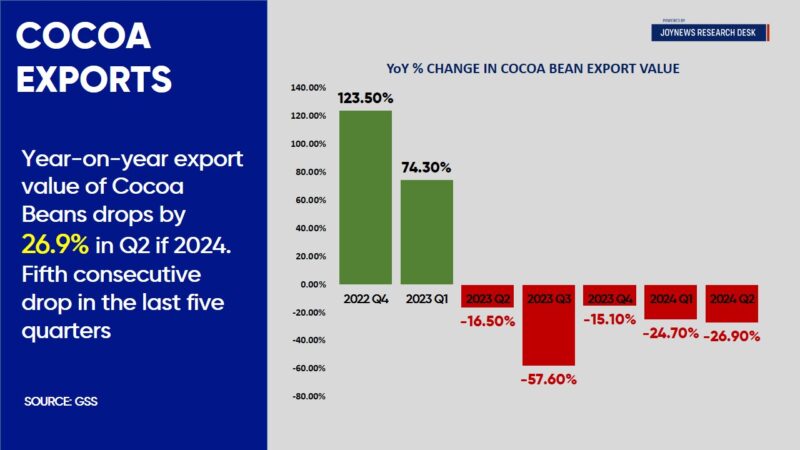
This decline is part of a continuing trend, with cocoa bean exports decreasing for the fifth consecutive quarter.
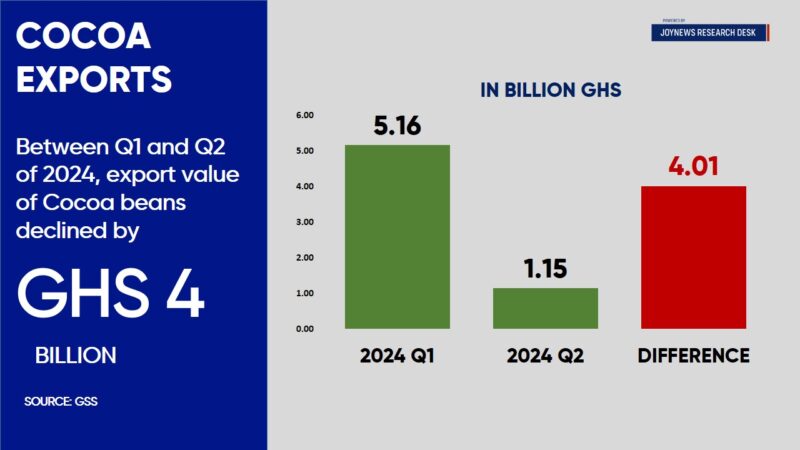
In the Q1 of 2024, the export value also dropped by 24.7% compared to Q1 of 2023. Notably, the quarterly decline between Q1 and Q2 2024 was even more drastic, with an 80% drop, equating to a GH₵ 4 billion reduction.
Production and Market Context
The reduced export values come amidst a challenging production season. By the end of June 2024, Ghana had produced about 429,323 metric tons of cocoa, less than 55% of the average production in previous years. This shortfall is expected to result in the lowest annual output in over two decades.
Supply and Price Dynamics
Poor harvests in Ghana and Ivory Coast have led to a four-year supply deficit in the global cocoa market, pushing up prices. Despite the increased global prices, Ghana has not reaped the benefits due to significant smuggling activities.
Low local prices and payment delays have driven farmers to sell to trafficking rings, resulting in a loss of over a third of Ghana's 2023/24 cocoa output—approximately 160,000 metric tons.
Price Adjustments and Smuggling
In response to the crisis, Cocobod has increased the farm gate price by 45% for the 2024/25 season, raising it from GH₵ 2,070 to GH₵ 3,000 per 64-kilogram bag. Previously, Ghana’s prices were GH₵ 490 lower than Côte d'Ivoire's, encouraging smuggling.
The new price is now GH₵ 440 higher than Côte d'Ivoire's current rate, but Côte d'Ivoire has yet to announce its 2024/25 price, leaving the impact of Ghana's price adjustment uncertain.
The decline in Ghana’s cocoa export value reflects broader issues of production shortfalls, market dynamics, and smuggling. While the farm gate price increase is a step towards addressing smuggling, its effectiveness remains to be seen, depending on regional pricing strategies.
Latest Stories
-
MTN set to deploy 5G services after winning spectrum licenses worth US$202m
2 hours -
NPP national elections: 3,000–4,000 police to handle security, traffic in Kumasi – Karbo
4 hours -
Atta Akyea fumes as Manhyia MP is to spend another night in EOCO custody
4 hours -
SSNIT says La Beach clearance was to protect hotel investments, beaches to remain public
5 hours -
APSU congratulates St Augustine’s College after back-to-back National Investment Quiz wins
5 hours -
Renewed flood intervention at Mallam Junction raises hopes among residents, businesses
6 hours -
St Augustine’s College retain National Investment Quiz title after nail-biting grand finale
6 hours -
Education infrastructure investment will drive Banda’s development – Ahmed Ibrahim
6 hours -
Teacher unions strike: Gov’t presents fresh proposals as talks end inconclusively
7 hours -
51,000 teachers’ promotion arrears to be validated for October payment – Education Minister
8 hours -
Kwabena Boamah appointed Board Chair for Impact Investing Ghana
8 hours -
Striking teacher unions to meet Fair Wages and Salaries Commission on October 6
8 hours -
EOCO working with AG to arraign Nana Baffour Awuah before weekend court
8 hours -
Duraplast reassures customers after fire, announces October 5 reopening
8 hours -
Call off strike, gov’t will not renege on promotion arrears pledge – Haruna Iddrisu to teacher unions
8 hours