

Audio By Carbonatix
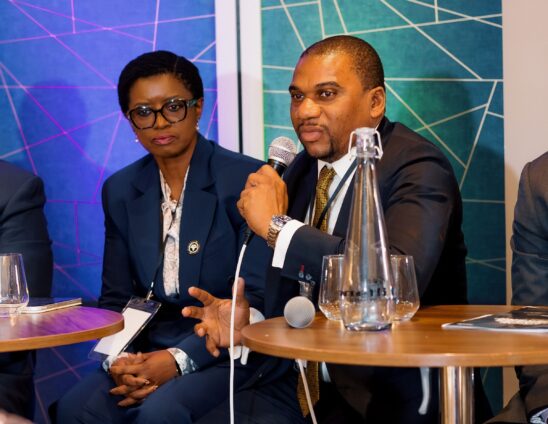
Managing Director of GCB Bank PLC, Farihan Alhassan, has called for a shift in Africa’s economic development strategy, arguing that the continent’s financing challenges are less about capital scarcity and more about building the right risk structures to attract investment at scale.
He made the remarks during the African Banking, Finance and Economic Leadership Roundtable held as part of the 16th African Business Leaders Awards in London, United Kingdom.
Speaking on the theme, Strategic Convergence: Aligning Global Capital with Africa’s Growth Imperatives, Farihan said Africa’s ability to attract sustainable long-term investment depends on how effectively governments, financial institutions and development partners work together to de-risk opportunities and create more predictable investment environments.
He pointed to the continent’s significant infrastructure financing gap, estimated at between US$68 billion and US$108 billion annually, as well as a widening climate finance deficit, where Africa currently receives only a fraction of the capital needed to meet its climate goals.
According to him, one of the biggest barriers remains what he described as the “Africa risk premium”, a perception that makes African countries pay significantly more to borrow, despite evidence suggesting actual default rates on infrastructure investments remain lower than in many other regions.
“The challenge is not always the absence of capital. Often, it is the structure of risk and the confidence needed to attract private capital at scale,” he said.
Farihan highlighted blended finance, partial credit guarantees and other de-risking tools as practical mechanisms that can help bridge the gap between global capital and African growth opportunities.
He referenced interventions by institutions such as the African Development Bank (AfDB), whose guarantee structures have helped mobilise billions of dollars in private sector investment, demonstrating the value of strategic partnerships in reducing risk and improving investor confidence.
He also described the African Continental Free Trade Area (AfCFTA) as a major catalyst for investment convergence, noting that the agreement creates an integrated market and provides a stronger foundation for industrialisation, regional trade and long-term capital flows.
Beyond foreign capital, Farihan urged African policymakers and financial institutions to focus on mobilising domestic institutional capital, including pension funds, sovereign wealth funds and insurance assets, which collectively hold more than US$2 trillion across the continent.
According to him, unlocking even a small share of these funds for infrastructure and private sector development could significantly transform Africa’s investment landscape and reduce overdependence on external capital.
The roundtable brought together senior banking executives, policymakers and financial sector leaders from across Africa to discuss practical strategies for accelerating investment, strengthening financial systems and positioning the continent for long-term economic transformation.
Other panellists included Henry F. Saamoi, Executive Governor of the Central Bank of Liberia; Shehu Usman Osidi, Managing Director and CEO of the Federal Mortgage Bank of Nigeria; Kapumpe Chola, Chief Executive Officer of First National Bank Zambia Limited; and Abdulmajid Nsekela, Group Managing Director of CRDB Bank Plc, Tanzania.
GCB Bank is Ghana’s number one bank and the country’s largest commercial bank. With 183 branches and over 340 ATMs nationwide, the Bank has served as a cornerstone of Ghana’s financial system since 1953, providing innovative financial solutions that support economic growth, financial inclusion and enterprise development across the country.
Latest Stories
-
Deputy Interior Minister calls for joint action to strengthen Ghana’s cybercrime response
6 minutes -
Gov’t announces plans to create 20,000 jobs in waste management, circular economy
11 minutes -
T-bills auction: Government exceeds target by 30%, but demand to remain relatively soft at next auction
13 minutes -
Election Watch Ghana raises concern over low female representation in NPP leadership
19 minutes -
Four drinks that help manage blood sugar
20 minutes -
Ray Michael Djan Jr puts Ghanaian creativity on global stage with Chelsea anthem
29 minutes -
Matilda Dibloni Kokar elected USAG president after two-year dormancy
32 minutes -
NPP delegates wanted youthful energy with Kojo Bamba’s election – Political scientist
35 minutes -
Zenith Bank supports Childhood Cancer Unit at Greater Accra Regional Hospital
36 minutes -
KMA empowers 64 persons with disabilities; Mayor unveils plan for sustainable skills centre
37 minutes -
DJs Union urges musicians to prioritise respect, communication amid industry tensions
45 minutes -
“Ghanaian DJs deserve their flowers” – Lasmid
46 minutes -
Zenith Bank supports childhood cancer unit at Greater Accra Regional Hospital
47 minutes -
‘Who’s in charge doesn’t really matter; we’re all servants’ – John Boadu on leader of NPP
51 minutes -
SLTF to advance fees for first-year students facing admission payment deadlines
1 hour