

Audio By Carbonatix
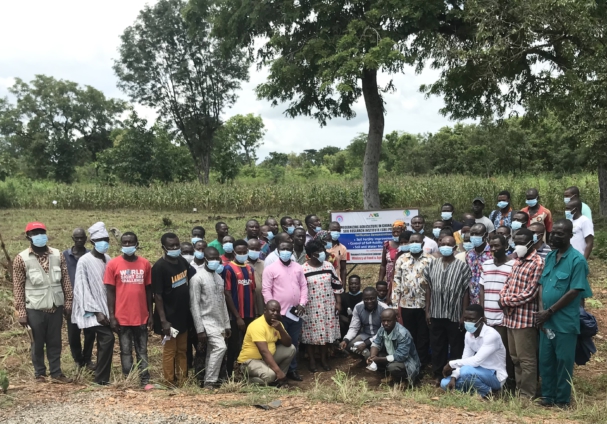
Farmers in the Sene East District of the Bono East region have been introduced to new farming technologies to improve their crop yields.
These new technologies were developed by the Soil Research Institute of the Council for Scientific and Industrial Research. It is under the Modernizing Agriculture in Ghana (MAG) programme, to help address the rapidly declining soil fertility levels in the region.
The 2020 Research Extension Liaison Committee observed farmers in the Bono East Region produced lesser crop yields due to declining soil fertility.
Scientists from the CSIR-Soil Research Institute visited the region to educate and demonstrate to farmers, its newly developed soil fertility management strategies.
A research scientist at the Institute, Dr. Emmanuel Dugan, took the farmers through the new technologies, including Biochar, a soil conditioner that helps to conserve both soil nutrients and moisture.
There is also poultry manure compost for soil fertility improvement and moisture conservation.
Mineral fertilizer (NPK 15-20-20+Zn) is specifically developed and recommended at 90-60-60 kilogram per hectare by the Institute for transition and part of semi-deciduous agroecology.
Scientific Secretary, Padlass Edeafour, representing the Institute’s director, urged the farmers to strictly adopt the strategies in cultivation.
“There are several developed farming technologies but their adoption by farmers remains a problem.
“I urge you all to put into practice what you’ll be taught here so that other farmers in the neighboring communities can as well adopt them,” he emphasized.
District Chief Executive of Sene East, Abraham Mbanye, lauded the programme and advised the youth to engage in farming to reduce the rate of unemployment in the region.
“I’m urging the youth that they shouldn’t see farming as a punishment or a non-lucrative job. Lately, if you want to count the wealthiest people in society, farmers are there.
“So, I am pleading to the youth, they shouldn’t see farming as a profession that belongs to the poor,” he emphasized.
Meanwhile, farmers who earlier adopted the strategy have evidently recorded improved crop growth.
The programme aims at supporting the government's flagship, Planting for Food and Jobs Programme.
Latest Stories
-
Power restoration fault suspected in Kumasi Central Market fire
3 hours -
The 7-foot giant of Ngleshie Amanfro: Seven-foot Ghanaian Ephraim Saawa dreams of joining the national basketball team
4 hours -
Government promises support for Kumasi Central Market fire victims
4 hours -
Vibes The Movie: Big Ghun’s Ghanaian film earns five nominations at 2026 REFFA
4 hours -
MamaCare CEO warns unresolved conflicts among health workers could undermine maternal and neonatal care
5 hours -
Health professionals urged to translate medical knowledge into practice to save mothers
5 hours -
Conflicts among care providers linked to maternal, neonatal deaths – Expert
6 hours -
GIS marks 10th TIME conference, champions improved teaching practices
6 hours -
BRICS Or Balance? What Ghana’s bid really means
7 hours -
GPRTU wants full TRAFFITECH-GH implementation to start in 2027
7 hours -
Mahama announces plans to import electric wheelchairs for PWDs
7 hours -
KGL U17 Colts 2026: Western beat Prempeh Elite Academy to set up final final with Greater Accra Region
7 hours -
Late Solanke strike salvages 10-man Spurs draw at Man United
8 hours -
Gender Ministry to monitor welfare of Nana Akua Addo’s children amid domestic violence case
8 hours -
Benedict Okyere Yeboah: Ghana’s football problem goes beyond sacking a coach
8 hours