

Audio By Carbonatix
It’s inevitable that floods will occur in some communities when the rains come down. But when it becomes the norm and has the potential of affecting the health of the residents in the community, fear doubles up. That’s what Ewuara Ama Helena Jesse faces every day.
“What I know is that floods occur when it rains heavily. But these days when it rains just between 2 to 3 hours then we get afraid because the waters rise so fast and enter our rooms,” Ewura Ama Helena Jesse stated.
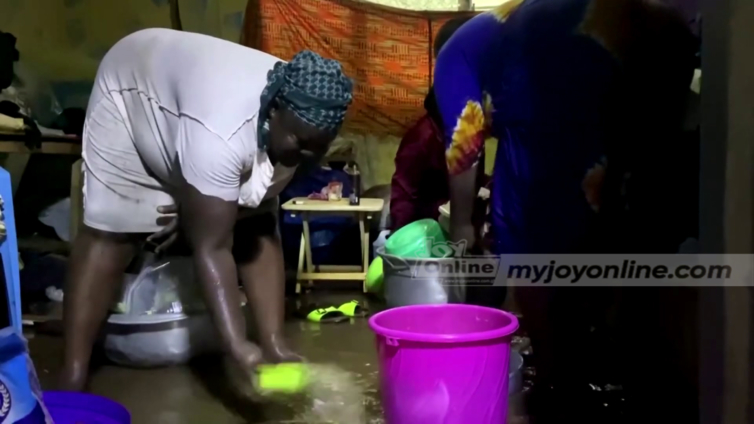
After the June 3, fire and flood-ravaged her family home at the Kwame Nkrumah Circle, behind the Ghana commercial bank tower, in the national capital Accra, she’s had to put off her refrigerator, pile her belongings on shelves, stop buying television sets because they are always washed away when the water enters her room.

She is always alert when the rains are about to fall because, in her world, rain equals disaster.
“It is very painful. I must tell you how I honestly feel about this situation. When it begins to rain around 5 pm and continues till around 8 pm, we all get anxious. We get scared even to put our heads on our beds.
"And yet we are helpless because we seem not to have any solution. All we can do is to watch the rain drain into our rooms. And the quantity of their property keeps decreasing due to the destructive power of the rainwater which floods their room, taking their things away.”
She went on to explain her survival methods which include fixing shelves on which she’s packed all her valuable assets so that they do not get wet when the rainwater gets into her room.
According to her, she placed her freezer at the topmost shelve to prevent it from getting destroyed by the rainwaters, meaning, she’s unable to use a refrigerator.
Aside from this, she and her family have had to worry about the dampness the rainwater leaves on the walls in the room.
According to an occupational hygienist, Dr Roland Sirigboh the dampness has the potential of causing asthma.
“After the floods recede, the damp environment can promote allergic reaction that can easily promote asthmatic attack,” he emphasised.
Dr Sirigboh also identified malaria after flooding as possible.
“We realise that there may be stagnant waters within our communities after the rains and this can promote the breeding of mosquitoes we know mosquitoes are the vectors of malaria, then by so doing malaria infection can increase during this time.”

The best or most suitable solution was perhaps, for Ewura Ama to have vacated this home, considering the cause of the flooding had not been addressed according to her.
But Ewura Ama who was born in this house cannot move out. Her source of livelihood was mainly from renting these 14 separate-room apartments tenants. That is no longer an option because her income has greatly dwindled with no one accepting to rent a house which floods every time it rains.
With a proud beam, she boasted “Look behind me. I have lots of empty rooms which I could have rented so I would earn some income. But I cannot do so because the rain waters come in and destroy the property of the tenants. I have two rooms with a hall, I had self-contained, and I have about six single rooms with each having its porch.
“They are all empty. Imagine how much I would have been earning from these empty rooms if I was renting them out. Yet, all these rooms are locked because of the rain.”
She narrated a story of how recently someone came to the house to rent a room but the rains destroyed all his things so he left. Ewura Ama describes this situation as ‘really depressing’ and retorts “But there is nothing much we can do about it than to keep collecting the waters when it enters our rooms, sometimes in three days the waters are still been collected, making them unproductive as well.”
Dr. Sirigbor who acknowledges that not all of the flooding situations can be easily averted, however outlined some solutions he believes when adhered to, can reduce the incidences of flooding in homes.
“We need to leave our compound greened. I am saying this because it has become a fashion for people to concrete their compounds and by so doing the water does not drain into the soil. When we concrete our homes it means that the water coming from our home won't get to seep into the soil.”
Whiles Ewuraana and her family attempt to abide by these measures, she’s hopeful of receiving the promised governmental support to enable her to raise the house beyond the current level so that it would be impossible for the flood waters to enter her room and also bring a permanent solution to the painful memories of June 3, especially when the clouds gather.
Latest Stories
-
“US Embassy introduced TRIBE Culture Fest to NSA, GTA” – Kofi Adams
32 minutes -
“NSA did not tell us of any embassy arrangement” – Kofi Adams
56 minutes -
Glasner suffers loss on Selhurst return as Palace beat Forest
3 hours -
WAFU B U17: ‘We won but I expected more from my boys’ – Kassim Ocansey
3 hours -
Man City cruise to statement win over 10-man Liverpool
3 hours -
Be careful with cross-border lending, foreign currency exposures – BoG to financial institutions
5 hours -
GPL 2026/27: Medeama go three clear as Hearts of Oak recover and Bechem stage stunning comeback
5 hours -
Ntiamoah Foundation launches “BEYOND 20” anniversary campaign
6 hours -
Credit Risk Management Directive: BoG to begin implementation for banks, others from July 1, 2027
6 hours -
Ghana Brands Awards 2026: Leading brands, business trailblazers to shine on November 20
6 hours -
T-bills auction: Demand improves as government exceeds target by about 76%; interest rates soften
6 hours -
Ziope undertakes initiative to build a technologically inclined community, commissions self-help ICT lab
7 hours -
ECG announces power outage in parts of Tema, Central Region due to network fault, maintenance
7 hours -
When the Gospel Becomes a Weapon: The church, blackmail and the abuse of faith
8 hours -
JoyNews’ Jacqueline Ansomah Yeboah selected for UK Media Excellence for Emerging Technologies Fellowship
8 hours