

Audio By Carbonatix
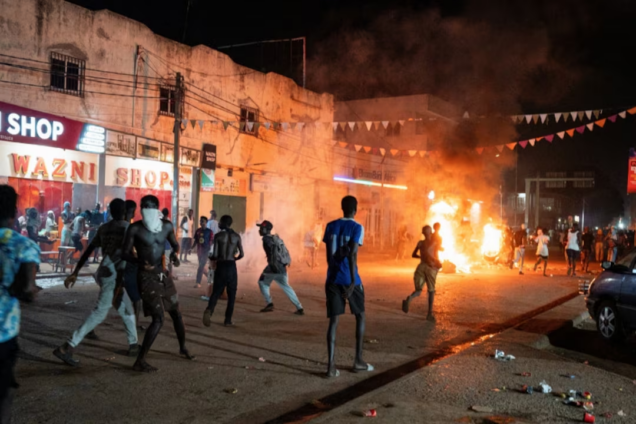
Gambia's police chief has announced that no further protests will be allowed in the West African nation without permits, after authorities used tear gas earlier in the week to disperse crowds that had formed to denounce prolonged power cuts during the hottest months of the year.
The protests over multiple nights highlighted frustration with President Adama Barrow ahead of the December elections.
"From this very moment, nobody is allowed to protest without an approved permit," Seedy Mukhtar Touray, Gambia's inspector general of police, said in a statement late Thursday.
"Nobody is allowed to converge, cause havoc, distort the peace and tranquility of the nation, especially during the night. Any violation to this will be met with necessary force."
During the unrest earlier this week, a police post was vandalised and "detainees were unlawfully released from custody", Touray said, while the national utility, National Water and Electricity Company Ltd (NAWEC), said it had closed three branches after attacks severely damaged buildings, infrastructure and office equipment.
Authorities have arrested 11 people in connection with vandalism during the unrest, Touray said.
'YOUTHS ARE FRUSTRATED', OPPOSITION CANDIDATE SAYS
In an interview with Reuters, Talib Ahmed Bensouda, mayor of Kanifing Municipality, said he understood why protesters were upset.
"If you can't sit in your house because of the heat. If you don't have [a generator] to do basic business or even to carry out informal activities… you're forced to take the matter to the streets," said Bensouda, who plans to challenge Barrow in the December election. "That's not something we support, but we understand the matter."
NAWEC said in a statement on August 15 that it was experiencing "an unforeseen surge in electricity demand during the peak period," which it attributed to high temperatures.
Barrow visited NAWEC facilities on Tuesday morning and promised that Gambia would receive new generators this week and restore electricity by the end of October.
He said the government was in the final stage of installing an additional 24-megawatt generation machine and that it awarded a contract for a 50-MW solar power plant.
But Bensouda faulted Barrow for relying too much on energy imports, leaving Gambia exposed to global supply disruptions.
"Youths are frustrated, and I think not just about energy, they're frustrated about a lot of things," Bensouda said. "There's a lack of opportunity and this is what's driving irregular migration to Europe."
Latest Stories
-
Livestream: The Law examines lawful arrest in Ghana
7 minutes -
Mahama urges African governments to treat healthcare as an investment, not budget cost
42 minutes -
Bawumia congratulates John Boadu and new NPP executives, pledges support ahead of 2028
43 minutes -
‘No talent should be left out’ – Bawumia pledges inclusive NPP campaign for 2028
49 minutes -
Prof. Mike Oquaye recounts how he blocked Special Prosecutor’s attempt to arrest Bawku Central MP
1 hour -
Make health sovereignty a priority for Africa – Mahama
1 hour -
Dorimon Naa, Wa West DCE lead massive clean-up exercise; threaten sanctions against recalcitrant residents
2 hours -
Photos from Adom FM Y2K Jam
2 hours -
Praye Tiatia steals the show at Adom FM Y2K Jam [Watch]
2 hours -
Boakye Agyarko congratulates John Boadu, pledges support for NPP leadership
2 hours -
Antwi HiMight thrills fans with Antwi ne Antwi hits at Adom FM’s Y2K Jam [Video]
2 hours -
Amb. Edward Boateng congratulates Boadu, Kodua on election wins
3 hours -
John Boadu pledges to rebuild NPP from grassroots and restore ‘winning machinery’
3 hours -
Ashaiman Assembly deploys monitoring system to curb dumping in storm drain
3 hours -
John Boadu must rebuild, unite NPP for 2028 – Edward Boateng
3 hours