

Audio By Carbonatix
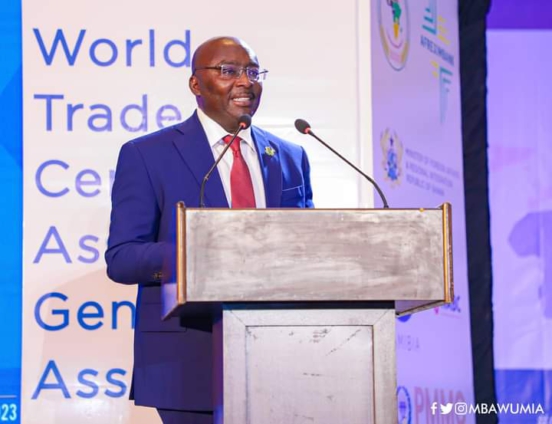
Vice President Dr Mahamudu Bawumia has underscored the government's dedication to addressing challenges within the informal economy through the implementation of the Ghana Card, a vital component of the digitalisation agenda.
Speaking at the 20th edition of the Ghana Club 100 Awards on Saturday, December 9, the NPP flagbearer highlighted the negative impacts of the informal economy, such as age cheating, identity fraud, and the proliferation of counterfeit documents like insurance, birth certificates, and passports.
Dr. Bawumia emphasised the importance of transitioning from an informal economy to a more disciplined and transparent system.
He outlined the issues faced in an informal economy, including corruption, lawlessness, tax evasion, and an unbanked society. To tackle these challenges and unlock the transformative potential of the economy, he noted that the government embarked on a formalisation process.
The Vice President explained that the digitalisation initiative played a pivotal role in this formalisation process, with the Ghana Card serving as its anchor.
He added that by digitising government services through Ghana.gov.gh and other initiatives, the government aims to enhance transparency, clarity, and efficiency in the system.
Dr Bawumia stated that these measures contribute to reducing corruption, as services can be accessed without the need for bribes.
“You look at an economy in the informal sense which turned to be undisciplined, the society is undisciplined because the economy is informal and there are no consequences for bad actions, you have a society where corruption prevails, you have lawlessness, you have a tax dodging society, you have an unbanked society, you have a loan repayment dodging society, identity fraud, people assuming identities of others, lack of address systems, age cheating, fake insurance, fake birth certificates, fake passports, no functional address systems, ghost workers on government payrolls.”
“These ills of the informal economy that we really inherited made it very difficult for the economy to transform to its potential. That is why we set out to formalize the economy to make sure that the economy works in a transparent system. In that area of formalisation of the economy we realized heavily on digitalization of the economy to formalize the economy.”
Latest Stories
-
Gov’t to establish Prison Industrial Hub to equip inmates with income-generating skills – Prison Service boss
9 minutes -
Alhassan Tampuli donates cement, roofing sheets to support storm victims in Gushegu
9 minutes -
Alhassan Tampuli appeals for urgent support for storm victims in Gushegu
12 minutes -
The hypocrisy must stop; pass Anti-LGBTQ+ Bill now – Alhassan Tampuli to Mahama
16 minutes -
Imprisonment should be rehabilitative, not punitive – Ghana Prisons boss at UNGA
38 minutes -
Ga Adangbe traditional priests petition Mahama over McDan aviation licence revocation
49 minutes -
Anti-LGBTQ Bill: NDC’s arrogance is worrying – Hassan Tampuli
59 minutes -
Let’s give OSP time to mature, not to scrap it – Hassan Tampuli
1 hour -
Nigeria convicts 386 Islamist militants in mass trials
1 hour -
Djibouti president wins election with 97.8% of vote, state media says
1 hour -
We don’t have mandate to deduct tax from rent allowance of security services personnel – Interior Ministry clarifies
1 hour -
Ablakwa receives Presidential Special Envoy on Reparations to advance global agenda
2 hours -
Christina Koch becomes first woman to travel around the moon on Artemis II
2 hours -
Epstein survivors’ calls to meet King Charles and Queen harder to ignore as US visit approaches
2 hours -
UN Secretary-General names Ghana’s Anita Kiki Gbeho as South Sudan envoy
2 hours