

Audio By Carbonatix
A coalition of civil society organisations is set to be launched in Ghana to strengthen the fight against transnational organised crime and the growing trafficking of young people into cyber-enabled scam operations across West Africa.
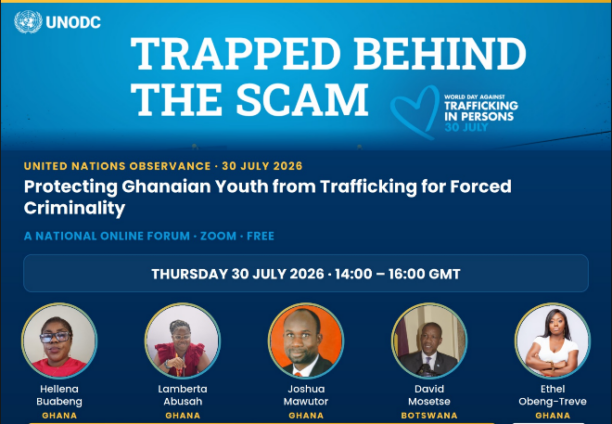
The announcement was made at a national forum held on Thursday, July 30, to mark the 2026 World Day Against Trafficking in Persons, where participants also adopted a communiqué outlining a series of recommendations for government, financial institutions, technology companies, regional organisations and civil society.
The forum, dubbed "Trapped Behind the Scam," was convened online by GYAN Ghana, the Democratic Network for Action (DNA) and Transnational Mobility Pathways (TMP).
It brought together representatives from government, the United Nations, regional organisations, survivor networks, academia, the financial and technology sectors, the media and youth groups.
The proposed Ghana Civil Society Coalition Against Transnational Crime will be formally launched in Accra on International Youth Day, August 12, 2026.
Organisers say it will serve as a survivor-informed platform to coordinate civil society action against trafficking for forced criminality and related transnational crimes, with plans to expand into West African and continental coalitions.
Trafficking victims forced into cyber fraud
The forum focused on what organisers described as one of the fastest-growing and least understood forms of human trafficking—victims who are recruited under false pretences and forced to engage in online fraud.
According to the organisers, many victims respond to seemingly legitimate job advertisements on social media or online recruitment platforms, only to discover after travelling that their passports have been confiscated, debts imposed on them and their freedom restricted.
They are then compelled to operate from secured compounds, carrying out cyber-enabled fraud under threats and daily performance quotas.
Participants warned that while the phenomenon initially gained prominence in parts of Southeast Asia, similar operations have increasingly emerged across West Africa.
Ghana no longer just a bystander
Speakers at the forum argued that Ghana has become a source, transit point and destination for trafficking linked to cyber fraud.
They cited several recent rescue operations involving Ghanaian nationals, including the rescue of more than 100 young Ghanaians in Ho in January 2026 after they had allegedly been recruited through social media, the repatriation of 28 Ghanaians from Côte d'Ivoire in May, and the rescue of 44 people from camps in Akwa Ibom State, Nigeria, in March.
Participants also referenced the July 21 rescue of nine people in Afienya, near Accra, and the arrest of 10 suspects in connection with suspected trafficking activities.
Call to protect victims, not prosecute them
A major concern raised during the discussions was what participants described as the growing overlap between victims and offenders.
They argued that many trafficked persons forced to commit online fraud are often arrested, prosecuted or deported as criminals rather than being identified as victims of trafficking.
The communiqué therefore calls for the strict application of the principle of non-punishment, urging authorities to screen every person rescued from scam compounds or returned from suspected trafficking situations before initiating criminal proceedings or deportation.
It also recommends providing legal aid, issuing clear guidance to law enforcement agencies and creating pathways for victims to have criminal records expunged where offences were committed as a direct consequence of being trafficked.
Experts highlight recruitment tactics and psychological impact
The discussions featured anonymous testimony from survivors alongside presentations by experts on the evolving nature of transnational crime.
Joshua Mawutor of Partners Recruitment Consult outlined how fake online job advertisements are used to lure victims into trafficking networks, while former INTERPOL Director and former Deputy Commissioner of the Botswana Police Service, David Mosetse, examined the cross-border and digital dimensions of the crime and strategies for disrupting criminal networks.
Clinical psychologist Mrs Ethel Obeng-Treve of Fafanto Psych and Wellness Consult spoke about the psychological trauma, stigma and long-term support required by survivors.
The All Africa Students Union also delivered a youth-focused presentation emphasising prevention among young people, who are considered particularly vulnerable to deceptive recruitment schemes.
GYAN Ghana urges stronger action
Lamberta Bina Abusah, co-convener of the forum for GYAN Ghana, said the organisation had spent years warning that many young people involved in internet fraud were themselves victims of exploitation.
"For fifteen years, since young Ghanaians first began to be drawn into online fraud, GYAN Ghana has warned that this was never simply a story of criminal young people—it was a story of young people preyed upon," she said.
"Today the world calls it 'Trapped Behind the Scam,' and the young person is no longer only running the scam—increasingly they are trafficked and forced to run it. This forum is a stand taken by young people, and our communiqué is a set of commitments we intend to carry to those with the power to act."
Key recommendations
Among the recommendations contained in the communiqué are calls for the Cyber Security Authority to simplify the reporting of online recruitment scams, work with digital platforms to remove fraudulent recruitment content and strengthen collaboration between cybersecurity and anti-trafficking agencies.
The forum also urged the Financial Intelligence Centre, banks and mobile money operators to treat suspicious scam-related financial transactions as potential indicators of human trafficking and to trace and freeze illicit proceeds while protecting victims whose accounts may have been used under coercion.
Participants further called for deeper cross-border collaboration through INTERPOL and ECOWAS, enhanced consular protection for Ghanaians trapped abroad and sustained youth-led awareness campaigns built around the message that legitimate employers do not confiscate passports, charge recruitment fees or pressure prospective employees into immediate travel.
The communiqué will be submitted to the relevant state institutions, while a full report on the forum and an edited recording of the event are expected to be published within the next three weeks.
Latest Stories
-
‘We have to say sorry’ – Queiroz apologies after Ghana’s humiliating defeat to Gambia
1 minute -
‘Beating Ghana did not surprise me’ – Gambia boss
41 minutes -
OpenAI agents get rebrand – as ‘dots’ – while safety worries delay new model
48 minutes -
US ban on Canadian alcohol and dairy takes effect as trade war drags on
1 hour -
Baffour Awuah’s EOCO case reopens Equity Savings & Loans file as SIC recovery battle emerges
1 hour -
Ghana ranked 5th source of cocaine seized at Antwerp, Belgium in 2025
1 hour -
‘We knew there was disruption’ – Gambia boss claims Ghana players clashed at half-time
1 hour -
Bagbin adjourns Parliament indefinitely
2 hours -
African Most Beautiful USA Queen to host Community Zumba Dance session in Accra
2 hours -
Cocaine probe: Speaker got it wrong by blocking parliamentary inquiry – Minority Leader
2 hours -
FoSCel foundation calls for end to stigma and stereotyping against people living with sickle cell disease
2 hours -
Auditor-General to track audit recommendations as GH¢280.5m in surcharges remains unpaid
2 hours -
Walewale MP withdraws ‘rude’ comment on Bagbin’s Parliament recall, apologises
2 hours -
FoSCel founder urges curriculum reform to strengthen sickle cell education in Ghana
2 hours -
United States launches America.Gov for public services 5 years after Dr. Bawumia launched Ghana’s version Ghana.Gov
3 hours