

Audio By Carbonatix
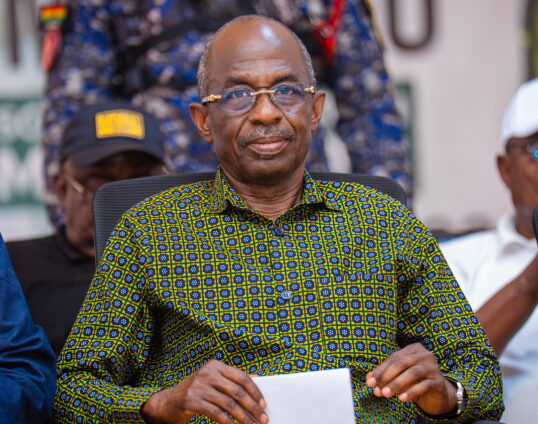
National Chairman of the National Democratic Congress (NDC), Johnson Asiedu Nketia, has called for sustained investment in scientific research, innovation and graduate education, arguing that Ghana's economic transformation will depend more on the quality of its human capital than on its natural resources.
He said countries that fail to prioritise research and innovation risk remaining consumers of knowledge and technology rather than becoming producers capable of driving economic prosperity.
Addressing participants as Guest of Honour at the second edition of the School of Sciences Science Fair, held under the theme "Advancing Graduate Education for Innovation, Entrepreneurship, Research Excellence and Global Impact," Mr Asiedu Nketia said graduate education must evolve beyond the acquisition of academic qualifications to become a catalyst for national development.
"We are living in an era defined by artificial intelligence, biotechnology, renewable energy, digital transformation, climate change and the knowledge economy. Countries that invest heavily in research and innovation are leading the global race for economic prosperity and technological advancement," he said.
Graduate education must solve national problems
Mr Asiedu Nketia said universities should become centres where research is translated into practical solutions capable of addressing Ghana's development challenges.
He argued that graduate education should nurture critical thinkers, innovators, entrepreneurs, policy advisers and problem-solvers rather than simply produce degree holders.
"Our universities must become centres where ideas are transformed into innovations, laboratories become incubators for businesses, and research findings influence public policy and industrial development," he stated.
According to him, scientific research only becomes valuable when it addresses real societal needs rather than remaining confined to academic publications and library shelves.
He therefore urged graduate students to focus their research on areas with direct relevance to national development, including food security, sustainable agriculture, climate resilience, environmental conservation, healthcare innovation, renewable energy, artificial intelligence, digital technologies, water and sanitation, manufacturing, industrial development and entrepreneurship.
"Research that remains on library shelves serves little purpose. Knowledge becomes truly valuable when it addresses real societal needs," he said.
Universities should create entrepreneurs
The NDC Chairman stressed that innovation and entrepreneurship must become integral components of graduate education, saying universities should produce graduates capable of creating jobs instead of merely seeking employment.
"The laboratories of our universities should become breeding grounds for startups, patents, commercial products and technological solutions," he said.
He called for stronger collaboration among government, industry, financial institutions and academia to ensure that promising scientific discoveries receive the funding and support needed for commercialisation.
"No nation has become economically successful without investing significantly in scientific research and innovation," he said.
Drawing lessons from countries such as South Korea, Singapore, China and Finland, Mr Asiedu Nketia said their rapid economic development was driven by sustained investments in education, science, technology and innovation.
He expressed confidence that Ghana possessed equally talented scientists and researchers but required visionary leadership, stronger partnerships, sustained investment and an enabling environment to unlock their potential.
Scientific evidence should guide policy
Mr Asiedu Nketia also advocated greater reliance on scientific evidence in public policymaking.
He said national policies on agriculture, health, education, infrastructure, environmental protection and industrialisation should increasingly be informed by credible research produced by universities and research institutions.
"As a politician and public servant, I firmly believe that scientific evidence should guide policymaking and drive our developmental agenda," he said.
Challenge to graduate students
Addressing graduate students directly, the NDC National Chairman reminded them that their qualifications carried responsibilities beyond earning certificates.
He urged them to use their research to tackle national and global challenges while remaining innovative and willing to question conventional thinking.
"Your degrees are not merely certificates; they represent responsibility. Your research should not merely satisfy academic requirements, but should contribute meaningfully to solving national and global challenges," he said.
He encouraged young researchers to remain curious, resilient and innovative, noting that many of the world's greatest inventions began as simple ideas developed by individuals who refused to accept that problems were impossible to solve.
Call for stronger academia-industry partnerships
Mr Asiedu Nketia also commended faculty members for mentoring the next generation of scientists and urged industry leaders to deepen partnerships with universities through internships, collaborative research, funding opportunities, innovation hubs and commercialisation initiatives.
"When academia and industry work together, innovation flourishes," he said.
He further emphasised that science should ultimately serve humanity by reducing poverty, improving healthcare, protecting the environment, strengthening food security, creating sustainable jobs and promoting peaceful and prosperous societies.
"The future belongs to nations that embrace knowledge, innovation and research," he said.
He challenged graduate students to think globally while developing solutions to local problems, expressing optimism that the next major technological breakthrough or life-saving medical discovery could emerge from the institution hosting the science fair.
Mr Asiedu Nketia concluded by congratulating the School of Sciences for organising the event and expressed the hope that the annual science fair would grow into one of Ghana's leading platforms for scientific discovery, innovation and research excellence.
He said graduate education should become "the engine of innovation, entrepreneurship, research excellence and sustainable national development," calling on all stakeholders to work together towards that goal.
Latest Stories
-
EOCO court warrant authorised search of Baffour Awuah’s law firm, not residence – Afenyo-Markin
6 minutes -
NPP delegates conference: 3,000 to 4,000 police personnel deployed for security in Kumasi – Anthony Karbo
8 minutes -
KGL Foundation commits $200,000 to support juvenile football for the next two years
24 minutes -
UNDP invites Mahama Ayariga to Northern Peace Conference in Tamale
29 minutes -
Afoko can give NPP ‘new identity’ ahead of 2028 to overcome NDC – Political scientist, Dr Amakye-Boateng
43 minutes -
2 injured amid gunshots during raid at Nawara Mining office at Nsuapemso
47 minutes -
St Augustine’s College retains 2026 National Investment Quiz title
52 minutes -
KNUST Nursing and Midwifery School staff recognised at 2026 Health Ministry Excellence Awards
60 minutes -
JoyNews’ Esther Esi Nkrumah selected for UK Media Excellence for Emerging Technology Fellowship
1 hour -
Five NDC youth organisers in Western Region pay courtesy call on Armah-Kofi Buah
1 hour -
NACOC demands tighter port controls to prevent Tema Harbour drug trafficking
1 hour -
Ghana’s startup ecosystem must build sustainability into innovation – Ghana Hubs Network
2 hours -
Friday’s beachfront demolition was carried out at Labadi Beach Hotel’s request, not for flood mitigation – Stan Dogbe
2 hours -
LA 2028: Mukarama returns to Black Queens squad for Olympic Games qualifiers
2 hours -
Fusaini Yakubu Abanga leads NPP National Youth Organiser race with 45% in Global InfoAnalytics poll
2 hours