

Audio By Carbonatix
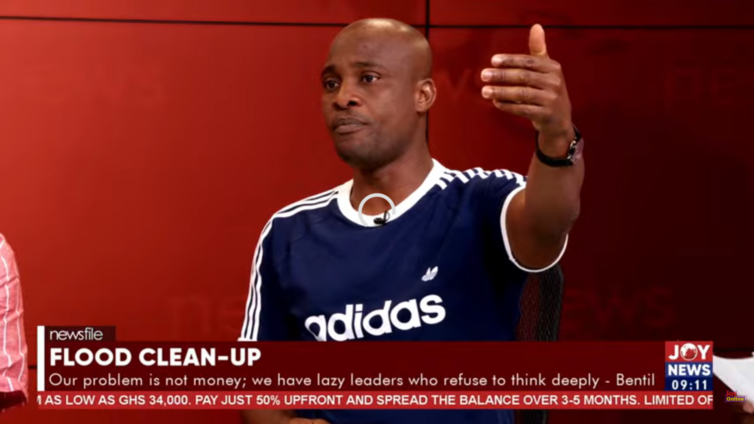
The Member of Parliament for Akwatia, Bernard Bediako Baidoo, has called for stronger enforcement of Ghana's existing environmental and sanitation laws and regulations, arguing that the country’s recurring sanitation and flooding challenges cannot be blamed solely on public indiscipline.
Speaking on JoyNews' Newsfile programme on Saturday, July 11, the legislator acknowledged concerns about indiscipline in the Ghanaian society but maintained that the major failure lies in the inability of state institutions to enforce laws that are already in place.
According to him, unlike many developed countries where compliance with regulations is largely observed, Ghana's challenge has been the weak enforcement of rules governing public behaviour, land use and sanitation.
"The kind of indiscipline, all of us, the kind of indiscipline we have here, the difference between here and there (Western countries) is the indiscipline, because if there is no indiscipline, you don’t talk about enforcement," he said.
However, Mr. Baidoo stressed that Ghana cannot attribute its sanitation and flooding problems entirely to indiscipline, insisting that the country already has sufficient legal frameworks and institutions capable of addressing these challenges.
The Akwatia MP argued that Ghana's inability to effectively manage sanitation and prevent environmental degradation is not because of a shortage of legislation.
"We have our laws, there are law enforcement officers and agencies, there are assemblies, we have so much laws," he stated.
He maintained that introducing more laws would not resolve the country's challenges unless existing regulations are properly implemented.
"In fact, we don’t need further laws, it's all about enforcement, and that is where I come to that we need to enforce it," he added.
His comments come amid renewed national discussions about the causes of recurring flooding and sanitation difficulties, following recent floods that affected several communities and sparked debate over whether the main challenge is public behaviour, weak governance systems or inadequate infrastructure.
Mr. Baidoo acknowledged that indiscipline contributes to environmental challenges, including poor waste disposal practices and disregard for regulations.
He referenced comments made by former President Nana Akufo-Addo during an engagement with Ghanaian residents in Canada, where the former president reportedly highlighted indiscipline as a major challenge facing the country.
"Former President Akufo-Addo conceded when he went to meet the Ghanaian community in Canada and said he will not even continue using our money to cure our indiscipline. He admitted that the problem was indiscipline," Mr. Baidoo said.
However, he argued that while individual responsibility remains important, the state cannot use public indiscipline as a substitute explanation for institutional failure.
Responding to President John Dramani Mahama's comments on the issue, the MP said he agreed with the need to address indiscipline but cautioned against presenting it as the sole reason for Ghana's current situation.
"President Mahama is saying, and I agree with him, but it cannot be said that we are where we are because of indiscipline," he stated.
Mr. Baidoo argued that Ghana's governance system already provides institutions with the authority needed to enforce standards in areas such as sanitation, construction, environmental protection and urban development.
He pointed to the role of law enforcement agencies and Metropolitan, Municipal and District Assemblies (MMDAs), saying these bodies must be empowered and held accountable for ensuring compliance.
According to him, effective enforcement would reduce practices such as illegal dumping, unauthorised developments and disregard for environmental regulations.
Mr. Baidoo urged authorities to move beyond assigning blame and focus on applying existing rules consistently.
He argued that sustainable solutions require a combination of responsible citizen behaviour and firm institutional action.
While acknowledging the importance of addressing societal attitudes towards sanitation and environmental protection, he maintained that laws only become effective when state institutions have the commitment and capacity to enforce them.
Latest Stories
-
Israel-bound flight diverted after fight between pilots
3 minutes -
EchoWave earns praise for sound quality at 10th Women in Worship
13 minutes -
Crackdown on South Africa’s unsafe streets ordered by president to keep women safe
24 minutes -
Banks are responding to improved monetary policy conditions – John Awuah
43 minutes -
Judges’ conference forces further adjournment of Salomey Baffoe case to Oct. 5
55 minutes -
Chorkor community joins AC4NCA clean-up to tackle marine and coastal pollution
1 hour -
GRA assures Tullow of collaboration to settle $393m tax liability without disrupting its petroleum operations
1 hour -
South Korea demands apology from Pyongyang for landmine blasts that injured three
1 hour -
Carlos Queiroz not the sort of coach Black Stars need – Nii Lante Vanderpuye
2 hours -
AFCON 2027Q: ‘Our Black Stars team is gone’ – Former Sports Minister
2 hours -
Prof. Prempeh calls for public review of draft constitutional reform bills
3 hours -
AFCON 2027Q: ‘I have never seen a poor performance from Black Stars like against Gambia’ – Nii Lante Vanderpuye
3 hours -
Bawumia backs insurance sector reforms after engagement with IBAG
3 hours -
Nigeria set to launch National Digital Address System 9 years after Ghana showed the way
3 hours -
Policy rate decision takes time to reflect in lower lending rates – BoG
3 hours