

Audio By Carbonatix
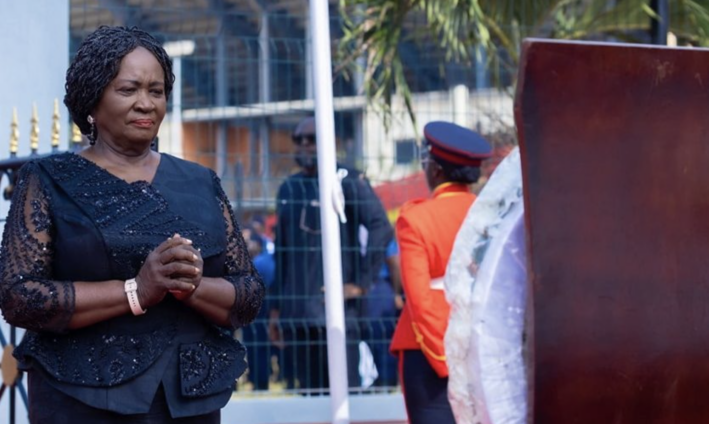
Vice President Professor Jane Naana Opoku-Agyemang has led a solemn wreath-laying ceremony at Ghana’s Nationalism Park, in Accra, in honour of the three ex-servicemen killed in the ‘February 28 Crossroads Shooting Incident’ that led to the country’s eventual independence.
Sergeant Major Adjetey, Corporal Attipoe, and Private Odartey Lamptey, the three martyrs, were members of the Gold Coast (now Ghana) Regiment enlisted in the British Army during the World War II.
Having seen combat in campaigns in East Africa, the Middle East, and Asia, these veterans would find themselves primarily ignored by the colonial administration upon their return, as promised pensions and benefits were either insufficient or unpaid.
This would lead to a protest march led by the three veterans on February 28, 1948, but events took a different twist as police on guard at the Christiansborg Castle, the seat of the colonial administration, opened fire on the peaceful protesters, killing the three heroes in the process.
Vice President Prof. Opoku-Agyemang was on hand to lay a wreath on behalf of the Government and People of Ghana as the West African nation, the first country in sub-Saharan Africa to gain independence from British colonial rule, marked the 78th Anniversary of the Shooting Incident.
Wreaths were also laid by representatives of the security services, traditional rulers, relatives of the departed souls, and Veterans Association, Ghana.
Other activities included a flag raising ceremony, observing a minute silence, as well as a reveille, symbolising the dedication and bravery of the soldiers in the line of duty.
A contingent of 50 officers and 143 personnel, drawn from the Ghana Armed Forces and Ghana Police Service, mounted a parade under the command of Wing Commander Christian Mensah in honour of the veterans.
Some seven decades after the tragic incident, Ghana has been eulogising the three ex-servicemen as the ramifications of their bravery led to the setting up of the Watson Commission, whose findings highlighted the deep-seated grievances of the Ghanaian people and the inadequacies of colonial governance.
The Commission would recommend substantial reforms, including the introduction of more representative government structures.
Significantly, these recommendations paved the way for drafting a new constitution, granting greater political representation to the local population, and the granting of independence to Ghana in 1957, the first to be achieved by any country in sub-Saharan Africa.
Latest Stories
-
Lawrence Kobena Nsarko Otoo, Esq
37 minutes -
Bel-Aqua intensifies mental well-being campaign ahead of 15th anniversary
40 minutes -
From banking to party finances: Alfred Kwadwo Thompson elected NPP Treasurer
44 minutes -
George Christian Papa Mends
49 minutes -
Ali Suraj elected NPP NASARA Coordinator
1 hour -
Mustapha Hamid misses out on NPP Vice Chairmanship by 31 votes despite early poll lead
1 hour -
Kojo Bamba, Henry Nana Boakye and Nana Akomea elected NPP Vice Chairmen
2 hours -
From Delta Force to NPP First Vice Chairman – Kojo Bamba’s political journey
2 hours -
Police restore calm at Larteh following Odwira festival disturbance
3 hours -
‘All the camps will dissolve’ – Bawumia demands one NPP for 2028
3 hours -
There is no time to waste – Bawumia orders NPP to begin 2028 work
3 hours -
Sarkodie visits MobileMoney Fintech LTD
3 hours -
John Boadu unveils new NPP strategy to win back youth and modernise party
3 hours -
Hawa Koomson elected NPP National Women’s Organiser
3 hours -
John Boadu begins NPP rebuild from grassroots ahead of 2028 election
3 hours