

Audio By Carbonatix
Foreign Affairs Minister, Samuel Okudzeto Ablakwa, has issued a staunch defence of the nation’s long-standing policy against hosting foreign military bases, arguing that the escalating conflict in the Middle East proves the wisdom of Ghana’s stern neutrality.
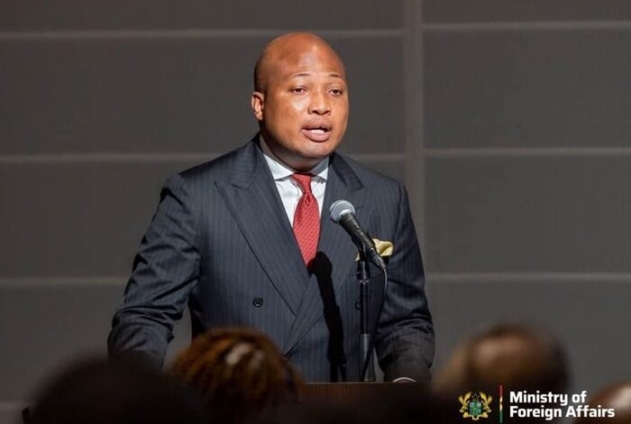
Speaking at the Chatham House think tank on Monday, 9th March 2026, the minister addressed growing regional anxieties over international defence pacts, including the pending EU-Ghana security cooperation, by clarifying that while Accra welcomes strategic partnerships, it will never concede its territory for the stationing of foreign troops.
The ‘Red Line’ of sovereignty
The minister’s comments come at a time of extreme geopolitical tension, as the US/Israel-Iran conflict spills over into neighbouring Gulf states. Recent retaliatory strikes by Tehran against regional hubs hosting American military assets have served as a grim backdrop for Ghana’s diplomatic positioning.
Mr. Ablakwa noted that Ghana’s refusal to host such bases is a calculated move to insulate the country from becoming a proxy battlefield for global powers.
“We do these things in our strategic national interest, and we are also careful to draw the lines. And so there’s a red line. We do not accept military bases in our country,” Mr. Ablakwa declared. “I’m sure that what is happening in the Middle East now vindicates Ghana’s position.”
Strategic interests vs. Permanent presence
Acknowledging existing arrangements, such as the Defence Cooperation Agreement (DCA) with the United States, approved by the Parliament of Ghana, the minister was quick to distinguish between logistical cooperation and permanent foreign footprints. He emphasised that Ghana maintains similar strategic ties with the UK and several GulfStates, but these are strictly bound by domestic law.
According to the minister, the stern position that once puzzled some international partners is now being viewed with newfound respect as the risks of hosting foreign assets become clear.
He stated thatall interventions and collaborations must be negotiated individually. No military movement or joint operation can occur without specific, high-level authorisation from the Ghanaian government, he stressed.
By avoiding permanent bases, Ghana avoids becoming a target for retaliatory strikes from the enemies of its strategic partners.
Echoes of the Sokoto Mission
The minister pointed to the Christmas Day 2025 strikes on ISIS targets in Sokoto State, Nigeria, as a prime example of how Ghana prefers to operate.
In that instance, Ghana collaborated with the US and Nigeria only after a formal invitation and an agreed-upon scope of intervention. This model allows for high-impact counter-terrorism without the long-term sovereign risks associated with a standing foreign base.
As the European Union prepares to sign its first-ever African defence pact with Ghana in the coming days, Mr. Ablakwa’s remarks serve as a definitive notice to Brussels: Ghana seeks a partnership of peers, not a station for foreign divisions.
READ ALSO: Ablakwa reveals Ghana’s role in US-Nigeria Christmas Day strikes on ISIS targets
Latest Stories
-
ICU urges GHABA members to transform hairdressing skills into sustainable enterprises
13 minutes -
Ghana eyes stronger trade ties as Australia hosts multicultural trade and investment forum
23 minutes -
Margaret-Marie Krakue
26 minutes -
Ayariga announces plans for live broadcast of MMDAs’ meetings on local radio stations
29 minutes -
Mrs Anna Tackie
31 minutes -
Ghana links Afghan heroin and Brazilian cocaine to global drug markets – Global Organised Crime Index
38 minutes -
NHIA launches nationwide inter-school quiz to deepen students’ knowledge of NHIS
44 minutes -
Political protection could be masking Ghana’s cocaine trade – Global Organised Crime Index
49 minutes -
AFCON 2027Q: ‘We have to dissolve the GFA’ – Effia MP after Black Stars lose to Gambia
51 minutes -
NPP announces voting schedule and ID requirements for October 3 national elections
53 minutes -
Lupus can mimic HIV symptoms and damage kidneys if untreated – KNUST expert
56 minutes -
Focus on Sickle Cell Foundation seeks to introduce sickle cell education through comics in Ghanaian schools
1 hour -
NPP rewrites the campaign playbok as opposition reality shapes National Executive contest
1 hour -
Road safety education will fail without enforcement – NRSA boss
1 hour -
Daily Insight for CEOs: Finishing Q3 strong and entering Q4 with purpose
1 hour