

Audio By Carbonatix
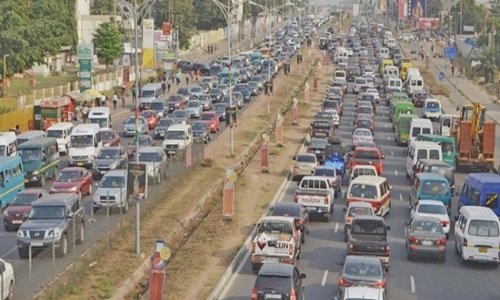
Ghana’s growing urban mobility crisis where commuters spend long hours in gridlocks during peak or productive hours, is costing the economy an estimated GH¢4.5billion per annum, according to findings from a study conducted by Glima Research—a leading research and consulting firm.
The study showed that traffic congestion, particularly along major ‘gridlock hotspots’ in Accra, has become a drawback to worker productivity, draining incomes and grossly impacting the quality of life in the capital.
In terms of breakdown, the findings showed that time lost in traffic accounted for approximately GH¢3.2 billion annually, representing about 71 percent of the total estimated losses.
Fuel waste contributed GH¢434 million, or roughly 10 percent, while productivity losses linked to stress and fatigue amount to GH¢815 million, representing about 18 percent of the total cost.
The research centered on the heavily congested Madina–37 corridor in Accra as a case study to project its national implications. The corridor was analyzed through data modeling to quantify time losses, fuel waste, and productivity impacts, which was then scaled nationwide using Gilma’s traffic multiplier model.
“Traffic congestion, particularly in Accra, is more than just a nuisance; it is a massive economic sinkhole quietly draining productivity, income, and quality of life,” the report highlighted.
It added: “This crisis is far from static - it is escalating; as Ghana’s urban population continues to rise, especially in key growth areas, so will the number of vehicles, the hours lost to traffic congestion, and the economic damage caused by traffic paralysis.”
Describing the situation as escalating rather than static, the report warns that Ghana’s rapidly growing urban population—particularly in key growth corridors—will only intensify congestion if urgent interventions are not implemented.
Beyond the economic toll, the environmental impact is equally alarming. The study estimates that preventable fuel waste from vehicles idling in traffic results in approximately 73,000 metric tons of excess carbon dioxide emissions each year nationwide—an environmental burden equivalent to wiping out the climate benefit of three million trees annually.
The study further revealed that congestion-induced stress and fatigue reduce effective productivity by about 30 minutes per commuter per day. On the Madina–37 corridor alone, this translates into an annual loss of GH¢72.8 million in reduced work output.
Other heavily congested routes—including Spintex Road, Mallam–Kasoa, and Circle–Achimota—face similar or even worse gridlock, particularly during peak hours, whilst several regional capitals grapple with varying degrees of traffic congestion, compounding the national economic impact.
To address the situation, the report proposed a number of interventions including widening roads along critical segments, an upgrade to inner and feeder roads to reduce pressure on major highways, and deployment of smart traffic lights.
“Urban mobility investments are no longer optional but urgent, high-return economic priorities essential to safeguarding Ghana’s productivity, environmental sustainability, and long-term development,” the report stated.
While widening can provide immediate relief, sustainable improvements will require a comprehensive, multi-pronged approach that anticipates future growth rather than merely responding to current pressure, it further suggested.

Other recommended interventions include graveling or concreting alternative routes in residential areas as well as decentralizing government services and business centers to reduce travel demand.
The report titled “The cost of gridlock: a policy brief on Ghana’s urban traffic crisis” was co-authored by a multidisciplinary team with deep expertise in engineering, analytics, and public policy comprised of lead research analyst Andy Sevordzi and Franklin Owusu-Kwakye, a seasoned geodetic engineer with extensive experience in transportation planning and infrastructure research.
Other team members were: Yussif Mohammed, a graduate of statistics with advanced data modeling skills and leadership in quantitative research; and Rudolph Djirackor, a biochemist and HSE specialist with proven track record in environmental health research and policy analysis.
Latest Stories
-
Kwaku Azar writes: A-G vs OSP
25 minutes -
Mfantsipim–Adisadel rivalry built excellence, not division – Sam Jonah
50 minutes -
Vice President launches Mfantsipim’s 150 years of shaping Ghana’s greatest mind
1 hour -
I assure Otumfuo, Mahama will join him to commission KNUST Teaching Hospital by end of this year – Haruna Iddrisu
2 hours -
Barcelona dominate derby to extend La Liga lead
2 hours -
Gov’t to roll out free special education for persons with disabilities from July 1 – Education Minister
2 hours -
Importers and Exporters Association declares full support for Publican AI port system
2 hours -
“We used it to test our officiating officials’ readiness” – Bawah Fuseini after CAA Athletics event
3 hours -
Volleyball emerges as Ghana’s fastest rising sport
3 hours -
National Sports Fund needs strong leadership from the top – Administrator David Wuaku
3 hours -
JoySports Exclusive: Steve McLaren in talks with GFA after expressing interest in Black Stars job
3 hours -
Fire guts auto parts warehouse at Bubuashie, one fire officer injured
3 hours -
I owe my victory to coach Ofori Asare – Allotey after winning WBA Africa Gold Super Flyweight belt
3 hours -
Church of Pentecost supports over 2,000 BECE candidates in Obuasi with career guidance seminar
5 hours -
Brandon Asante and Coventry all but promoted to Premier League despite Sheffield Wednesday draw
5 hours