


Audio By Carbonatix
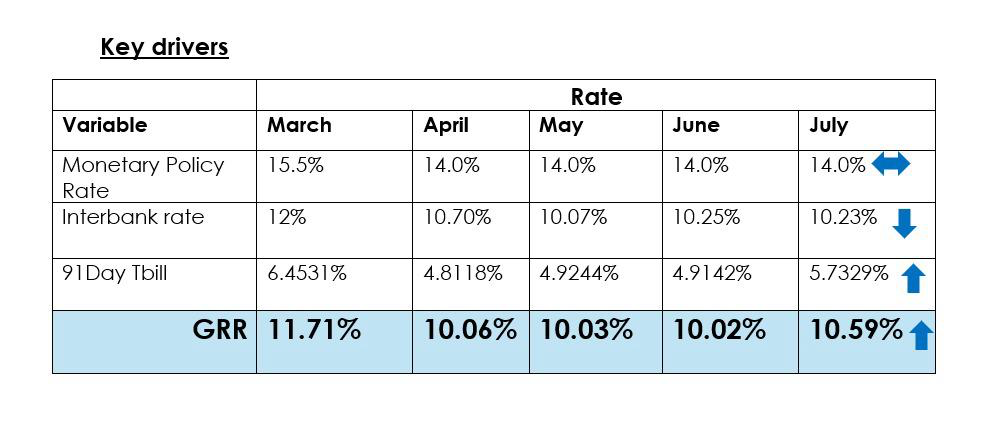
The Ghana Reference Rate (GRR), the benchmark used by commercial banks to price loans, has increased marginally to 10.59% in July 2026 from 10.02% in June.
The latest rate, published by the Ghana Association of Banks on July 1, 2026, could result in a slight increase in lending rates over the next month.
The Ghana Reference Rate is calculated using three key variables: Treasury bill rates, the interbank rate and the Bank of Ghana’s Monetary Policy Rate.
What drove the increase?
Industry data suggests the marginal rise in the July GRR was driven mainly by the increase in the 91-day Treasury bill rate and the Bank of Ghana’s decision to raise the Cash Reserve Ratio (CRR) to 20% from 15%.
Previously, banks operated under a tiered CRR framework with a minimum threshold of 15%. The central bank has since replaced that system with a uniform 20% CRR, regardless of a bank’s Loan-to-Deposit Ratio (LDR).
Bank of Ghana Governor, Dr Johnson Asiama, recently told chief executives of commercial banks that the higher cash reserve requirement is intended to strengthen liquidity management and support efforts to stabilise the cedi.
The increase in the Ghana Reference Rate could trigger another round of lending rate adjustments by commercial banks.
However, borrowers with fixed-rate loan facilities are not expected to be affected. Businesses with strong credit profiles may also experience little or no change in borrowing costs.
Analysts say concerns remain that any future increase in the Monetary Policy Rate, driven by global developments including tensions in the Middle East, could push borrowing costs even higher.
Background
The Ghana Reference Rate serves as the benchmark for loan pricing across the banking sector.
The latest increase comes at a time when businesses continue to face tight credit conditions, largely due to liquidity management measures aimed at controlling inflation and maintaining macroeconomic stability.
Despite the July increase, the GRR has been declining in recent months. It declined from 15.58% in January to 14.58% in February, 11.71% in March, 10.06% in April, 10.03% in May and 10.02% in June before edging up to 10.59% in July.
The Ghana Reference Rate was introduced in 2017 by the Bank of Ghana in collaboration with the Ghana Association of Banks to provide a transparent benchmark for determining lending rates across the banking sector.
Latest Stories
-
Hawa Koomson pledges experienced and mature leadership of NPP women’s wing
1 hour -
Young woman found dead at Kasoa Peace Town
2 hours -
Playback: The Law examined lawful arrest in Ghana
2 hours -
Mahama urges African governments to treat healthcare as an investment, not budget cost
3 hours -
Bawumia congratulates John Boadu and new NPP executives, pledges support ahead of 2028
3 hours -
‘No talent should be left out’ – Bawumia pledges inclusive NPP campaign for 2028
3 hours -
Prof. Mike Oquaye recounts how he blocked the Special Prosecutor’s attempt to arrest Bawku Central MP
3 hours -
Make health sovereignty a priority for Africa – Mahama
3 hours -
Dorimon Naa, Wa West DCE lead massive clean-up exercise; threaten sanctions against recalcitrant residents
3 hours -
Photos from Adom FM Y2K Jam
4 hours -
Praye Tiatia steals the show at Adom FM Y2K Jam [Watch]
4 hours -
Boakye Agyarko congratulates John Boadu, pledges support for NPP leadership
4 hours -
Antwi HiMight thrills fans with Antwi ne Antwi hits at Adom FM’s Y2K Jam [Video]
4 hours -
Amb. Edward Boateng congratulates Boadu, Kodua on election wins
4 hours -
John Boadu pledges to rebuild NPP from grassroots and restore ‘winning machinery’
5 hours