

Audio By Carbonatix
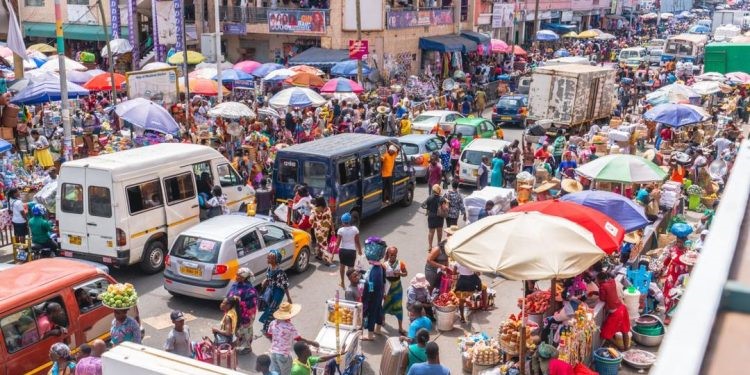
The Ghana Statistical Service (GSS) has underscored the immense value of informal cross-border trade (ICBT) to Ghana’s economic development, describing it as a crucial engine for growth, regional integration, and livelihood support.
According to the GSS, data gathered from the recently launched ICBT survey is invaluable for capturing the full scope of cross-border economic activities, allowing policymakers to design more equitable and evidence-based economic strategies.
In the data, the total value of informal trade in the fourth quarter of 2024 is estimated at GH₵ 7.4 billion.
The survey also reveled that, Ghana posted notable trade surpluses with Burkina Faso (GH¢576 million) and Côte d’Ivoire (GH¢378 million) in the Fourth Quarter of 2024, to underscore the strength of informal trade links with its northern and western neighbours.
Read also: Ghana records trade surplus with Burkina Faso and Côte d’Ivoire – GSS
GSS noted that informal trade is not merely a marginal activity but a vital component of Ghana’s economic fabric, especially in border and rural communities where formal trade channels remain limited.
The GSS outlined several key benefits that Ghana stands to derive from the effective utilisation of ICBT data:
- Improved trade statistics: The data enhances the accuracy of Ghana’s external trade records, allowing for more reliable economic planning and policy formulation.
- Better Balance of Payments data: With more precise estimates of informal exports and imports, Ghana can achieve a truer reflection of its trade balance and overall economic performance.
- Enhanced food security: Informal trade helps maintain a steady and affordable food supply, particularly in areas where formal trade networks are weak or disrupted.
- Stronger income generation policies: ICBT supports thousands of traders, farmers, and transporters in border communities, offering a foundation for targeted income and employment policies.
- Promotion of regional integration: By understanding the dynamics of informal trade, Ghana can better align its policies with the African Continental Free Trade Area (AfCFTA), identifying and addressing the practical barriers to trade while ensuring that informal traders are included in regional economic integration.
The GSS emphasised that recognising and integrating informal trade into Ghana’s policy framework would lead to more inclusive economic planning, fairer distribution of resources, and stronger collaboration across borders.
By leveraging ICBT data, the Service stated, Ghana can ensure that no segment of its trading population is overlooked, turning informal trade into a strategic pillar for sustainable growth, social stability, and continental partnership.
Latest Stories
-
GPL 2025/26: Late Kwartemaa strike downs Hearts in Tema
4 seconds -
Ghana Faces Sierra Leone Moment as Prosecutorial Powers come under strain
10 minutes -
Don’t consume fish or seafood from Tema Shipyard until further notice – FDA warns
15 minutes -
Why volunteering might be Africa’s most underrated career accelerator
21 minutes -
ActionAid Ghana raises concern over gender gaps in Feed Ghana Programme
23 minutes -
Windstorm wreaks havoc in Gushegu, displacing nearly 2,000 residents and damaging schools
25 minutes -
Friends of Bridget Bonnie Marks her 35th birthday with donation to Kasseh Model Health Centre
1 hour -
From Ekumfi Kokodo to the Pulpit Stage: Essi Donkor’s gospel journey takes shape
1 hour -
Landfilling waste management creates no value, it’s an economic waste
2 hours -
Photos: Speaker Bagbin Commissions MPs constituency office under parliamentary decentralisation programme
2 hours -
Black Stars technical advisor Winfried Schäfer sacked as GFA shakes up backroom staff
2 hours -
Wenchi water project almost complete, critical to gov’t agenda – GWL MD
2 hours -
Anti-LGBTQ+ bill not part of government’s legislative agenda – Inusah Fuseini
2 hours -
Anti-LGBTQ Bill: Forget the rumour mongers, I’m a man of action, and will pass the bill – Speaker
3 hours -
Women and children among those killed in Sudanese army shelling of wedding celebration
3 hours