

Audio By Carbonatix
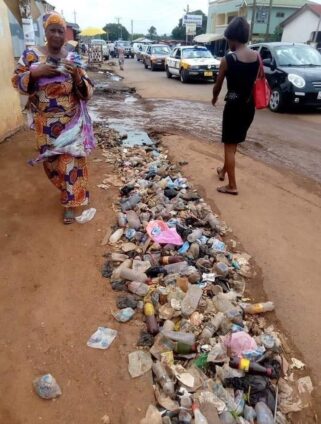
Imagine walking through a busy Ghanaian community after a heavy rainfall. Instead of seeing clean gutters carrying rainwater away, you find plastic bottles, sachet bags and food packages blocking the drains. For many communities, this has become an unfortunate part of everyday life.
Plastic waste has become one of the most visible environmental challenges in Ghana. From busy markets to residential areas, beaches and drainage systems, discarded plastics can be seen almost everywhere. Ghana generates a large amount of plastic waste each year, but only a small proportion is recycled.
UNDP
When a Plastic Bottle Becomes a Flood Risk
A plastic bottle may look harmless when it is thrown onto the ground, but thousands of bottles can create serious problems. When plastics enter gutters and drains, they prevent rainwater from flowing freely. During heavy rainfall, blocked drains can contribute to flooding, affecting homes, businesses, roads and livelihoods.
Recent efforts in Accra have shown just how much waste can accumulate underground. In March 2026, a major desilting exercise at the Kantamanto area removed about 60 tonnes of waste, including plastics, silt and textile materials, from drainage infrastructure.
Accra Metropolitan Assembly
This raises an important question: Should we continue treating plastic waste as ordinary rubbish when it can contribute to problems that affect entire communities?
The Problem Is Not Only Government’s Responsibility
It is easy to blame government agencies and sanitation authorities whenever our communities become dirty. However, individuals also have an important role to play.
Throwing a sachet into a gutter, leaving a plastic bottle on the roadside or dumping rubbish in an open space may appear to be a small action. When thousands of people behave the same way, however, the result becomes a national problem.
Ghana already has initiatives aimed at tackling plastic pollution. Some organisations are collecting discarded plastics and turning them into useful materials. For example, a project involving local companies has explored converting plastic waste into building materials such as bricks.
Ghana News Agency
From Waste to Opportunity
Plastic waste does not have to remain a problem. It can also become an economic opportunity.
Recycling companies and waste collectors are creating ways to collect, sort and process plastic waste. These activities can provide employment while helping to keep communities cleaner. Some Ghanaian initiatives have also involved young people in collecting plastic bottles and educating communities about proper waste management.
Al Jazeera
The solution therefore goes beyond simply cleaning the streets. Ghana needs stronger public education, responsible waste disposal, effective recycling systems and consistent enforcement of sanitation laws.
The Choice Is Ours
The next time you finish drinking water from a plastic bottle or sachet, think before throwing it away. There may be a drain, stream, farm or community waiting to receive the consequences of that single action.
A cleaner Ghana will not be created by government alone. It will require households, schools, businesses, local authorities, journalists, community leaders and young people to work together.
The plastic bottle we throw away today may become tomorrow’s blocked gutter, flooded street or polluted water body. But if we collect and recycle it, the same bottle can become part of the solution.
The question is no longer whether Ghana has a plastic waste problem. The question is: What are we going to do about it?
Latest Stories
-
Two dead, 14 rescued after accident on Kpetoe-Sarakope road
20 minutes -
AFCON 2027Q: Moroccan referee Mustapha Kechchaf to officiate Ghana-Gambia match
29 minutes -
Our mental health is restored – How Medical Trust Fund is giving doctors hope again
32 minutes -
2027 budget to provide for grain silos – Agric Minister
32 minutes -
Damongo Communique: Democracy Not For Sale
34 minutes -
Yusif Sulemana pushes community benefits, national systems in Global Forest Finance Debate
51 minutes -
Todays Front pages: Monday, September 28, 2026
58 minutes -
WAFU B U-17 Girls Cup: Black Maidens finish tournament with 4-0 win over Cote d’Ivoire
1 hour -
2026 Women’s Super Cup: FC Savannah to face Epiphany Warriors in final on September 29
1 hour -
Ghana’s second chance: How President Mahama’s return offers historic opportunity for transformation
1 hour -
AFCON 2027Q: Alexander Djiku ruled out of clash against Gambia
1 hour -
RCI Immanuel Temple donates supplies to Motherly Love Orphanage
2 hours -
Ghana calls for predictable, people-centred financing to protect tropical forests
2 hours -
COCOBOD asks investors to fund cocoa purchases, but proceeds may also repay old debt
3 hours -
Gov’t hands over site for construction of 160-bed Savannah Regional Hospital
3 hours