

Audio By Carbonatix
Ghana’s public debt stock has surged again, rising by more than GH¢70 billion in just three months, reflecting pressures from the cedi’s sharp depreciation against the US dollar in the third quarter of 2025.
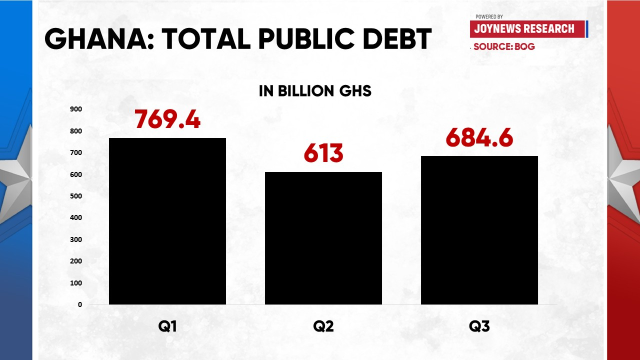
Latest Bank of Ghana data tracked by JoyNews Research shows that Ghana’s public debt increased by about GH¢71.6 billion in the third quarter, with projections indicating that total public debt could exceed GH¢700 billion by the end of the year if the cedi remains under sustained pressure against the dollar.
Total public debt, which declined by GH¢156.4 billion between the first and second quarters, has now risen to GH¢684.6 billion, heavily driven by the cedi’s renewed struggle against the US dollar in Q3.
The local currency lost about 24% of its value in the third quarter against the US greenback, after having appreciated by more than 40% in Q2.
Earlier this year, the Finance Minister, Dr Cassiel Ato Forson, revealed in the 2025 Mid-Year Budget that “prudent debt management and exchange rate appreciation have resulted in a significant improvement in Ghana’s debt profile.”
He noted that public debt declined from GH¢726.7 billion at the end of December 2024 to GH¢613 billion by the end of June 2025.
However, historical data show that exchange rate depreciation remains a key driver of Ghana’s rising debt levels. In 2023 alone, currency depreciation accounted for 62.5% of the increase in the total public debt stock, reinforcing concerns about the country’s exposure to foreign currency risks.
Also the slowdown in foreign exchange interventions by the Bank of Ghana, combined with rising import pressures, has contributed to the recent depreciation of the cedi.
Over the years, dollar injections by the central bank have helped cushion the cedi against excessive depreciation, a development that has in turn supported a more favourable public debt profile.
This year alone, the Bank of Ghana is reported to have supplied about US$10 billion to the foreign exchange market, operating under what it describes as a foreign exchange intermediation framework rather than direct market intervention.
The projection is that additional depreciation of the local currency could worsen the debt profile should the current pressures persist.
Watch the full analysis on JoyNews’ Beyond the Numbers here:
Latest Stories
-
I don’t have an official car, I use my own – Pelpuo
9 minutes -
Maiden Black Star Fashion Week to highlight Ghana’s national fashion platform
9 minutes -
GPRTU has entrusted vehicle inspection responsibility to station masters – GPRTU member
9 minutes -
President Mahama to open housing finance conference in Accra on October 7
17 minutes -
Cocaine probe: Speaker is right in dismissing Minority’s motion of parliamentary inquiry – Dr Pelpuo
17 minutes -
Academic City presents cybersecurity white paper to Communications Minister
18 minutes -
Pelpuo calls for independent commission to oversee Ghana’s public sector remuneration
18 minutes -
Bekwai MP to engage Assembly over traders displaced by market redevelopment
20 minutes -
Accra-Abidjan flight relaunch will boost trade, investment and regional integration – Ambassador Alhassan Abu
21 minutes -
Mahama tasked me to identify initiatives that fit Reset Agenda – Pelpuo
22 minutes -
Makola and Abossey Okai named in crime index as fake goods trade grows
25 minutes -
John Boadu, Justin Kodua, Nana B lead NPP’s race in latest survey
29 minutes -
Abdul-Rashid Pelpuo praises Mahama’s UNGA 81 address as bold and decisive
30 minutes -
Girls must have equal place in Ghana’s digital future – Vice President
42 minutes -
High Court issues EOCO warrant to arrest Manhyia South MP Baffour Awuah
47 minutes