

Audio By Carbonatix
As numerous foreign banks either exit or plan to exit various African markets as part of their de-risking strategies, Ghana International Bank (GHIB), has chosen a rather different approach to risk management in its sub-Saharan operations.
GHIB’s de-risking strategy for Africa is to train and upscale the capacities of correspondent banks in Africa to ensure the high standards of compliance required in facilitating cross-border trade.
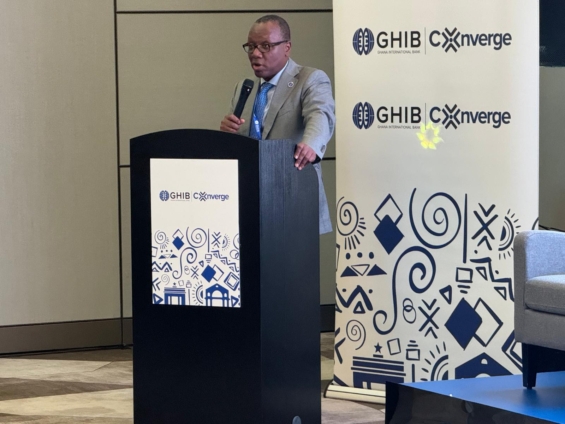
At the just ended CNVERGE conference in London, Dean Adansi, Chief Executive Officer of GHIB, touched on this important issue and how the bank is positioning itself to fill the critical gap.
During his address, mentioned that by leveraging its regional expertise and robust network, GHIB is set to be a key player in the continent's evolving economic landscape.
“At a time when other financial institutions have de-risked and exiting the Sub-Saharan Africa region, GHIB has elected to build capacity in the region and finance trade on the continent,” Mr. Adansi said.
He added that, “During the recent financial crisis in Ghana, GHIB continued to finance trade even as other banks retreated and de-risked. Given the important role of treating advancing growth in our markets, it’s imperative that we find and implement solutions to promote trade activity. I think the biggest question to keep in mind as we explore and discuss species related to trade of this conference is how best to play our part in growing trade in our markets.”
Ghana International Bank (GHIB), through its CNVERGE conference, is committed to being a pivotal player in addressing these challenges and shaping the future of African trade.
As one of the pioneering pan-African financial institutions in the City of London, GHIB is uniquely positioned to lead these critical conversations. CNVERGE has been specifically designed to harness GHIB’s extensive experience and leverage its network of partners, clients, and even competitors.
Through this platform, the bank aims to initiate a continuous series of roundtables focused on generating, discussing, and implementing new ideas to foster the growth of African trade.

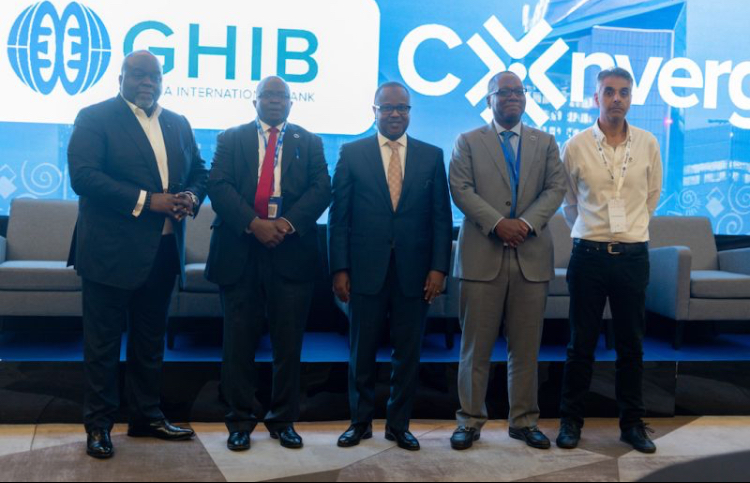
The inaugural conference, which was held under the theme “The Risk/Opportunity Interplay for African Trade,” had participants from over 60 corporates, sovereigns and banks operating in the United Kingdom and Sub-Sahara Africa. High-level representatives from the central banks of Ghana and The Gambia as well as trade and economic attaches from African High Commissions in London, attended the event.
International Trade in Africa has long faced significant barriers due to the trade finance gap, a persistent and formidable obstacle that hampers business activities both within the continent and with external partners. This gap, characterized by the disparity between the demand for and supply of trade finance, was estimated by the African Development Bank to have reached a staggering $81.8 billion in 2019. More recent assessments suggest that this shortfall could now be as high as $120 billion.
The situation has been further aggravated by a global trend of de-risking, which has led to the withdrawal of many global banking franchises from the African market. This retrenchment has been driven by concerns over the perceived risks associated with financial transactions in the region, compounding the challenges faced by businesses that rely on trade finance to facilitate cross-border trade and investment. The withdrawal of global banks from Africa jeopardises access markets because of a dearth in correspondent banking for trade, which is critical for emerging economies.
The confluence of these factors underscores the urgent need for innovative solutions and enhanced support mechanisms to bridge the trade finance gap and stimulate economic growth across Africa. In all of this, GHIB’s approach has been to keep faith with correspondent banks on the continent to enable them provide quality services to their clients.
GHIB has been at the forefront of trade financing in Anglophone West Africa (excluding Nigeria), having handled $6.5 billion in documentary trade collections over the past five years. The bank boasts 70 counterparty and correspondent banking relationships across Sub-Saharan Africa.
Additionally, GHIB has successfully executed over $600 million in secondary market trade finance transactions and $1.3 billion in primary trade finance transactions within the region during the same period. In 2023 alone, the bank estimates it facilitated $8.5 billion in downstream payments to West Africa.
Latest Stories
-
President Mahama ends Resetting Ghana tour of Ahafo Region
1 hour -
African negotiators seek delivery of climate commitments at COP31
1 hour -
BoG develops AI rules for financial sector
1 hour -
‘Big Push’: Government assures contractors of prompt payments
1 hour -
Court fines miner for breaking into gold buying shop
2 hours -
Tarkwa court jails labourer for three years over GH¢123,000 theft
2 hours -
GAEC must retain nuclear scientists for Ghana’s nuclear ambitions – Minister
3 hours -
Man reportedly mistaken for game and shot by hunter dead in forest
3 hours -
19-year-old mason jailed 15 years for defiling seven-year-old pupil
3 hours -
Ghana’s banking sector assets rise 20.47% to GH¢500.2bn – BoG Governor
3 hours -
22 injured as Sprinter bus overturns at Sege after tyre burst
3 hours -
UN housing expert urges Ghana to strengthen Rent Control Department amid housing affordability concerns
3 hours -
Delta-BCI partnership reaches 166,000 people with breast cancer education
4 hours -
Power restoration fault suspected in Kumasi Central Market fire
9 hours -
The 7-foot giant of Ngleshie Amanfro: Seven-foot Ghanaian Ephraim Saawa dreams of joining the national basketball team
9 hours