

Audio By Carbonatix
The Government has approved a proposal to constitutionally cap the size of Parliament at a maximum of 300 Members, as part of a broader package of constitutional reforms aimed at strengthening Ghana's democratic governance and promoting greater inclusivity in the country's legislative process.
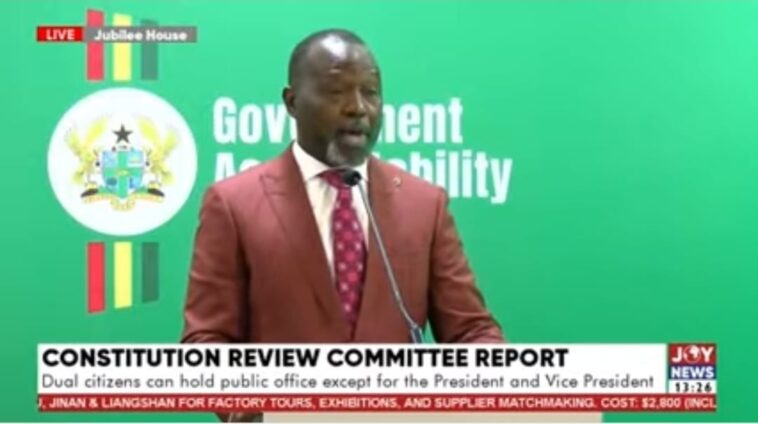
The announcement was made by the Attorney-General and Minister for Justice, Dr Dominic Ayine, during the presentation of the Government's White Paper on the recommendations of the Constitutional Review Committee on Thursday, July 30.
The proposed reform seeks to preserve Ghana's existing constituency-based electoral system while introducing a proportional representation mechanism to broaden participation in Parliament, particularly for groups that have historically been underrepresented.
Under the proposal, the current 276 parliamentary constituencies will remain unchanged, with Members continuing to be elected through the existing first-past-the-post electoral system. An additional 24 parliamentary seats will be created through a proportional representation model, bringing the total membership of Parliament to a constitutional maximum of 300.
The reserved seats are expected to enhance the representation of women, persons with disabilities (PWDs) and young people, groups that have consistently faced barriers to securing parliamentary representation through conventional constituency elections.
Explaining the Government's decision, Dr Ayine said the constitutional cap would help contain the size of the legislature while ensuring Parliament becomes more reflective of Ghana's diverse population.
"The government has accepted that the size of Parliament be capped and we propose a ceiling of 300 members. The current membership of Parliament is 276 and so these will be elected directly in constituency elections like we already have and the remaining 24 will be elected or selected through proportional representation among women, persons with disabilities and the youth.
"An independent study will be commissioned into the design of the proportional representation element. Capping Parliament saves cost and the reserve element opens the doors of our legislature wider to those that our politics have historically kept outside."
According to the Attorney-General, the Government will commission an independent study to determine the most appropriate design and implementation framework for the proportional representation system before it is introduced.
Latest Stories
-
Over 3,000 displaced as flooding overwhelms Hohoe communities
5 minutes -
Sunyani East NPP executives begin reconciliation drive ahead of 2028 polls
10 minutes -
Agric Minister engages Ga Mantse on agriculture transformation agenda
15 minutes -
Aayalolo expansion targets private car users, not trotro operators – Mahama Ayariga
20 minutes -
KNUST, GMTF explore AI partnership to transform healthcare delivery
25 minutes -
MTTD records 9,000 preventable crashes, over 900 deaths in eight months
30 minutes -
UN Secretary-General expresses optimism about future, pledges support for Mahama, AU
35 minutes -
Ghana’s desalination lesson: A water project must work on paper and at the tap
50 minutes -
Bawumia calls for paradigm shift in Ghana’s healthcare policies after GMA engagement
56 minutes -
77 aspirants pick NDC nomination forms in Sunyani West
1 hour -
Mahama holds talks with China Vice President Han Zheng in New York
1 hour -
Patriotic Intellectuals-TTU endorses John Boadu for NPP National Chairman
1 hour -
Mahama links Accra Reset to Africa’s push for health sovereignty
1 hour -
Mahama outlines thinking behind the Accra Reset
1 hour -
GNFS responds to two separate fire incidents in Greater Accra
1 hour