

Audio By Carbonatix
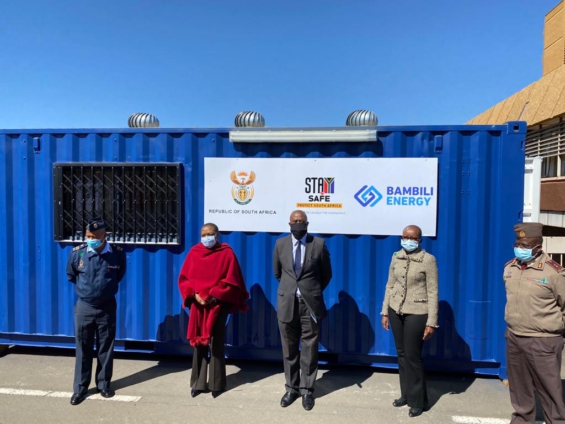
The Department of Science and Innovation (DSI) will on Wednesday, 19 August 2020 unveil seven hydrogen fuel cell systems which are being used as the primary power source for the field hospital established at 1 Military Hospital in Pretoria as part of the government's response to COVID-19.
The project is a public-private partnership between the DSI, the Department of Public Works and Infrastructure (DPWI), the Department of Defence (DoD), local companies Bambili Energy and HyPlat, and international companies PowerCell Sweden.

Horizon Fuel Cell Technologies (Singapore) and Element 1 Corporation (United States). Further contributions, in the form of methanol and hydrogen fuel for the fuel cell units, were also received from Air Products South Africa, Protea Chemicals and Sasol.
Bambili Energy focuses on the hydrogen economy, providing solutions to complement various forms of alternative energy, and is committed to commercialising intellectual property developed through the Hydrogen South Africa (HySA) programme.
The COVID-19 pandemic has highlighted the need to respond with speed and flexibility, particularly in providing high care facilities for those who need them most.
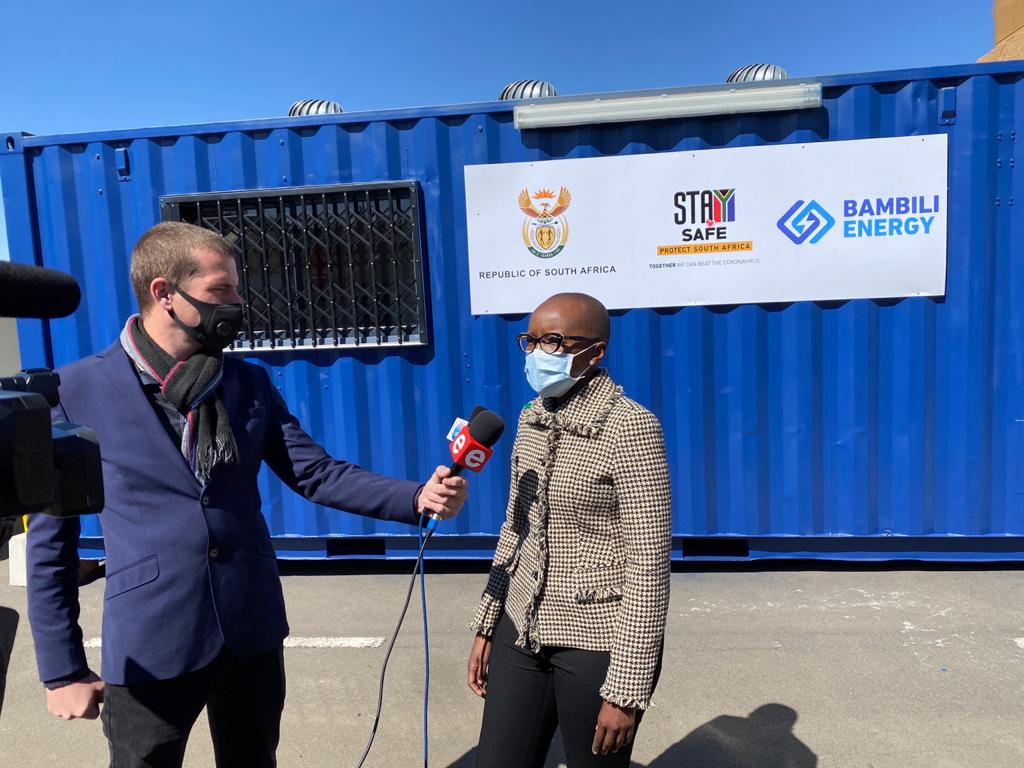
Containerised hydrogen fuel cells can be deployed at short notice to provide a clean source of energy, even when the need is only temporary.
The support provided to 1 Military Hospital will be complemented by hands-on training to ensure that the skills required to operate and manage the fuel cell systems are institutionalised within government.
The first two phases of training will focus on officials from the DoD and DPWI, while the third phase will involve unemployed TVET college graduates with N4 electrical and light and heavy current qualifications.
Hydrogen fuel cell technology is globally recognised for its potential to decarbonise the energy and transport sectors.
Hydrogen fuel cells produce electricity by means of a chemical reaction, using hydrogen as the basic fuel together with platinum-based catalysts.
They are efficient, reliable, safe and quiet, ensuring a non-intrusive standby and primary power solution.
Being modular in nature, they can be deployed rapidly and scaled up easily as the need arises, and their maintenance cost is relatively low.
Latest Stories
-
Ghana eyes stronger trade ties as Australia hosts multicultural trade and investment forum
3 minutes -
Margaret-Marie Krakue
6 minutes -
Ayariga announces plans for live broadcast of MMDAs’ meetings on local radio stations
9 minutes -
Mrs Anna Tackie
11 minutes -
Ghana links Afghan heroin and Brazilian cocaine to global drug markets – Global Organised Crime Index
18 minutes -
NHIA launches nationwide inter-school quiz to deepen students’ knowledge of NHIS
25 minutes -
Political protection could be masking Ghana’s cocaine trade – Global Organised Crime Index
30 minutes -
AFCON 2027Q: ‘We have to dissolve the GFA’ – Effia MP after Black Stars lose to Gambia
32 minutes -
NPP announces voting schedule and ID requirements for October 3 national elections
34 minutes -
Lupus can mimic HIV symptoms and damage kidneys if untreated – KNUST expert
37 minutes -
Focus on Sickle Cell Foundation seeks to introduce sickle cell education through comics in Ghanaian schools
43 minutes -
NPP rewrites the campaign playbok as opposition reality shapes National Executive contest
44 minutes -
Road safety education will fail without enforcement – NRSA boss
45 minutes -
Daily Insight for CEOs: Finishing Q3 strong and entering Q4 with purpose
46 minutes -
National Ambulance Service begins ‘Operation Restore Fleet’ to restore grounded ambulances
47 minutes