

Audio By Carbonatix
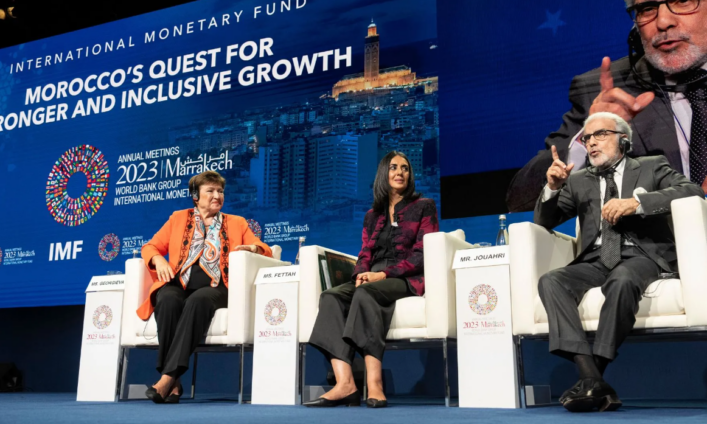
The 2023 annual meetings of the International Monetary Fund (IMF) and the World Bank Group (WBG) on Monday opened in Marrakech, Morocco.
This is the second time that an African country is hosting the meetings of the two global finance institutions.
Kenya last hosted the IMF/WBG annual meetings in 1973.
In the wake of the current global economic crisis, the theme for this year’s meetings is: “Global Action, Global Impact.”
The theme has been crafted to inspire actions that would support poverty eradication, economic development, and aid effectiveness.
The meetings, which would be held from October 9 to 16, would be attended by some 12,000 participants.
They include global central bankers, ministers, private sector executives, civil society representatives, youth leaders, academics, and other stakeholders.
Job boosting, digital infrastructure, and climate action would be key discussion features of the meetings.
The event would also explore the new playbook needed to respond to intertwined global challenges, by reflecting on solutions that have worked on the ground in developing countries.
The World Economic Outlook would also be released during the meetings.
During her curtain raiser speech, Kristalina Georgieva, Managing Director, IMF, called for global cooperation to deal with economic fragmentation, which she described as a threat to further undermining growth prospects.
“With the right policies, we can build a bridge to a more prosperous and peaceful future. We can lay the groundwork for half a century even more impressive than the last,” she said.
To achieve this, Ms Georgieva, said it was important to reinforce economic and financial stability by keeping interest rates higher for longer.
There should also be a foundation for inclusive, sustainable growth through transformational reforms, build strong institutions, and boost collective resilience through international cooperation.
For Ghana, the meetings would be a critical moment to cement discussions to sign a Memorandum of Understanding (MoU) with the country’s external creditors for a debt treatment.
This MoU, as the IMF has noted, is necessary for the West African country’s second tranche of $600 million of a total $3 billion loan support programme.
Last Friday, Ghana reached a Staff-Level Agreement with the IMF Staff Mission on economic policies and reforms after the first review of the 36-month ECF-supported programme.
This will pave the way for the release of about US$600 million in financing once the review is approved by IMF Management and formally completed by the IMF Executive Board.
Latest Stories
-
When share ownership becomes personal: The African mindset of the Dangote IPO
7 minutes -
Why MFWA Legal Fund matters to Ghana’s democracy
7 minutes -
Fuel prices to rise from October 1; diesel could hit GH¢19.60 – COMAC
8 minutes -
Parliament must investigate how 3.9 tonnes of cocaine left Ghana undetected – Samuel Jinapor
9 minutes -
Government pledges to pay striking teachers as payment dispute is resolved
23 minutes -
Government cannot investigate drug exports under its own watch – Abu Jinapor
25 minutes -
Government extends GH¢2 diesel subsidy for two more months
32 minutes -
GTEC flags over 100 tertiary institutions as unrecognised
34 minutes -
Agric Committee chair commends NAFCO for turnaround from GH¢20m debt to GH¢96m profit
39 minutes -
NPP: Judicial office requires judges to surrender some personal freedoms
44 minutes -
Senyo Hosi: Ghana missed its chance to end galamsey under Akufo-Addo
50 minutes -
Okaikwei Central MP alleges Ghana was close to settling Tullow tax dispute for $150m
52 minutes -
Patrick Boamah credits Godfred Dame for Ghana’s victory in $400m Tullow tax arbitration
55 minutes -
Dr Jasaw calls for National Agriculture Development Fund to accelerate food systems transformation
59 minutes -
Armah-Kofi Buah honoured for developmental initiatives in Aiyinasi-North
1 hour