

Audio By Carbonatix
India, home to 1.3 billion, is aiming to inoculate about 300 million people by July.
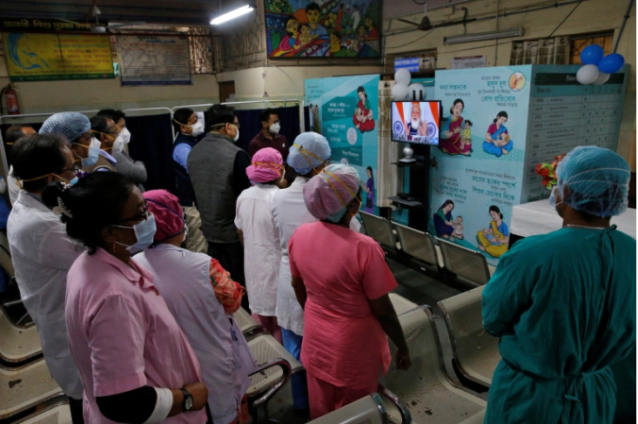
India launched one of the world’s largest coronavirus vaccination drives on Saturday as the coronavirus pandemic spread at a record pace and global COVID-19 deaths surged past two million.
Indian Prime Minister Narendra Modi, who addressed healthcare workers through video conferencing, will not immediately take the vaccine himself as India is initially prioritising nurses, doctors and others on the front line.
“We are launching the world’s biggest vaccination drive and it shows the world our capability,” Modi said in his address. He implored citizens to keep their guard up and not to believe any “rumours about the safety of the vaccines”.
“Please do not start being careless once you get vaccinated, do not take off your mask or forget social distancing,” said Modi.
The sheer scale has its obstacles. For instance, India plans to rely heavily on a digital platform to track the shipment and delivery of vaccines. But public health experts point out the internet remains patchy in large parts of the country, and some remote villages are entirely unconnected.
India gave the nod for emergency use of two vaccines: one developed by Oxford University and UK-based drug-maker AstraZeneca, and another by Indian company Bharat Biotech on January 4. Cargo planes flew 16.5 million shots to different Indian cities last week.
Health experts worry the regulatory shortcut taken to approve the Bharat Biotech vaccine without waiting for concrete data that would show its efficacy in preventing illness from the coronavirus could amplify vaccine hesitancy.
At least one state health minister has opposed its use.
India’s health ministry has bristled at the criticism and said the vaccines are safe, but maintains that health workers will have no choice in deciding which one they get.
According to Dr SP Kalantri – director of a rural hospital in Maharashtra, India’s worst-hit state – such an approach was worrying because he said regulatory approval was hasty and not backed by science.
“In a hurry to be populist, the government [is] taking decisions that might not be in the best interest of the common man,” Kalantri said.
Against the backdrop of the rising global COVID-19 death toll – it topped two million on Friday – the clock is ticking to vaccinate as many people as possible. But the campaign has been uneven.
India is second to the United States with 10.5 million confirmed cases, and ranks third in the number of deaths, behind the US and Brazil, with 152,000.
More than 35 million doses of various COVID-19 vaccines have been administered around the world, according to the University of Oxford.
While the majority of COVID-19 vaccine doses have already been snapped up by wealthy countries, COVAX – a UN-backed project to supply shots to developing parts of the world – has found itself short of vaccine, money and logistical help.
As a result, the World Health Organization’s chief scientist warned it is highly unlikely that herd immunity – which would require at least 70 percent of the globe to be vaccinated – will be achieved this year. As the disaster has demonstrated, it is not enough to snuff out the virus in a few places, experts say.
Latest Stories
-
Government identifies payment discrepancy holding up teachers’ strike resolution
9 minutes -
BoG signals no FX intermediation for October as GoldBod plans $1bn support for banks
13 minutes -
When share ownership becomes personal: The African mindset of the Dangote IPO
23 minutes -
Why MFWA Legal Fund matters to Ghana’s democracy
23 minutes -
Fuel prices to rise from October 1; diesel could hit GH¢19.60 – COMAC
24 minutes -
Parliament must investigate how 3.9 tonnes of cocaine left Ghana undetected – Samuel Jinapor
25 minutes -
Government pledges to pay striking teachers as payment dispute is resolved
39 minutes -
Government cannot investigate drug exports under its own watch – Abu Jinapor
41 minutes -
Government extends GH¢2 diesel subsidy for two more months
48 minutes -
GTEC flags over 100 tertiary institutions as unrecognised
50 minutes -
Agric Committee chair commends NAFCO for turnaround from GH¢20m debt to GH¢96m profit
55 minutes -
NPP: Judicial office requires judges to surrender some personal freedoms
60 minutes -
Senyo Hosi: Ghana missed its chance to end galamsey under Akufo-Addo
1 hour -
Okaikwei Central MP alleges Ghana was close to settling Tullow tax dispute for $150m
1 hour -
Patrick Boamah credits Godfred Dame for Ghana’s victory in $400m Tullow tax arbitration
1 hour