

Audio By Carbonatix
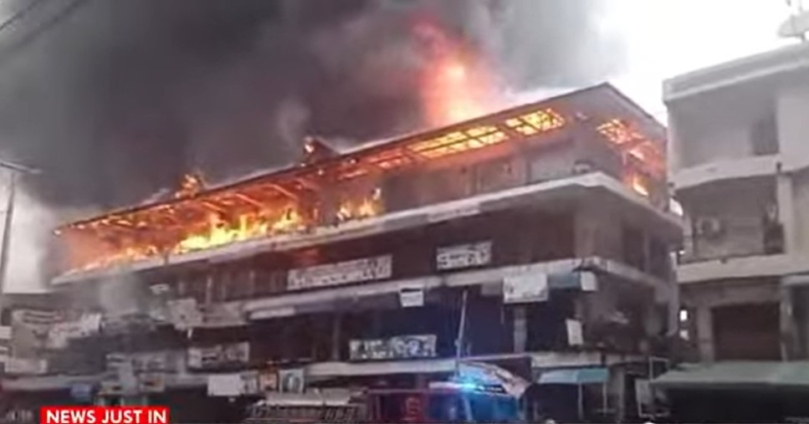
In the early hours of 21st March 2025, Ghanaians woke up to yet another devastating fire outbreak, this time in Adum, the bustling commercial heart of Kumasi, the capital of the Ashanti Region and Ghana's second-largest city. The blaze, which ripped through sections of this vital trading hub, sent thick plumes of toxic black smoke into the skies and could be seen from miles away. As traders looked on helplessly, years of savings, goods, and capital were reduced to ashes. This incident follows closely on the heels of a similar disaster in Katamanto, a busy market area in Greater Accra, where fire gutted numerous shops, wiping out the livelihoods of many small-scale traders.
The cause of the Kumasi fire remains under investigation, with officials from the Ghana National Fire Service (GNFS) expected to release a formal report in the coming days. However, preliminary reports suggest that poor electrical wiring, congested structures, and lack of fire safety mechanisms may have played a role, challenges that have been highlighted in numerous past reports but remain inadequately addressed.
Coincidentally, on the same day, a massive fire broke out at an electrical substation near Heathrow Airport in London, one of the world's busiest aviation hubs. The fire led to the temporary shutdown of the airport, the cancellation of thousands of flights, and mass disruptions across the UK and Western Europe. British authorities immediately deployed high-tech fire engines and rapid response teams, containing the fire within hours. Detailed economic assessments are already underway to quantify the losses and plan compensation.
In contrast, Ghana's response to such emergencies often lacks precision, adequate resources, and long-term planning. More often than not, we fail to capture the economic losses these fires inflict on our informal sector, an area that contributes approximately 70% to Ghana's employment and plays a significant role in the country's GDP. The absence of data-driven damage assessments and lack of insurance coverage for affected traders only compounds the economic devastation.
Lessons from the Great Fire of London and Other Global Incidents:
After the Great Fire of London in 1666, authorities instituted far-reaching reforms, including strict building codes, fire-resistant materials, wide roads for fire truck access, and mandatory fire hydrants in commercial areas. These measures transformed urban planning and significantly reduced the frequency and impact of major fires in the UK.
It's time Ghana followed suit.
Recommendations for Ghana's Fire Safety Reform
1. Mandatory Installation of Fire Suppression Systems
All commercial buildings and markets must be required by law to install fire suppression systems, including sprinkler systems, smoke detectors, and fire alarms. While these may not prevent fires entirely, they can significantly slow the spread and give firefighters a chance to respond before damage becomes catastrophic.
2. Accessible Infrastructure for Emergency Response
Market areas, especially in Accra, Kumasi, Tamale, and Takoradi, must be redesigned to include accessible roads for emergency vehicles. Many fire trucks currently struggle to reach the centre of market fires due to narrow alleys and congested layouts.
3. Investment in Firefighting Equipment
The Ghana National Fire Service is in urgent need of modern firefighting equipment. The government should invest in reliable fire engines from manufacturers such as Mercedes-Benz, Scania, or DAF—vehicles that are durable, efficient, and suited for Ghana's road conditions. Additionally, the acquisition of at least one or two firefighting helicopters could dramatically improve our ability to combat large-scale fires in hard-to-reach areas.
4. Public Education and Insurance
Public awareness campaigns on fire prevention, safe electrical practices, and emergency protocols should be intensified. Simultaneously, trader associations and market landlords should be compelled to adopt commercial insurance schemes to provide a safety net in the event of disasters. These should be encouraged through policy incentives or made mandatory in high-risk areas.
5. Building Codes and Regulations Enforcement
Local authorities must enforce building codes that prioritize fire safety, including spacing between structures, use of fire-resistant materials, and designated escape routes. The current lax enforcement of regulations is a major contributor to the frequency and severity of market fires in Ghana.
6. Digitised Damage Assessments and Economic Impact Studies
Ghana should begin to digitize fire incident reporting and invest in post-disaster economic impact assessments to quantify losses in real terms. This will not only help in policy planning and support but also serve as data to attract donor support and insurance partners.
A Call for Resilience in a 24-Hour Economy
As Ghana seeks to industrialize and introduce a 24-hour economy, the ability to safeguard commercial infrastructure becomes non-negotiable. Investors, both local and foreign, need assurance that their assets are protected—not only from theft or political instability but from the increasingly common threat of fire disasters.
If we are to build a resilient economy that can withstand shocks and protect livelihoods, then we must act decisively and differently. The infernos in Accra and Kumasi are not just isolated incidents, they are warnings. Let us not wait for another tragedy to make the necessary changes.
Food for thought from a concerned Ghanaian citizen.
******
The writer is the NDC UK and Ireland Chapter, Deputy Communications Officer
Latest Stories
-
Haruna Iddrisu calls for limits on annual university accommodation fee increases
28 minutes -
Today’s front pages: Tuesday, October 13, 2026
1 hour -
Wealth Over Water: How Galamsey Is Threatening Ghana’s Water Security
2 hours -
LA 2028: Black Queens pumped up for second leg of Mauritius tie
2 hours -
LA 2028: Black Queens hold final training session ahead of second leg against Mauritius
3 hours -
Standards are not Seasonal: What the EC appointments teach both sides
3 hours -
King Mohammed VI urges private sector to create youth jobs and spread benefits of growth
3 hours -
KGL U17 Colts 2026: Greater Accra win title after penalties win over Western Region
3 hours -
UK Investment Roadshow opens in London to advance UK-Ghana growth partnership
3 hours -
Assemblies of God requires pastors to resign before entering partisan politics – Rev. Wengam
3 hours -
Ghana targets 20% annual reduction in maternal deaths – Health Minister
3 hours -
Cyber attacks in Africa grow faster than global rate, report finds
3 hours -
Ghana signs UAE deal to create 5,000 overseas jobs
3 hours -
One Million Coders Programme targets 100,000 digital jobs in two years – Sam George
3 hours -
John Jinapor, Italian Ambassador explore opportunities for energy sector investment
3 hours