

Audio By Carbonatix
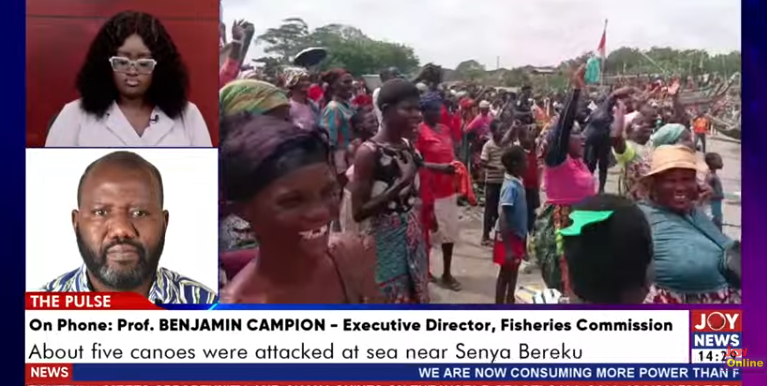
Executive Director of the Fisheries Commission, Prof. Benjamin Campion, has highlighted the need for insurance cover for fishermen as part of urgent measures to tackle rising piracy and robbery attacks at sea.
Speaking on JoyNews' The Pulse on February 26, Prof. Campion said authorities are shifting focus beyond security patrols to also cushion fisherfolk against financial losses.
“We’ve received reports from the fishermen themselves, and one of the major efforts we’ve been undertaking in recent times is not only to look at security at sea but also to provide some form of insurance for them,” he stated.
His comments follow attacks on some fishermen at sea near Senya Beraku, where gun-wielding men robbed the Ghanaian crew of their outboard motors, generators and other valuables.
According to him, several fishermen have reported cases where sea robbers vandalised their canoes, seized fishing equipment and made away with their catch.
“Sometimes they vandalise the canoes, take items they are interested in and take their fish away. Some form of insurance will help and give them some level of protection,” he explained.
Prof. Campion disclosed that discussions are ongoing with an insurance agency to develop tailored packages for small-scale fishers.
Unlike artisanal canoe operators, industrial trawl and tuna vessels typically have insurance cover and, in some cases, onboard security.
He, however, admitted that providing individual security for the over 14,000 registered canoes across the country remains a major challenge.
“It will be very difficult providing them individual policing at sea for each canoe,” he said.
As part of alternative interventions, he said that authorities are collaborating with the Ghana Navy to organise training programmes aimed at equipping fishermen with basic security awareness and survival skills.
“Our canoes have flags and inscriptions and they know each other. If they see a suspicious vessel, they should move away or work together. There is strength in numbers,” he advised.
He further revealed that naval patrols will be intensified within recognised fishing grounds, particularly within the 12-nautical-mile Inshore Exclusion Zone reserved for artisanal fishers.
However, he cautioned that some fishermen venture beyond the designated zone, exposing themselves to greater danger.
“When they move beyond the 12 nautical miles, we also have to look at how to protect them. That is why we are focusing on training and survival skills at sea,” he said.
Latest Stories
-
Church of Pentecost supports over 2,000 BECE candidates in Obuasi with career guidance seminar
36 minutes -
Brandon Asante and Coventry all but promoted to Premier League despite Sheffield Wednesday draw
58 minutes -
GPL 2025/26: Late Kwartemaa strike downs Hearts in Tema
1 hour -
Ghana Faces Sierra Leone Moment as Prosecutorial Powers come under strain
1 hour -
Don’t consume fish or seafood from Tema Shipyard until further notice – FDA warns
1 hour -
Why volunteering might be Africa’s most underrated career accelerator
1 hour -
ActionAid Ghana raises concern over gender gaps in Feed Ghana Programme
1 hour -
Windstorm wreaks havoc in Gushegu, displacing nearly 2,000 residents and damaging schools
1 hour -
Friends of Bridget Bonnie Marks her 35th birthday with donation to Kasseh Model Health Centre
2 hours -
From Ekumfi Kokodo to the Pulpit Stage: Essi Donkor’s gospel journey takes shape
3 hours -
Landfilling waste management creates no value, it’s an economic waste
3 hours -
Photos: Speaker Bagbin Commissions MPs constituency office under parliamentary decentralisation programme
3 hours -
Black Stars technical advisor Winfried Schäfer sacked as GFA shakes up backroom staff
3 hours -
Wenchi water project almost complete, critical to gov’t agenda – GWL MD
3 hours -
Anti-LGBTQ+ bill not part of government’s legislative agenda – Inusah Fuseini
3 hours