

Audio By Carbonatix
The 17 Nations Sustainable Development Goals have always been an abstract subject to many Ghanaians, especially the layperson.
With only 6 years to reach the attainment of the global goals, many households reel under the impact of the environmental challenges.
This is attributable to the low public sensitisation to attract more people to strive for a sustainable nation.
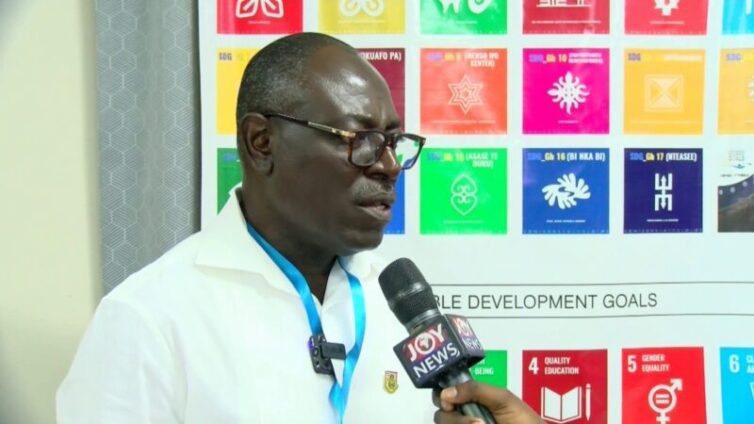
In creating public awareness as the country races against time to achieve the goals, an architect and lecturer at the Kwame Nkrumah University of Science and Technology (KNUST) has developed local symbols and meanings for the Sustainable Development Goals.

Seventeen unique goals to be achieved globally by countries under the United Nations for a sustainably developed world.
Ghana, like many countries who signed this treaty, have more to accomplish before the 2030 targeted deadline.
But, are people even aware of these goals?
“No, I haven’t seen or heard them before,” Adwubi, a hairdresser at Ayigya in Kumasi, said.
Another also added: “I have seen them but I don’t really understand”.
This level of low awareness confirms a 2023 research on Examining the level of Public Awareness on the Sustainable Development Goals in Africa: Empirical Evidence from Ghana.
It revealed some Ghanaians knew about goal 1 to 4 of the SDGs, but generally awareness of the global goals was low.
It surmised that the government must re-examine and adopt an effective communication policy framework which involves the local population and communities.
Each of the 17 sustainable development goals comes with a unique blend of colours and symbols.
Out of the numerous languages of the world, the SDG symbols are only transcribed into six dialects.
But researchers in Ghana are adopting the local arts and meanings from the Adinkra symbols to represent the goals.
Known as “Adinkratecture”, the 17 designs were selected from the over 96 known Adinkra symbols and localized into the Ghanaian parlance for a more comprehensive description while clamoring for action.
Prof Rexford Asaase-Oppong is the brain behind the piece.
“One of the key things about Sustainability is our capability and ability to appreciate our culture and bring culture into it. Sustainability is about people and development,” he said.
The Adinkra symbols, ascribed to the Ashanti’s and by extension Akans, is believed to have originated from the Gyaman tribe in Ghana’s neighboring country, Ivory Coast.
Named after the traditional ruler of the tribe, Kwadwo Adinkra, the Adinkra symbol, despite being artistic, has meanings which communicate.
Cultural Historian at the Manhyia Palace, Teacher Sarfo Kantanka, explains “the unique nature of the symbols allows it to be well-communicated and people can easily understand these symbols just as we see them in our local attires and graffiti”.
The team allowed some members of the public to explain some of the Adinkra symbols.
“That is Sankofa, and the other is Gye Nyame. Sankofa means to revisit and take up a rejected tradition or object,” Akua Nimo, a vendor, hurriedly explained some of the Adinkra Symbols.
The SDGs remain an abstractive subject and many individuals are closely vulnerable to the vagaries of the implications of environmental sustainability.
Prof Asaase-Oppong says little has been done to include the vulnerable in the global conversations as it has only been for the intellectuals.
“Health and well-being is basically abstract. But if you bring it to our local system and you’re showing a symbol of ‘Aho)den’ - strength - to the local person, they will know that if I have strength, I will be able to work and reduce poverty,” he said.
There is a call for the incorporation of the symbology in the local curriculum to expose children to climate action and environmental sustainability.
The adinkra symbols - globally known to be of African descent - is expected to contribute to communicating meanings for the needed action in protecting the world.
Latest Stories
-
Tyson Fury dominates Makhmudov, calls out Joshua next
13 minutes -
I have supported highway authority financially to fix roads in my constituency – A Plus
1 hour -
US, Iran fail to reach peace agreement after marathon talks in Pakistan
2 hours -
ECG kicks off Phase Two of transformer upgrades at Lashibi; brief outages expected
2 hours -
Port crises loom as 11,000 drivers threaten four-day strike
3 hours -
A source of excellence across generations – Vice President Opoku-Agyemang lauds Mfantsipim
4 hours -
(Photos) Mfantsipim School launches historic 150th anniversary
4 hours -
Knights and Ladies of Marshall group backs Catholic Bishops’ stance on anti-LGBTQ+
5 hours -
Bright Simons writes: All the Filla in the Ibrahim Mahama/E&P – Gold Fields Saga
6 hours -
Monetise Idiocy In Ghana
6 hours -
The Ghanaian prophet and the mysterious death of his scottish wife Charmain Speirs
7 hours -
Nearly 400 sentenced in Nigeria for links to militant Islamists
7 hours -
Ghana’s recovery supported by gold strength despite global oil price pressures – Standard Bank Research
7 hours -
Methodist Church hails Mfantsipim@150; calls for “fresh consecration” to excellence
7 hours -
‘Excellence is our inheritance’ – Nana Sam Brew-Butler hails Mfantsipim’s 150-year reign in leadership
8 hours