

Audio By Carbonatix
Kpone (Le Sega) is a town in the Greater Accra Region of Ghana, located along the Eastern coast of the country, situated near the capital city, Accra.
The Le from the Sega Hills (present site of VALCO), who are related to the totemic Le people of La, Tema, and Nungua, and a group of later arrivals from Osodoku make up the Kpone confederation.
This confederation makes up the current two boroughs (Akutsei) of Jɔɔshi (with 7 Clans) and Alata (with 3 Clans) respectively.
The basic form of subsistence for the Kpone people was fishing and farming until recently when industrialization within the Tema industrial zone has rendered farming almost extinct within the town. Fishing is however still practiced by a few family-owned fishing businesses.
The Kpone stool is called the Dortey stool named after Nene Dortey I (Akpeng bi Dortey), the founder of contemporary Kpone. The stool is however nicknamed Ashirikwa Jaku. Aya, a snake with a sacred grove, Klaŋ the hyena, which is also venerated in Teshie, and La and Osabu the Leopard were and are still the gods of Le Sega.
Currently, the Osabu and Klaŋ sacred groves are located adjacent each other at Mantse Agbo-Naa Agbonaa near the Shajotso (Baoba tree).

When the Alata quarters came to Sega, they brought the god Nadu with them and his wife Naa Bake.
Mi music is used to worship all four of the Kpone principal gods in the Dangme language.
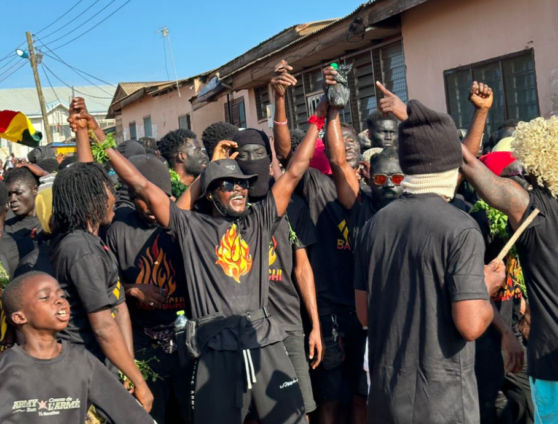
Kplejoo is a festival for the gods during which both the gods and people are purified.
The festival lasts a whole month and takes place in June or July depending on where the moon stands in the sky. During this festival, a sheep or a cow is sacrificed to appease the gods and ward off mishaps and bad omen that might befall the town in the upcoming year.
The Kplejoo festival offers the chance to either admonish citizens of their wrongdoings or commend them for their good deeds through the singing of Kple songs by various teams within the boroughs.
Some of the teams that participated in the 2023 edition include inter alia; Baamuchi, Angelina, Boaje, Downtown, Kpookeke, K20, Rasters, Station and NBA.
Connecting the two amalgamated systems of Kpone are a spectrum of Kple gods with their songs sang in Obutu. Gao, Laloi Bake, Okutenten (and his two wives, Afieye Okropɔŋ and Afiɔkɔ Samanyaa), Nyaŋkɔmle, Tsawe Otrome and Akpo Diŋla, are among them.
The fact that practically all Ga towns share the same Kple gods or the same god in various towns is equally instructive. Sakumɔ, the most senior deity of Tema, whose wulɔmɔ is the high priest of Tema, Tsade, Awudu (the horned, black-spitting serpent known as Blika), Akpitiɔkɔ, Okulate, Latekale, Ahulubeseikwa (which is also found in Kpone), and other Kple gods are all fed fotoli in Tema.
A variety of Kple deities, such as Gbɔbu (whose wulɔmɔ is the high priest of the entire Ga-Dangme state), Oshwe whose wulɔmɔ is the Nungua Mantse), Osabu (also in Kpone), etc., are also worshipped by the Nungua people. The Kple gods of La include Nyɔŋmɔ Tsawe, Osabu, Klaŋ (the hyena deity also in Kpone), and others. The La-Kpa deity is the oldest god in La and exhibits traits of both a Kple and a war god in addition to being a war god.
The Homowo celebration is actually heralded by the Kple festival, and among the Kpone people, it is the Kple festival that initiates the Sɛi faayaa (purification of the Dortey stool), the principal festival of the Kpone people.
Early in February, the town is purified as part of the preparations for the Kplejoo festival. A white cow is killed and distributed among the elders of the 10 clans, and a black one killed, chopped into bits, and scattered across the Kpone town.
The Kpone Mantse, who is also the wulɔmɔ of the Aya deity, notifies the community of his plans to observe the Sɛi faayaa in early May by the use of his gong-gong beater (town crier). The presentation of corn (Abelejaa) to the gods to be used in their Nyedaa beverage comes next.
During the Abelejaa ceremony, the first ban on drumming and noisemaking is placed. The shrines (gbatsui) are whitewashed a week later.
On a Friday, the Aya shrine is whitewashed first, and on a Sunday, Osabu and Klaŋ's are next. On the next Tuesday and Wednesday, respectively, the Gao shrine and Diŋla are painted white. In the third week of May, there’s a wake-keeping for the Aya deity led by the Mantse on Thursday night in which Abletsi (ram) is sacrificed for Aya.
For the Aya deity, a special delicacy known as mushe (made with Abele mamu (corn flour) and palm oil) is also prepared and offered to the deity. The Aya priestess offers spiritual prayers for the community and its residents at this wake.
On the next Tuesday, what is called ‘journey to Le Sega’ is performed at the Gao shrine (on the banks of the Gao lagoon). This marks the first day of Kple.
At this ceremony, a sheep is killed for the Gao deity and the priestesses murmur Kple songs as a form of worship for the Gao deity.
Just before sunset, the group that went to the Gao shrine (which includes the Mantse) makes a stop at the Okutenten shrine at Alata where special rites are performed with nyanyara (hyssop) leaves in a sese (wooden bucket) for cleansing by the priestesses. This ceremony officially marks the beginning of the Kplejoo festival.
The festival is repeated the next day which is a Wednesday. The Kple deity Akpla dugufue is worshipped at his shrine on the following Saturday. The Agbaafoiatse and the Akpla wulɔmɔ are in charge of this event. The various Kple teams present a spectacular performance of Kple songs on the final day of Kple, which is the following Tuesday.
The next Friday is the last day of Kple worship. This ritual is performed in conjunction with jaratsemɔ, in which wɔyei (priestesses) visit various markets to collect goods and food from market women that are then distributed to the town's elders at the Aya naa (forecourt of the Aya shrine). The actual event is held at the Otutu of the Kple gods Abloma and Adade, which is situated at the forecourt of the Ati We clan.
References:
1. Religion and Medicine of the Ga people, M.J Field, Oxford University Press, 1937.
2. Kpone history interview with Nuumo Tei Dortey (Head of Kojo We Royal Clan), June
2022
3. Kpone history interview with Ayikushi Sackey (Osabu woyoo), August 2021
Written by Dr. Evans Ago Tetteh, Acting Chief, Kpone Sebrepor and Lecturer, Regional Maritime University
Latest Stories
-
Photos: Speaker Bagbin Commissions MPs constituency office under parliamentary decentralisation programme
9 minutes -
Black Stars technical advisor Winfried Schäfer sacked as GFA shakes up backroom staff
13 minutes -
Wenchi water project almost complete, critical to gov’t agenda – GWL MD
29 minutes -
Anti-LGBTQ+ bill not part of government’s legislative agenda – Inusah Fuseini
31 minutes -
Anti-LGBTQ Bill: Forget the rumour mongers, I’m a man of action, and will pass the bill – Speaker
1 hour -
Women and children among those killed in Sudanese army shelling of wedding celebration
1 hour -
President Mahama is not sincere with Ghanaians on LGBTQ bill matter – Hassan Tampuli
2 hours -
Gov’t to establish Prison Industrial Hub to equip inmates with income-generating skills – Prison Service boss
2 hours -
Alhassan Tampuli donates cement, roofing sheets to support storm victims in Gushegu
2 hours -
Alhassan Tampuli appeals for urgent support for storm victims in Gushegu
2 hours -
The hypocrisy must stop; pass Anti-LGBTQ+ Bill now – Alhassan Tampuli to Mahama
2 hours -
Imprisonment should be rehabilitative, not punitive – Ghana Prisons boss at UNGA
2 hours -
Ga Adangbe traditional priests petition Mahama over McDan aviation licence revocation
3 hours -
Anti-LGBTQ Bill: NDC’s arrogance is worrying – Hassan Tampuli
3 hours -
Let’s give OSP time to mature, not to scrap it – Hassan Tampuli
3 hours