

Audio By Carbonatix
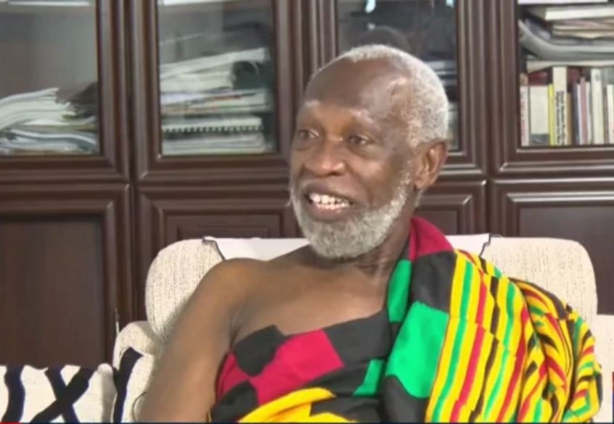
Former Rector of the Ghana Institute of Management and Public Administration (GIMPA), Professor Stephen Adei, has urged government to classify grand corruption as a felony offence.
He argued that equating corruption with serious crimes, such as murder, would ensure that offenders face severe legal consequences, thereby deterring others from engaging in corrupt practices.
“We have to make grand corruption a felony in Ghana and must be treated in the same way as we treat murderers because they do more harm than them,” he said during the launch of the 25th-anniversary celebrations of the Ghana Integrity Initiative (GII), in Accra, on Wednesday.
He was speaking on the theme: “Twenty-five Years of Advancing the Vision of a Corruption-Free Ghana: Reflections on the Way Forward.”
Prof. Adei said corruption continued to pose a significant threat to national development, despite numerous efforts to combat it.
He noted that the fight against corruption had not produced the expected results, attributing this to a lack of interest and commitment from leadership over the years.
“I personally believe that the major reason corruption seems to be so difficult to tackle is that the leadership of Ghana pays lip service to fighting corruption, but they do not have an iota of interest in fighting this canker.
“Leadership is cause, everything else is effect, and unless we discover a means to build the part of leadership and make them accountable for not only presiding over a corrupt system, possibly actively participating and at best, acquiescing it, we are not going to go anywhere,” he said.
Prof. Adei, therefore, called for drastic measures, including making corruption a felony and a high-risk venture, as well as tackling it in a more ruthless manner.
“The next stage of fighting corruption should be much more militant, not in terms of guns, but with passion and anger because if we do not very soon, this our nation, seeing what is happening to galamsey and the rest, we will have no nation. Without fighting corruption, our nation cannot be great and strong,” he said.
Prof. Adei also advocated for the establishment of robust systems to combat corruption, suggesting that Ghana could emulate countries like Rwanda, Estonia, Denmark, Brazil, and Singapore, which have successfully addressed the issue.
He urged the state to invest in digitalisation to minimise human interaction within various institutions, as a means of reducing opportunities for corrupt practices.
“Again, there must be verifiable and open asset declaration for all political office holders and senior public servants, and this must be, we must give a legal basis for that,” he proposed.
Mr. Sammy Darko, Director, Strategy, Research and Communication Division at the Office of the Special Prosecutor, expressed concern about the public's apathy towards the corruption fight.
“I think that leadership is a problem, but I also see a public that appears to have been enchanted. Did you see the passion and anger with which Ghanaians stood up against LGBTQ? Have you ever seen that passion being used against corruption before, in Ghana? No.”
Additionally, Mr. Joseph Whittal, Commissioner of the Commission on Human Rights and Administrative Justice (CHRAJ), stressed the necessity of reversing the burden of proof in corruption cases.
This approach would require public officials accused of corruption to prove their innocence, rather than placing that burden on state institutions.
He praised the Ghana Integrity Initiative for its dedication to combating corruption and shaping public policies over the past 25 years.
Established in 1999, GII is a non-partisan, non-profit civil organization dedicated to combating corruption and promoting good governance in Ghana.
As the local chapter of Transparency International, GII plays a crucial role in the global fight against corruption, collaborating with civil society organizations in over 120 countries to enhance transparency and accountability.
Mrs. Mary Addah, Executive Director of GII, highlighted the organization's significant contributions to the fight against corruption in Ghana over its 25 years of existence.
She noted that GII had played a crucial role in advocating for the passage of key legislation, including the asset declaration and disqualification regime established in 1998, which has helped to enhance accountability and transparency in public service.
“We have been part of several other landmark legislations including the Right to Information (RTI), in the case of the OSP, we led the civil society coalition that put in a very strong recommendations for the enactment,” she noted.
Latest Stories
-
Nearly 400 sentenced in Nigeria for links to militant Islamists
17 minutes -
Ghana’s recovery supported by gold strength despite global oil price pressures – Standard Bank Research
24 minutes -
Kwaku Azar writes: A-G vs OSP
57 minutes -
Mfantsipim–Adisadel rivalry built excellence, not division – Sam Jonah
1 hour -
Vice President launches Mfantsipim’s 150 years of shaping Ghana’s greatest mind
2 hours -
I assure Otumfuo, Mahama will join him to commission KNUST Teaching Hospital by end of this year – Haruna Iddrisu
2 hours -
Barcelona dominate derby to extend La Liga lead
3 hours -
Gov’t to roll out free special education for persons with disabilities from July 1 – Education Minister
3 hours -
Importers and Exporters Association declares full support for Publican AI port system
3 hours -
“We used it to test our officiating officials’ readiness” – Bawah Fuseini after CAA Athletics event
3 hours -
Volleyball emerges as Ghana’s fastest rising sport
3 hours -
National Sports Fund needs strong leadership from the top – Administrator David Wuaku
4 hours -
JoySports Exclusive: Steve McLaren in talks with GFA after expressing interest in Black Stars job
4 hours -
Fire guts auto parts warehouse at Bubuashie, one fire officer injured
4 hours -
I owe my victory to coach Ofori Asare – Allotey after winning WBA Africa Gold Super Flyweight belt
4 hours