

Audio By Carbonatix
The Minerals Income Investment Fund (MIIF) has placed Environmental, Social, and Governance (ESG) principles at the core of its investment strategy as it aims to transform the mining sector into the first pillar of the economy while ensuring long-term environmental sustainability.
Chief Executive of MIIF, Edward Nana Yaw Koranteng, outlined the fund's commitment to ESG in a recent interview with journalists at a stakeholders forum.
He said; "For MIIF, our investments, especially in mining, have a direct impact on the environment. This makes it crucial for us to have ESG as the pivot on which all our investments rest.”
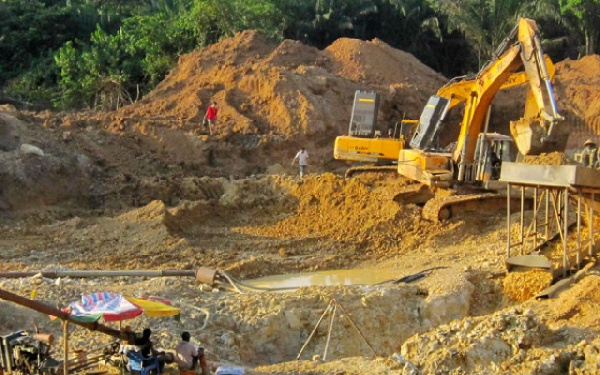
The emphasis on ESG comes at a critical time for Ghana's mining industry, particularly illegal small-scale mining, also known as ‘galamsey’, which has been under scrutiny for its environmental impact, including the destruction of cocoa farms and pollution of water bodies.
The Ghana Cocoa Board (Cocobod) reports a 20 percent reduction in cocoa production over the past five years, primarily attributed to illegal mining activities.

This has resulted in a significant economic loss for the nation, estimated to be approximately US$2.3 billion annually. Furthermore, the Forestry Commission has documented a loss of more than 2.5 million hectares of forest cover due to galamsey.
On August 31, 2024, the Ghana Water Company Limited in the Central Region blamed galamsey for recent water supply challenges in Cape Coast, Elmina, and surrounding communities.
Additionally, on September 2, 2024, the company announced that it might have to close two major treatment plants in the Ashanti Region due to high turbidity levels, which have increased production costs.
MIIF's strategy aims to address these concerns head-on, recognizing that the future of mining in Ghana depends on sustainable practices.
"If we want to invest in mining and make it the cornerstone of our economy, why would we invest and lose our ability to provide food, protect the environment, and safeguard our water bodies," Mr Koranteng questioned, stressing the interconnectedness of mining and environmental health.
MIIF, according to its CEO, is not merely paying lip service to environmental, social, and governance (ESG) principles. Instead, the organisation is actively implementing concrete policies that reflect its commitment to sustainability.
Every investment and programme undertaken by MIIF is evaluated through an ESG lens. This ensures that environmental considerations are a central part of all decision-making processes. One such initiative is the Small-Scale Mining Incubation Program, designed to formalize a sector that contributes significantly to Ghana's economy. By focusing on traceability, environmental governance, and ESG principles, this program aims to improve the sustainability of legitimate small-scale mining operations.
MIIF's approach to ESG aligns closely with government policies on mining sustainability, Mr. Koranteng added.
This includes strict regulations for decommissioning mining sites and environmental bonding. Additionally, the organisation is actively involved in supporting scientific attempts to clear the silted rivers as a result of illegal mining, advocacy and education efforts.
“By promoting environmental awareness and understanding across various sectors of society, MIIF is working to build a broader consensus on the importance of sustainable mining practices,” he said.
The focus on ESG is not without its challenges. Some industry observers have argued that the battle for environmental sustainability in mining is an uphill one. However, Mr Koranteng remains optimistic.
"We have seen a critical mass of environmental advocates in Ghana now, So far as we have that growing, we have the advocacy, we have the influencers coming in, we have government policy support, we have companies like MIIF making sure its support to mining companies is premised on environmental sustainability. We will be able to shift."
The approach also aligns with global trends in responsible investing, potentially making Ghana's mining sector more attractive to international investors who prioritize ESG considerations.
As Ghana positions itself to leverage its mineral wealth for economic development, MIIF's ESG-centric approach could prove to be a crucial differentiator. By balancing the pursuit of mineral income with stringent environmental and social standards, Ghana has the opportunity to set a new benchmark for sustainable resource management in Africa.
Mr Koranteng concluded with a message that encapsulates MIIF's philosophy; "Our environment is our life. We make it analogous to degrading the environment to reducing our lifespan. When the last tree dies, the last man dies."
Latest Stories
-
Ghana Water revenue mobilisation below 50% of potential – MD
6 minutes -
Ghana’s democracy must accommodate dissent and constructive criticism – Haruna Iddrisu
6 minutes -
Fact check: Trump posts fake quote of Denzel Washington supposedly praising him
7 minutes -
UPSA students lament high fees at private hostels, call for government intervention
18 minutes -
We will upgrade Ghana’s credit ratings if government maintains fiscal discipline, policy effectiveness – Moody’s
19 minutes -
Gender Ministry supports four siblings allegedly sexually abused by their father
23 minutes -
UMB MD wins ‘CEO of the Year’, banking category at 2026 Ghana Credit Excellence Awards
23 minutes -
Don’t throw away empty egg cartons — 6 smart ways to reuse them
27 minutes -
GoldBod poised to surpass 2025 forex performance – Sammy Gyamfi
28 minutes -
Old students of Peki SHS break ground to give 70-year-old school infrastructure a facelift
42 minutes -
Ablakwa facing ‘personal vendetta’ over refusal to grant Nana B service passport – Majority
43 minutes -
Every year, the lawyers come out, and so does the nonsense! – Ace Ankomah writes
55 minutes -
Digital transformation without an ownership culture can digitise poor service
59 minutes -
Fishing communities demand revocation of offshore gold exploration licences over livelihood concerns
1 hour -
How Ghanaian tycoon Manoj Lakhiani built a water and plastics empire from a $25,000 loan
1 hour