

Audio By Carbonatix
Ghana is at an urgent inflection point regarding national security, with experts warning that economic grievances and the proliferation of illegal mining are creating fertile ground for violent extremist groups in the country’s mineral-rich regions.
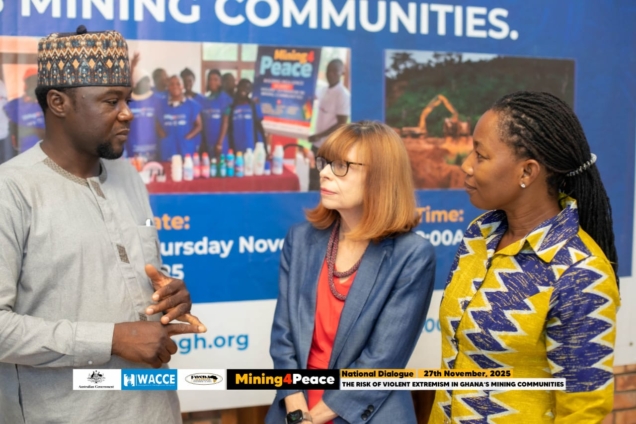
This stark warning was delivered at a national dialogue on Wednesday, November 27, 2025, convened by the West Africa Centre for Counter-Extremism (WACCE) and the Foundation for Security and Development in Africa (FOSDA).
The event, held at the Coconut Grove Regency Hotel, highlighted the critical need for long-term development solutions over short-term crackdowns.
The Dual Crisis: Galamsey as a Recruitment Tool
The dialogue, part of the Mining for Peace (M4P) project supported by Australia’s Department of Foreign Affairs and Trade (DFAT) and the Australian High Commission, brought together key stakeholders, including government officials, security agencies, civil society organisations, and traditional authorities.
Presenting findings from the M4P project, WACCE and FOSDA detailed how youth unemployment, acute economic vulnerability, and deep community grievances are being exploited to fuel instability. Speakers noted several intersecting threats:
- Arms Proliferation: An increase in the availability of illicit firearms within mining zones.
- Cross-Border Crime: The growing operational presence of organized criminal networks.
- Profitability of Galamsey: The huge profits and lack of alternative economic opportunities make illegal mining an appealing, high-risk pathway for desperate youth.
The Australian High Commissioner, Berenice Owen-Jones, praised the M4P project for its efforts and reaffirmed Australia’s commitment to peace and security in Ghana, citing key initiatives like the West Africa Mining Security conference (WAMS) and fellowships for journalists focusing on the extractive sector.
Madam Theodora Williams Anti, Executive Director for FOSDA, emphasised the socio-economic foundation of the crisis:
"Executive Director for Foundation for Security and Development in Africa (FOSDA), Madam Theodora Williams Anti, speaking as a panelist emphasized the reality of youth unemployment in mining communities as local content requirements and Corporate Social Responsibility (CRS) programs fail to adequately target local unemployed youth."
Government Pledges Alternative Livelihoods
Mr. Yussif Sulemana, Deputy Minister for Lands and Natural Resources, reaffirmed the government’s commitment to tackling the problem through development, not just enforcement.
He outlined various initiatives aimed at combating galamsey by increasing alternative livelihood opportunities for affected communities. Mr. Sulemana also stressed the need for:
- Stronger Community Engagement: Mining companies must deepen their relationship with host communities.
- Security Risk Caution: He called attention to the significant security risks posed by foreign illegal miners operating within the country.
Call for Swift Action and Sustainable Solutions
Panellists and participants strongly agreed that reliance on crackdowns alone cannot address the twin challenges of illegal mining and extremist recruitment. They advocated for structural, long-term investments, including:
- Job Creation: Long-term investments in diversified economic opportunities.
- Community Resilience: Building stronger social and institutional structures to resist external influence.
- Firearm Regulation: Strengthening controls to curb arms proliferation.
- Improved Company-Community Relations: Repairing the often-strained relationships between mining corporations and host communities.
Attendees also voiced frustration over the alleged involvement of authorities in the illegal mining industry, a factor that further erodes public trust and exacerbates grievances.
Mr. Mutaru Mumuni Muqthar, Executive Director at WACCE, delivered a powerful final call to action, urging the government to recognize the immediacy of the threat.
“Every day we miss an opportunity to act, it allows space for a worse situation. Ghana must not wait until the threat escalates to the level we see elsewhere in the region. We have a responsibility to act now.”
Latest Stories
-
SOE comments controversy: ‘We must never abandon our humanity because of judicial office’ – CJ
2 minutes -
Samuel Kojo Brace declares intention to contest NPP parliamentary primary in Ahanta West
3 minutes -
Dr Apaak calls for evidence-based education response to emergencies
7 minutes -
Pilot may have sought to crash Israel-bound flight after stabbing other pilot, Netanyahu says
11 minutes -
Report flags potential money laundering, terrorist financing risks among Ghana’s NGOs
12 minutes -
Breast Cancer Awareness Month launched: 2,695 women die from breast cancer annually — Dr Ann-Dadzie
19 minutes -
Mahama’s proposed airline looks to South America, Caribbean as Ghana confronts mounting drug trafficking cases
35 minutes -
5% progress on Suame Interchange Phase One inadequate – Roads Minister tasks contractor to speed up work
37 minutes -
Photos: Vice President joins GAAS Awards to celebrate outstanding women leaders
38 minutes -
OSP vs Ken Ofori-Atta, SML and others: Court gives OSP four more weeks to serve Ofori-Atta with summons
40 minutes -
High Commission sends caution to Ghanaians in South Africa ahead of planned protests
43 minutes -
Okai Mintah outlines vision for NDC Youth Wing as he engages MMDCEs
48 minutes -
Mahama Ayariga leads renewed push for stronger local governance through partnerships
52 minutes -
NDC youth organiser aspirant Okai Mintah consults MMDCEs ahead of elections
53 minutes -
PHOTOS: Ayikuma Methodist Basic School wins National Juniors Challenge
55 minutes